The federal Attorney General’s Office (FGR) announced Tuesday that the remains of one of 43 students who disappeared in Guerrero in 2014 has been conclusively identified.
Omar Gómez Trejo, the special prosecutor in charge of the reexamination of the disappearance and presumed murder of the 43 Ayotzinapa rural teachers college students, said that a bone fragment of Jhosivani Guerrero de la Cruz was identified via nuclear DNA testing at the University of Innsbruck in Austria.
“Today we can report … that the identification of Jhosivani Guerrero de la Cruz is certain and absolute,” he said.
The University of Innsbruck identified a bone fragment as matching the DNA of Guerrero de la Cruz’s mother in 2015 but that finding wasn’t considered conclusive.
Gómez said the bone fragment analyzed was found in a ravine in the municipality of Cocula, Guerrero. Authorities found the remains of another Ayotzinapa student, Christian Alfonso Rodríguez Telumbre, in the same ravine last year. DNA analysis at the University of Innsbruck identified the remains as those of Rodríguez.
The remains of three of the 43 students have now been formally identified. Those of Alexander Mora were identified in December 2014.
The previous federal government claimed that the students were intercepted by corrupt municipal police in Iguala on September 26, 2014, after they commandeered a bus to travel to a protest in Mexico City. According to its “historical truth,” the police handed the students over to a local crime gang, the Guerreros Unidos, whose members killed them, burned their bodies in the Cocula dump and scattered their ashes in the nearby San Juan River.

However, the remains of Guerrero de la Cruz and Rodríguez showed no evidence of fire damage.
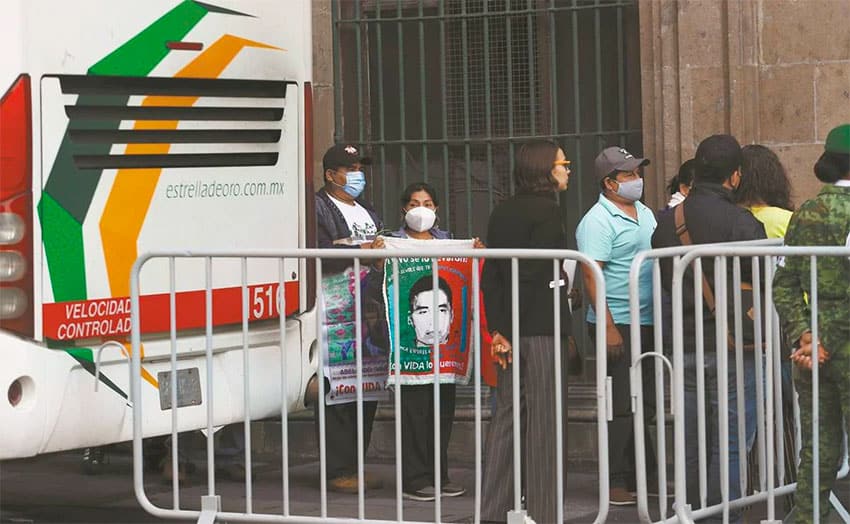
The parents of the former were notified of the positive identification of their son last weekend. They met with President López Obrador on Tuesday along with other parents of the disappeared students.
A lawyer for the parents, Vidulfo Rosales, said the president told them that the United States had advised Mexico of the arrest of a person allegedly involved in the case. However, it is unclear whether that person will be extradited to Mexico and when that might occur.
Scores of suspects have been arrested in connection with the students’ disappearance but many were later released because they were found to have been tortured while being questioned about their alleged crimes.
President López Obrador established a super commission to conduct a new investigation into the Ayotzinapa case shortly after he took office in late 2018. His administration has dismissed the previous government’s “historical truth” but hasn’t established its own definitive version of events.
The army has long been suspected of involvement in the students’ disappearance, and leaked testimony obtained by the newspaper Reforma earlier this year supported that theory.
With reports from El Universal and AP