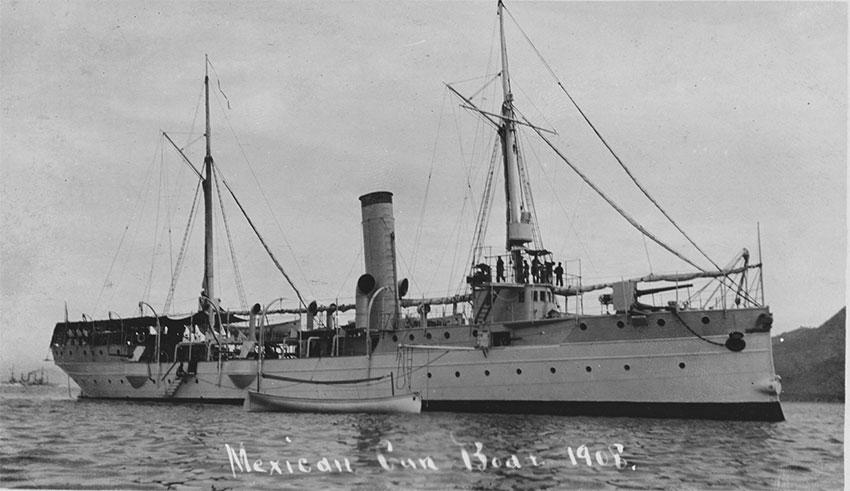
A gunboat that sank in 1914 after it was engaged in a series of Mexican Revolution battles has been located off the coast of Sinaloa.
Experts from the Underwater Archaeology Department (SAS) at the National Institute of Anthropology and History (INAH) found the wreckage of the warship Tampico on the Gulf of California seabed near the port town of Topolobampo.
SAS chief Dr. Roberto Junco Sánchez described the sunken gunboat as a “tomb of war” and said its discovery will allow researchers to learn more about an important naval battle and the history of the “legendary commander” of the Tampico, Hilario Rodríguez Malpica.
He explained that the discovery, undertaken with the support of the navy, was the result of two periods of fieldwork undertaken this year and more than a decade of research by an INAH team that combed through naval records of both Mexico and the United States in order to determine the approximate location of the gunboat.
During a voyage on a navy research vessel between March 30 and April 2, INAH archaeologists used sonar technology to obtain 3D images of the Gulf of California seabed, which revealed the presence of an “anomaly,” Junco said, explaining that its dimensions – 60 meters in length by 10 meters in breadth – matched that of the revolutionary vessel.
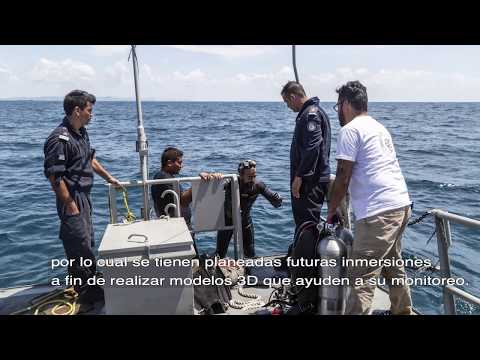
During the second stage of fieldwork in early September, underwater archaeologists supported by a navy interceptor boat dived to a depth of 40 meters and confirmed the presence of the Tampico.
It was the first time that the gunboat had been seen in 105 years, INAH said in a statement Monday, adding that the vessel has deteriorated considerably during its time underwater. More dives are planned with a view to developing a 3D model of the boat.

Built in shipyards in New Jersey, United States, at the start of the 20th century, the Tampico engaged in several battles with the Guerrero, another Mexican gunboat built in Liverpool, England, and other vessels.
On February 22, 1914, recalls historian Raúl Tapia, Rodríguez Malpica, a 25-year-old first lieutenant of the Tampico at the time, initiated a rebellion in Guaymas, Sonora, against the rule of Victoriano Huerta, who seized the presidency of Mexico by assassinating Francisco I. Madero.
With the help of other crew members, Rodríguez took the gunboat’s captain prisoner and assumed control of the Tampico himself. The new captain set sail for Topolobampo, which was controlled by troops loyal to Huerta’s rival, Venustiano Carranza.
In retaliation against Rodríguez’s treason, the Huerta-led government ordered an attack on the Tampico, which came under fire from the Guerrero and the gunboat Morelos as it approached Topolobampo in early March.
Between March 31 and April 22, 1914, the Tampico engaged in several other battles with the Guerrero, and the former sustained severe damage. However, the biplane bomber Sonora came to its assistance and managed to repel, although not damage, the Guerrero.
“From April 22 to June 10, they did all that was possible to re-float the Tampico,” said Tapia, explaining that it began a voyage to Mazatlán on June 14 to undergo further repairs.
However, after advancing just 30 nautical miles, the gunboat’s sole operational boiler broke down and it was left adrift at the mercy of the sea, INAH said.
On June 16, the gunboat once again came under attack by the Guerrero, causing a fire to take hold on board. Captain Rodríguez quickly issued a two-part order: scuttle the ship and abandon it.
The crew members tried to reach land in lifeboats but were intercepted by the Guerrero, leading Rodríguez to take a fateful, final decision: he put his pistol inside his mouth and pulled the trigger.
His suicide, Tapia said, prevented his near-certain death at the hands of forces loyal to Huerta.
Two United States warships, the USS Preble and the USS Perry, were in Mexican waters to protect American interests in the region and witnessed the final battle and sinking of the Tampico. Their records were crucial in determining the area in which to search for the gunboat.
Junco said the discovery is the “first step” in an investigative process to better understand an episode of the Mexican Revolution that hasn’t been given the attention he thinks it deserves.
A bronze porthole from the Tampico that was found meters away from the main gunboat wreckage on the Gulf of California seafloor will be returned to the Mexican navy and displayed at the Naval Museum in Veracruz, INAH said.
Mexico News Daily