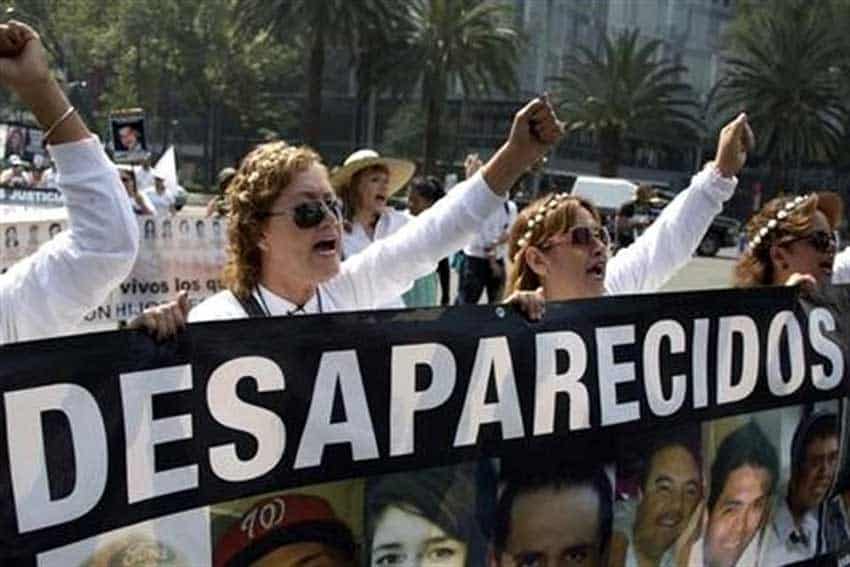
The Tamaulipas government is offering 85 million pesos (US $4.5 million) in rewards in the cases of 85 missing persons, most of whom disappeared between 2010 and 2015.
The state’s Attorney General’s office (PGJE) said that 69 of the persons sought are men, 16 are women and 36 of the victims were aged between 21 and 30 when they last had contact with their families.
The government will pay 1 million pesos (US $53,600) to anyone who provides information that leads to any of the 85 being located, the PGJE said.
All but 12 disappeared during the six-year term of former state governor Egidio Torre Cantú, who left office in September 2016.
The remainder of the listed cases occurred during the term of current Governor Francisco García Cabeza de Vaca.
The 85 persons for whom the rewards are offered represent just 1.4% of the 5,999 people who have officially been reported as missing in the northern border state.
According to the National Registry of Data on Missing and Disappeared Persons, no state has more missing persons.

Among those listed in the rewards program are 38-year-old Carlos Ornelas Puga, who was abducted from a church in the municipality of Jiménez in November 2013, Milinaly Piña Pérez, who at age 13 disappeared in August 2014 while traveling on the Ciudad Victoria-Ciudad Mante highway, and journalist and news outlet owner Víctor Calzado González who disappeared in September 2011.
The full list of the 89 missing persons covered by the rewards program is published on the PGJE website.
Another wave of missing persons cases has been reported in Tamaulipas this year.
The United Nations said in May that there are “strong indications” that federal security forces were responsible for the disappearance of 23 people, including at least five minors, in Nuevo Laredo between February and May.
The federal Attorney General’s office launched an investigation and after finding the bodies of nine people who were reported missing, turned its focus to the Zetas drug cartel.
A local activist and member of a collective made up of the family members of disappearance victims claims that the presence of the military on the streets of Tamaulipas has led to more rather than less crime in the state.
“The interference of the army in police duties has worsened the situation, not lowered the rate of violence or drug trafficking, homicides or kidnappings. On the contrary, they’ve increased,” Guillermo Gutiérrez Riestra said.
Across Mexico, there are now more than 37,000 missing persons, a figure that has risen by 40% since 2014.