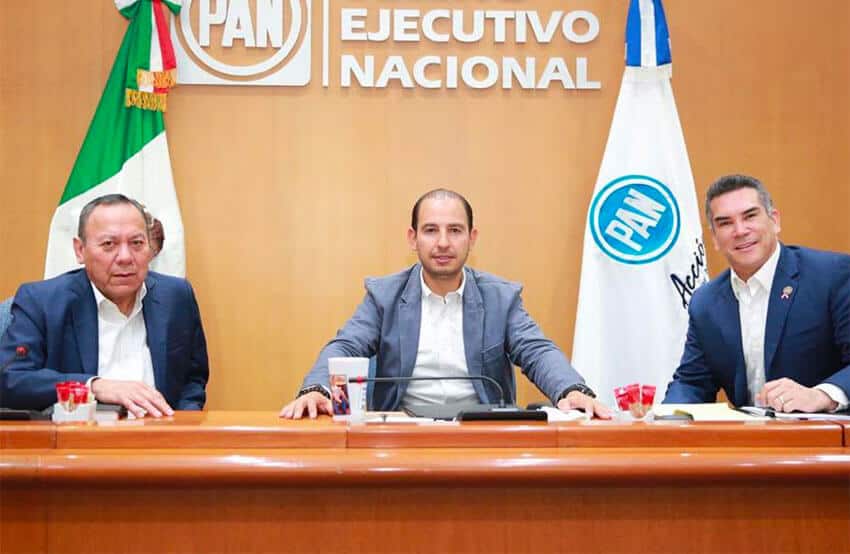
A three-party right-left coalition that was established to contest this year’s midterm elections will run on a joint ticket in at least four state elections in 2022.
The conservative National Action Party (PAN), the center-right Institutional Revolutionary Party (PRI) and the leftist Democratic Revolution Party (PRD) have reached an agreement to contest elections in Aguascalientes, Durango, Hidalgo and Tamaulipas under the Va por México (Go for Mexico) banner.
The leaders of the three parties told a press conference Tuesday that the alliance could also contest next year’s elections in Oaxaca and Quintana Roo, although no pact for those states has yet been reached.
Voters in the six states will elect new governors next June. The PAN currently holds office in Aguascalientes, Durango and Tamaulipas, Hidalgo and Oaxaca have PRI governors and the PRD is in power in Quintana Roo.
PAN national president Marko Cortés said the aim of the alliance is to stop Mexico’s ruling Morena party from seizing more governorships. It is currently in power in 16 of the country’s 32 states.
“We will be joining forces … in Aguascalientes, Durango, Hidalgo and Tamaulipas. … What we’re seeking is to avoid the bad Morena government from arriving … and destroying these federal entities,” Cortés said.
PRI chief Alejandro Moreno said that voters will face a stark choice at next year’s state elections.

Morena is “a disaster for this country” and hasn’t achieved anything, while Va por México is a “powerful coalition” capable of solving problems and achieving results for the wellbeing of society, he said.
PRD national leader Jesús Zambrano, an outspoken critic of President López Obrador and Morena, said it’s likely the three parties will also join forces in Oaxaca and Quintana Roo.
“It will depend on how the talks progress,” he said before floating the possibility that an alliance could be struck between just two of the three Va por México members and local political forces.
“… We have full confidence that we can win and we’re going to work to win the majority of these elections in 2022 and to remove the [federal] government in 2024 as well,” Zambrano said.
The López Obrador administration is responsible for the “national nightmare” Mexico is currently going through, he added.
The three leaders said that each party will put forward potential gubernatorial candidates and a coalition flag bearer for each state will be chosen from among them in the coming months. They ruled out any possibility of the Citizens Movement party – currently in power in Jalisco and Nuevo León – joining their alliance.
“… Citizens Movement is not on Mexico’s side, it doesn’t want change,” Moreno said.
With reports from El Universal