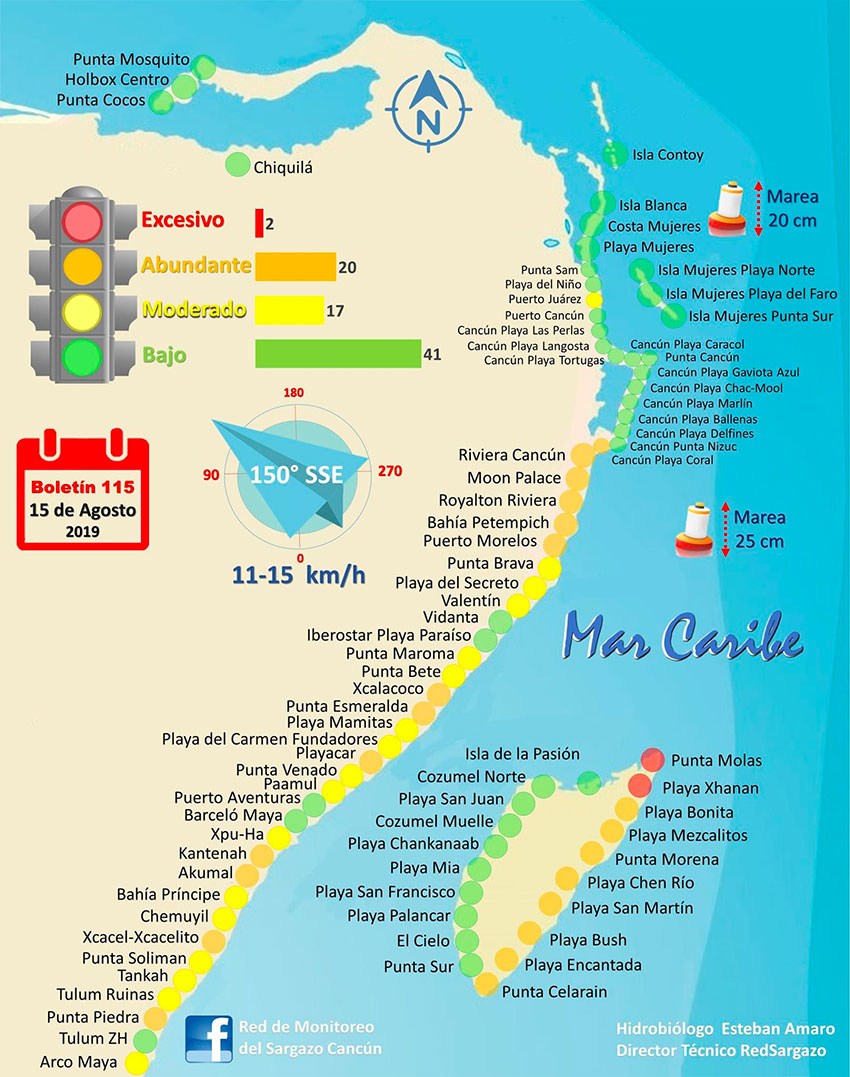
The beaches at Cancún and elsewhere on the Caribbean coast are clean and free of sargassum, according to Quintana Roo Governor Carlos Joaquín González.
He attributed the clean coastline to efforts by the Mexican navy and President López Obrador.
Joaquín said there hasn’t been a significant resurgence of the smelly and unsightly algae in recent weeks.
He explained that the infrastructure installed with the support of the federal government has worked well.
“We’re waiting for more infrastructure, more boats, more barriers that will work in coordination with the navy, which has yielded good results up to now,” he said.
Meanwhile, a man described in news reports as a construction industry expert says sargassum is not a problem but an opportunity.
Ricardo Lambretón López-Ostolaza says the seaweed can be used to make bricks for low-cost housing.

“Advances in the industry have given us the opportunity to build houses and other structures ecologically and affordably,” he said.
“We should take advantage of problems like this, putting the resources to good use, rather than wasting them.”
He highlighted the low cost and durability of bricks made of sargassum, claiming that they have been shown to have a lifetime of up to 120 years.
He plans to build houses with 40 square meters of floor space using 20 tonnes of sargassum, for which the approximate cost would be 150,000 pesos (US $7,700).
“It’s incredible how such an opportunity has arisen from this problem, which is now seen to have a great social impact for nearby areas of extreme poverty,” he said.
Lambretón is not the first to see an opportunity for construction. A Puerto Morelos businessman has built at least one house using sargassum and adobe and was planning to build a hotel in Tulum with the same materials.
Source: Milenio (sp)