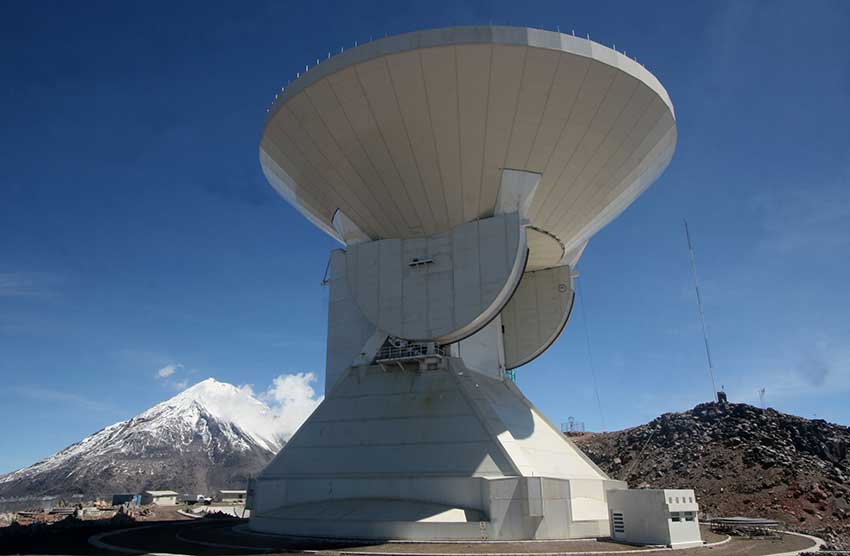
Scientists at the Alfonso Serrano Large Millimeter Telescope (GTM) and the High Altitude Water Cherenkov Observatory in Puebla have abandoned their posts because of the threat of organized crime in the region.
The telescope, the largest of its kind in the world, is located on top of the Sierra Negra volcano on the Puebla-Veracruz border.
The roads leading to the telescope, nicknamed “Death’s Way” by locals, have been taken over by criminal organizations, employees told reporters. Scientists who work at the site say they have been the victims of constant attacks by crime gangs engaging in robbery and kidnapping.
The Alfonso Serrano telescope is the culmination of 20 years of work and an investment of US $20 million. The binational project, a collaboration between the National Institute of Astrophysics, Optics and Electronics (INAOE) and the University of Massachusetts Amherst, was completed just last year.
The telescope is the world’s largest in its frequency range. According to the project website, it is uniquely suited to the study of the birth and evolution of stars, the formation of planets, the growth and distribution of galaxies, the constitution of comets and planetary atmospheres and the origins of the universe.
According to the newspaper Diario Cambio, the highways that cross the boundary between Puebla and Veracruz are considered to be some of the region’s most dangerous because of the “cockroach effect,” produced by the government’s strategy to combat fuel theft. Such operations tend to push criminal gangs from one area into another.
The INAOE confirmed today that activities at both the telescope and the observatory have been reduced due to insecurity, but expressed hope that the problem would be resolved soon.

Scientific work will resume at the two facilities once authorities have confirmed that conditions are safe, the institute said.
Source: Milenio (sp), Diario Cambio (sp)