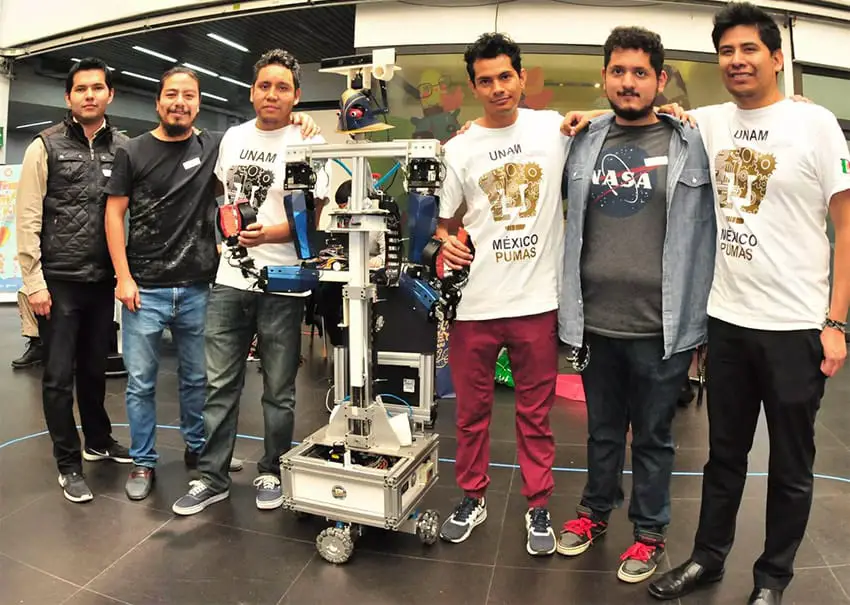
Students from the National Autonomous University (UNAM) earned some awards this past week at the 2018 RoboCup, an annual robotics competition that was held this year in Montreal, Canada.
Mexican students won second place in both the OPL Service Robot and the DSPL Toyota Service Robot categories with their robots named Justina and Takeshi.
Both teams are part of the Pumas group, whose members are enrolled in the biorobotics laboratory at the UNAM Engineering School (FI), led by researcher Jesús Savage.
At the Montreal event, held June 18-22, there were more robots than people, 5,000 all told, built by more than 4,000 university students from 35 countries. The competition includes several categories, including rescue, virtual simulation and soccer matches.
The event is intended to promote the development of new robotic technologies.
Savage said UNAM students have been participating in RoboCup since 2006. In 2007 they obtained a third and fourth place, along with a prize for the best voice recognition and natural language system.
RoboCup was established in 1997 when its goal was to build a team of autonomous robots capable of winning a soccer match against the World Cup’s reigning champions by 2050.

The goal remains but the RoboCup Federation’s main purpose is to advance the state of the art of intelligent robots.
Source: El Universal (sp)