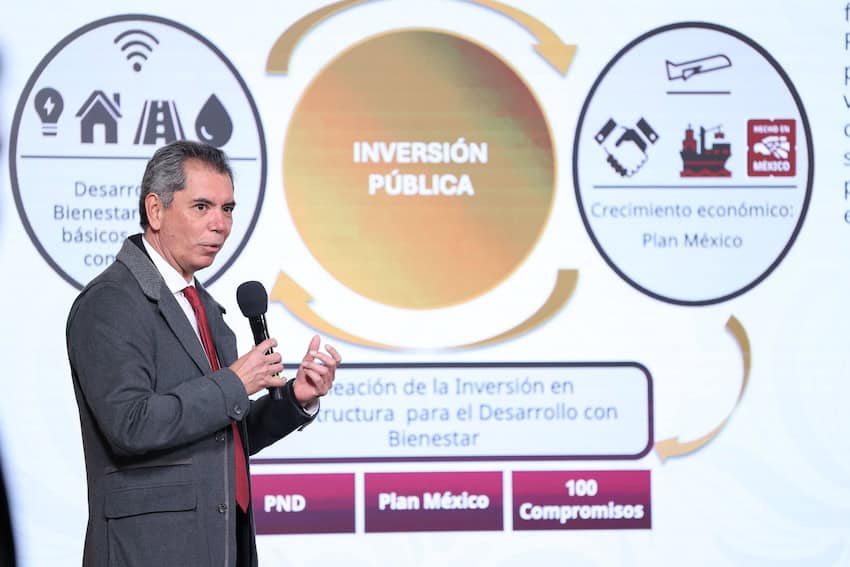
The federal government unveiled a mixed public-private investment plan on Tuesday, committing 5.6 trillion pesos (US $323.4 billion) toward spurring major infrastructure and development projects over the next four years.
During the president’s daily press conference at the National Palace, Finance Minister Edgar Amador announced that the funds will be distributed across eight strategic sectors, following the analysis of more than 1,500 potential projects identified by federal agencies.
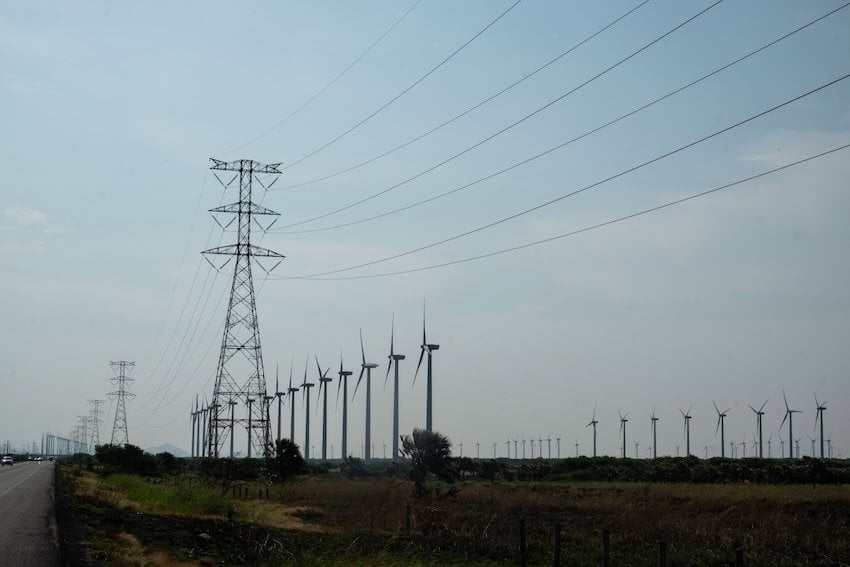
The development plan targets eight critical sectors: energy, railways, highways, ports, health care, water, education and airports.
Amador said more than half the money (54%) would be spent on energy sector projects, with railways (16%) and highways (14%) also getting considerable attention.
President Claudia Sheinbaum described the ambitious program as a “reinvigoration of Plan México,” the scheme she launched in January 2025 with the aim of making Mexico the 10th largest economy in the world.
Plan México outlines a vision for “equitable and sustainable development” that promotes growth while prioritizing the public good. Its goal is to reduce reliance on imports from China and create 1.5 million new jobs.
“Public investment in highways, water and energy will continue to rise, equaling 2% of GDP,” she said.

Infrastructure investment was a point of contention during congressional budget debates. Mexico’s 2026 budget allocates 1 trillion pesos (US $58 billion) to welfare programs and a similar amount to public investment.
Sheinbaum said the Finance Ministry will utilize “a range of mechanisms” to increase public investment by an additional 722 billion pesos (US $41.9 billion) this year. Still, in terms of GDP, the percentage destined for infrastructure is trending downward from the 2014 high of 4.5%.
Jorge Mendoza, director of the National Bank of Public Works and Services (Banobras), said the new model is aimed at “guaranteeing state ownership and oversight of key projects with the help of private capital to lessen risk.”
Sheinbaum restated Mendoza’s claim, declaring that, unlike past schemes, the new investments guarantee that concessions remain in the hands of the state, with controlled financing rates and no predatory contracts.
Amador reiterated that the central focus of the strategy is public investment as a catalyst for development, emphasizing that economic growth must be complemented by income distribution and social welfare.
“We don’t just need growth in macroeconomic variables,” he said. “We need to complement growth with justice and income distribution.”
Facing a fiscal deficit of 4.3% and with limited room for maneuver, the Sheinbaum administration is seeking a third way, working with the private sector to bolster public investment with private capital.
The plan envisions the use of new investment vehicles specializing in infrastructure. Amador promised more efficient and transparent financing schemes than the old Public-Private Partnerships (PPPs).
The government intends to maintain a degree of control over the investments, while also aiming for effective governance to ensure the projects are financeable and bankable.
“We will be looking for highly cost-efficient schemes, with transparency and a specific focus on infrastructure projects,” he said.
With reports from Reuters, El País, El Economista and El Heraldo de México