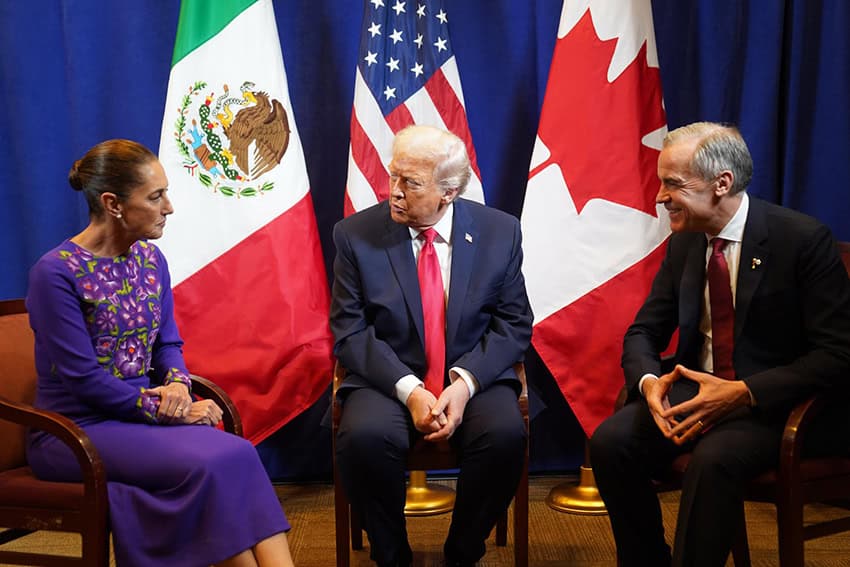
Amid increased tension between the United States and Canada, President Claudia Sheinbaum said on Thursday that her government would work to ensure that there is no rupture of the USMCA, the North American free trade pact that is subject to a formal review process this year.
At her morning press conference, Sheinbaum was asked whether the “clash” between the viewpoints expressed by Canadian Prime Minister Mark Carney and U.S. President Donald Trump in speeches at the World Economic Forum (WEF) meeting placed “the life” of the USMCA at risk.
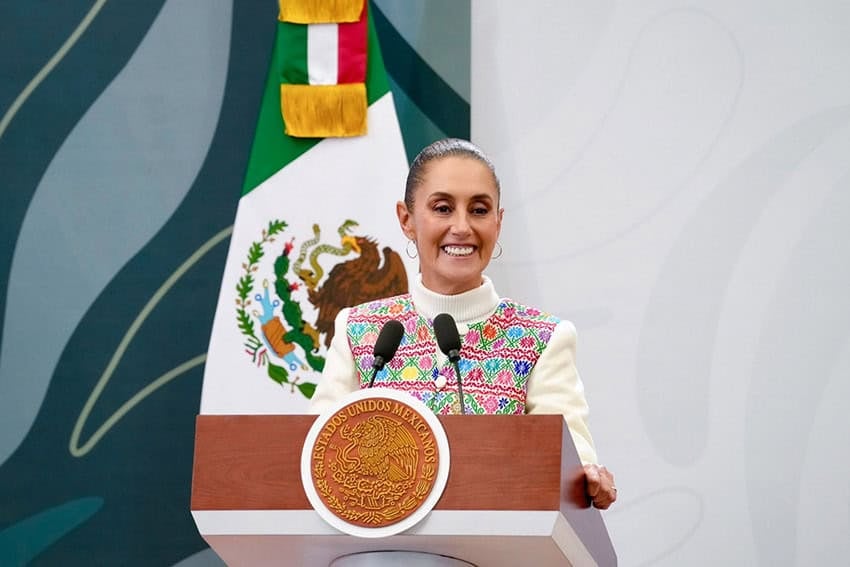
“We are going to work so that it doesn’t break,” the president said of the agreement that governs trade worth around US $2 trillion per year.
“And we believe it’s a good idea for the three countries to maintain the trade agreement,” said Sheinbaum, who noted that Economy Minister Marcelo Ebrard will travel to Washington D.C. next week “to continue working on trade issues” with U.S. officials.
Even if Mexico, the United States and Canada don’t agree to extend the USMCA during this year’s review process, the pact would not be terminated until 2036. An agreement to extend the pact would ensure its survival until at least 2042. Mexico and Canada’s trade relationships with China will likely be discussed during bilateral and trilateral negotiations, along with things such as rules of origin and the United States’ trade deficit with each of its neighbors.
Sheinbaum remains optimistic that the review process will go well, despite the differences between the U.S. and Canadian leaders.
On Thursday morning, she told reporters that she wouldn’t describe the expression of different opinions by Carney and Trump in Davos, Switzerland, over the past two days as a “clash of discourse.”

“They’re simply different points of view regarding what is happening internationally,” said Sheinbaum, who on Wednesday endorsed Carney’s WEF speech, describing it as “very good” and “very much in tune with the current times.”
Carney criticizes use of ‘tariffs as leverage’
In his speech at the annual WEF meeting on Tuesday, Carney took aim at Trump without mentioning the U.S. president by name.
The Canadian prime minister said that “for decades, countries like Canada prospered under what we called the rules-based international order,” even though “we knew the story of the international rules-based order was partially false” due to factors including that “trade rules were enforced asymmetrically.”
“… This fiction was useful,” Carney said.
“And American hegemony, in particular, helped provide public goods: open sea lanes, a stable financial system, collective security and support for frameworks for resolving disputes.”
This speech *is* one for the history books. But that’s less a compliment, than a coda.
Carney has given us the words to mark the end of the ‘rules-based order’…by acknowledging it never really existed.
It was a collective illusion. That now is over. pic.twitter.com/H4gWysDBmH
— Carole Cadwalladr (@carolecadwalla) January 20, 2026
Canada, Carney continued, “participated in the rituals” of the the rules-based international order, “but this bargain no longer works.”
“Let me be direct: We are in the midst of a rupture, not a transition,” he said.
“Over the past two decades, a series of crises in finance, health, energy and geopolitics have laid bare the risks of extreme global integration,” Carney said.
“But more recently, great powers have begun using economic integration as weapons. Tariffs as leverage. Financial infrastructure as coercion. Supply chains as vulnerabilities to be exploited,” said Carney, who was widely interpreted to be referring to the United States under Trump.
In that context — one that includes tariffs Trump imposed on a range of Canadian goods, and Mexican goods, in defiance of the free trade framework the USMCA provides — the prime minister noted that Canada has been diversifying its security and trade relationships.
“We are rapidly diversifying abroad. We’ve agreed a comprehensive strategic partnership with the EU, including joining SAFE, the European defense procurement arrangements. We have signed 12 other trade and security deals on four continents in six months,” Carney said.
“In the past few days, we have concluded new strategic partnerships with China and Qatar. We’re negotiating free trade pacts with India, ASEAN, Thailand, Philippines and Mercosur,” he said.
Carney said last Friday that “the world has changed” and that improved trade ties with China — the United States’ main strategic rival — sets Canada up “well for the new world order.”
Still, the United States is by far Canada’s largest trade partner, and the Canadian government remains firmly committed to the USMCA despite Trump’s rhetoric and its decision to ease trade barriers on China, at a time when Mexico is taking the opposite approach.
While Mexico’s decision to increase tariffs on Chinese goods could benefit it in the USMCA review process, Canada’s decision to ease duties on certain products from the East Asian nation — including on a quota of 49,000 electric vehicles per year — could complicate its trade talks with the United States.
Trump responds
Trump hit back at Carney in his WEF address on Wednesday, calling the Canadian prime minister ungrateful.
Referring to a proposed missile defense system for the United States, he said:
“We’re building a golden dome that’s going to, just by its very nature, going to be defending Canada. Canada gets a lot of freebies from us, by the way. They should be grateful also. But they’re not. I watched their prime minister yesterday. He wasn’t so grateful, they should be grateful to us. Canada lives because of the United States. Remember that Mark, the next time you make your statements.”
Trump: “Canada lives because of the United States”
Canada lives because the United States failed to annex us in 1775 and 1812. pic.twitter.com/ZlS9xm1d3f
— Riley Donovan (@valdombre) January 21, 2026
Trump also spoke glowingly about tariffs, which he has previously described as “the most beautiful word … in the dictionary.”
“With tariffs, we’ve radically reduced our ballooning trade deficit, which was the largest in world history,” he said.
Trumps’ remarks in Davos came eight days after he asserted that the USMCA provides “no real advantage” to the United States and is “irrelevant” to him.
“I want to see Mexico and Canada do well, but the problem is we don’t need their product,” he said Jan. 14.
“… We don’t need cars made in Canada, we don’t need cars made in Mexico, we want to make them here. And that’s what’s happening.”
Trump also said that having the USMCA or not “wouldn’t matter” to him.
Trump says he doesn’t care about USMCA; Sheinbaum says US businesses do
“I think they want it, I don’t really care about it,” said the U.S. president, who in the past has floated the possibility of the United States entering into bilateral trade deals with each of Mexico and Canada.
While Trump claims that the United States doesn’t need Canadian goods, The New York Times pointed out in a report published on Tuesday that “the majority of the oil the United States imports comes from Canada.”
Companies in the U.S. across a range of sectors, including automakers, are dependent on inputs that are made in Mexico. In light of the economic integration across North America, Sheinbaum has said she is “very optimistic” about the USMCA review.
Sheinbaum to seek calls with Trump and Carney
Sheinbaum told reporters on Thursday morning that she hasn’t recently spoken with Carney, but would seek a call with him.
“We’re going to try to have a conversation, and of course with President Trump [as well],” she said, adding that they would discuss “all the negotiations that have to do with the trade agreement.”
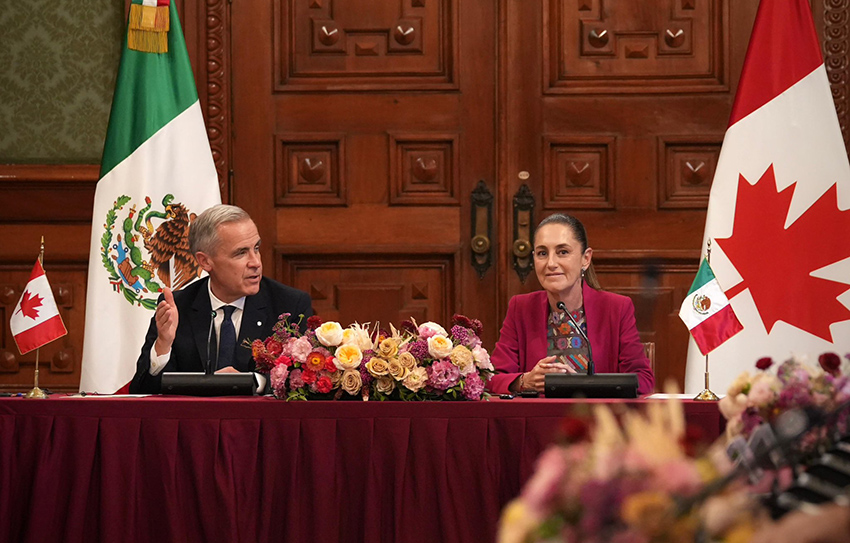
Carney visited Mexico last September, at which time he and Sheinbaum pledged to deepen ties and work to strengthen the USMCA. Earlier this week, Canadian Governor General Mary Simon traveled to Mexico and met with Sheinbaum at the National Palace.
Sheinbaum spoke to Trump last week, but their conversation focused on security issues.
After the 15-minute call, Sheinbaum said she and Trump agreed to another call soon in order to discuss “other issues,” including trade.
In a future trade-focused call with Trump, Sheinbaum’s main aim — it would appear — will be to convince her U.S. counterpart of the relevance and vitalness of the USMCA, including by emphasizing that the United States does indeed need Mexican (and Canadian) goods.
By Mexico News Daily chief staff writer Peter Davies (peter.davies@mexiconewsdaily.com)