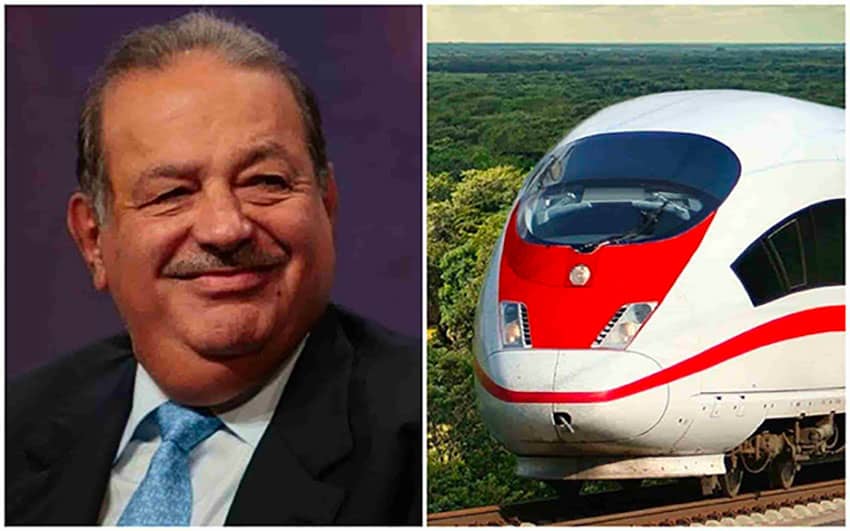
A consortium controlled by billionaire businessman Carlos Slim has secured the second contract awarded by the federal government for the construction of the US $8-billion Maya Train railroad project in Mexico’s southeast.
The National Tourism Promotion Fund (Fonatur), which is managing the project, announced on Thursday that Slim’s company Cicsa and Spanish construction firm FCC – of which the Mexican magnate is the largest shareholder – were successful with their bid to build the 222-kilometer section of the railroad between Escárcega and Calkiní in Campeche.
The consortium submitted an 18.55-billion peso (US $752.8-million) bid for the contract, which Fonatur administration and finance director Arturo Ávalos said was the best among 15 proposals.
The companies’ proposal received an overall rating of 94.06 out of 100 – 45.13 for the technical proposal and 48.93 for the financial one.
Fonatur said that Cisca and FCC will begin construction on May 12 pending approval from the Health Ministry. That would appear to be a formality given that Fonatur chief Rogelio Jiménez Pons said last month that President López Obrador had ordered the continuation of the Maya Train project despite the worsening coronavirus pandemic.
The awarding of the contract to the Slim-led consortium came a week after Fonatur announced that a consortium led by Portugal’s Mota-Engil and the majority state-owned China Communications Construction Company (CCCC) had won the contract to build the first section of track between Palenque, Chiapas, and Escárcega.
The consortium presented a 15.5-billion peso bid for the 227-kilometer section, beating out 13 other proposals. Fonatur said that it would be responsible for drawing up the master plan for the project, building the tracks and purchasing all required materials.

The CCCC has faced corruption charges and was blacklisted by the World Bank in 2011 for fraudulent practices related to a highway project in the Philippines but Fonatur said that the proposal it presented along with Mota-Engil and three other companies was the best in terms of both cost and quality.
The United Nations Office for Project Services reviewed all 14 bids for the Palenque-Escárcega section and agreed that the Portuguese/Chinese bid was the best.
Slim’s Cicsa/FCC consortium has also submitted one of 16 bids to Fonatur to build the third section of the Maya Train between Calkiní and Izamal, Yucatán. Fonatur is due to announce the winner of that contract on May 15.
The Maya Train, President López Obrador’s signature infrastructure project, will connect cities and towns in five states: Tabasco, Campeche, Yucatán, Quintana Roo and Chiapas.
The 1,500-kilometer railroad, endorsed by a controversial consultation last December, is scheduled for completion in 2023.
Source: Infobae (sp), Reforma (sp), El Financiero (sp)