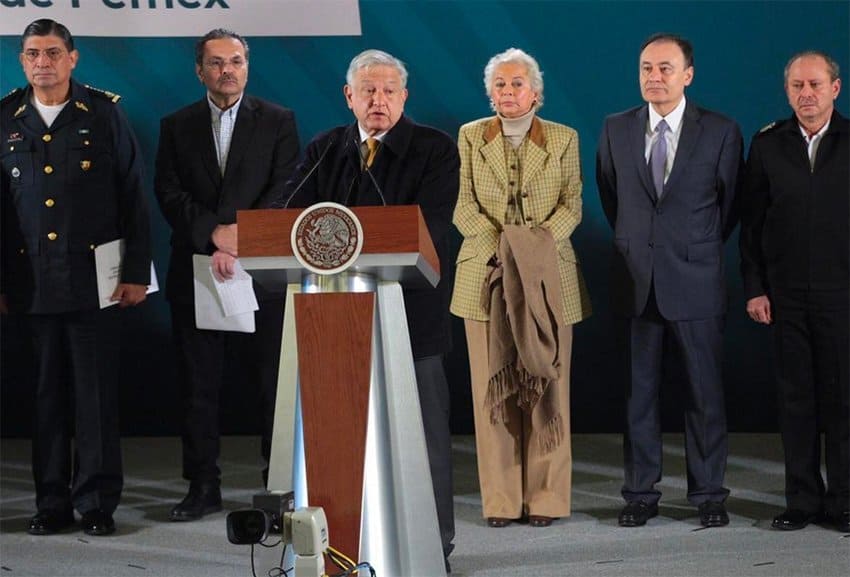
The federal government will deploy 4,000 soldiers and marines to guard the nation’s oil refineries and petroleum storage facilities to combat fuel theft, President López Obrador announced today.
All told, 57 facilities will be protected by the military: six refineries, 39 storage terminals and 12 pumping stations.
The use of the army and navy is part of the government’s wider plan to combat petroleum theft.
López Obrador said that state oil company Pemex lost 60 billion pesos (US $3 billion) due to fuel theft last year, a figure double the amount cited by the company’s former CEO, and charged that the theft couldn’t have occurred without the complicity of members of the previous government.
“The aim of the plan is to avoid [fuel] theft . . . [The amount] stolen each year equates to 60% of what’s going to be allocated to old-age pensions. It’s 60 times more than the amount we’re going to use next year to create 100 public universities. We can’t allow this, we have to put an end to this corruption . . .” López Obrador said.
At the same press conference, acting Attorney General Alejandro Gertz Manero said that three officials at Pemex who were allegedly complicit in the theft of petroleum have been dismissed and will face criminal charges.
Just hours after López Obrador’s announcement, soldiers assumed responsibility for the security of the Pemex refinery in Salamanca, Guanajuato.

“We arrived in the state of Guanajuato last night and today they sent us here,” an army sergeant told the newspaper Milenio.
Personnel at the refinery have previously come under investigation for involvement in fuel theft.
López Obrador told reporters that 15 government departments are involved in the implementation of the new anti-fuel theft strategy.
He called on Pemex employees to help stamp out corruption, on gas station owners to not sell stolen fuel and on citizens to not buy it.
The president said there was no evidence that former Pemex directors had participated in the theft of petroleum but charged that they were aware that it was occurring within the company.
Combatting fuel theft is one of the biggest security challenges faced by the new federal government.
The incidence of illegal taps on state-owned petroleum pipelines increased sharply throughout the six-year term of the last government and there is evidence that Mexico’s notorious drug cartels have moved in on the lucrative racket.
In the first 10 months of 2018, the number of taps detected increased by 45% compared to the same period last year, according to the latest Pemex report on the crime.
López Obrador said that fuel was also stolen from 600 tankers per day last year and the same number this year.
Gangs of fuel thieves known as huachicoleros are believed to behind the alarmingly high levels of violence in some states including Guanajuato, which has been transformed from a relatively peaceful state to one of the most violent in the country this year.
Source: Milenio (sp), El Financiero (sp)