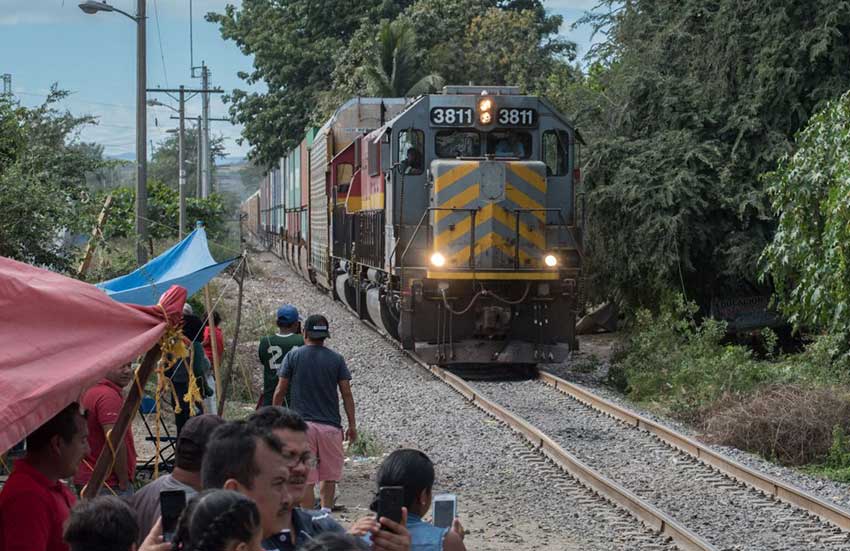
Trains could soon be running again in Michoacán after teachers yesterday began lifting an 18-day rail blockade that cost the economy at least 18.5 billion pesos, although one railway company representative described the partial clearing of the tracks as “useless.”
Teachers affiliated with the CNTE union started moving off the tracks yesterday morning and last night, a Kansa City Southern train left Lázaro Cárdenas with a load of at least 235 containers.
But the railway company said that it would only travel to its station in the port city, explaining that it couldn’t resume operations because there was still a risk that the ongoing dispute between teachers and the state government could once again strand its trains.
Teachers who have been protesting against the non-payment of salaries, benefits and bonuses in Lázaro Cárdenas, Nueva Italia, Maravatío and La Piedad dismantled their camps during the course of the day yesterday but those in Pátzcuaro, Caltzontzin and Yurécuaro continued to block tracks this morning.
Isidoro Castañeda, a regional leader for the CNTE, said that although railway tracks had been cleared at some points, teachers had not returned home.
“We’re not leaving the tracks, we’re going to allow the departure of the trains and depending on the conclusions that authorities reach with our representatives we’ll decide if we once again block [the tracks] or completely withdraw,” he said.
The union said yesterday that other protests, including barricades at government offices, and a work stoppage will continue until all of its demands have been met and all outstanding payments have been made.

Michoacán Governor Silvano Aureoles said on Twitter today that progress has been made towards an agreement with the teachers.
He said there was “complete commitment to find a solution to the legitimate demands of teachers” at a meeting yesterday in Mexico City between union representative and state and federal authorities.
But for rail companies and the wider private sector, for whom economic losses continue to mount, “progress” and “commitment” to a solution to the dispute is cold comfort.
Lourdes Aranda, a spokeswoman for Ferromex, said in a radio interview today that the partial clearing of the tracks was not enough to allow the company’s trains to resume service.
“For the purpose [of resuming operations] it’s useless. We have four points cleared and three blocked, the fact that they [teachers] are deployed at the side of the tracks doesn’t offer much security,” she said.
Separate estimates from the Confederation of Industrial Chambers (Concamin) and the Business Coordinating Council (CCE) relating to different periods of the 18-day rail blockade, once conflated, indicate that accumulated private sector losses have reached at least 18.5 billion pesos (US $967 million).
Lydia Nava, president of the Mexican Employers Federation (Coparmex) in Michoacán, said that even if trains resume operations today, it will take days before they are able to shift the backlog of cargo.
The private sector reported that there are 8,200 stranded shipping containers carrying 1.2 million tonnes of freight.
Source: Milenio (sp), El Financiero (sp), T21 (sp)