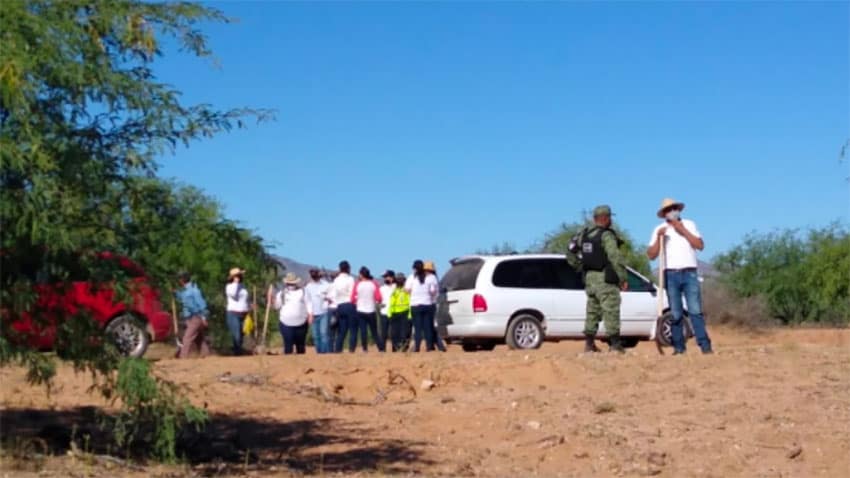
A search brigade of women in Sonora has discovered clandestine crematoriums on a ranch in the Altar desert.
Sifting through the ashes under the searing desert sun, members of “Madres Buscadoras de Sonora,” or Searching Mothers of Sonora, a collective of mothers and family members of missing persons, found bone fragments, charred clothing and other personal effects belonging to an unknown number of victims.
The group of around 30 women, armed only with shovels and pickaxes for digging, were accompanied to the area outside Magdalena del Kino on Thursday by 10 members of the National Guard. The desert in the region is notoriously dangerous as it is one of the main drug and human smuggling routes to the United States.
Their destination, La Cebolla ejido, was received through an anonymous tip advising that hundreds of people had been burned at the site using wood and tires as fuel.
At one point during their two-hour journey to the site, a car started coming toward them at a high rate of speed but stopped when it saw they were accompanied by the National Guard, the women reported.
The group found at least 10 crematoriums, some of which were five meters deep.
The brigade was able to sift through four of them, an emotional task for mothers of children whose whereabouts are unknown.

“The worst thing a mother can live through is finding your child in a handful of ashes,” brigade leader Cecilia Flores Armenta said.
Flores hopes that through DNA analysis of the bone fragments, those burned there can be identified and their families can find closure. In the past, the FGJE has promised the group protection during their search efforts, technical assistance from forensic experts, psychological attention and the support of the state’s forensic science laboratory.
Flores’ group was formed in May 2019 after her son, Marco Antonio, went missing in Bahía de Kino, located near Hermosillo, the state capital. The women say they have located 127 remains of disappeared persons across the state.
Citizen-led search efforts are not uncommon in Mexico, where the National Search Commission’s registry reports more than 61,000 Mexicans have been reported missing. More than 70 civilian search organizations are active across the country, the vast majority of which are made up of relatives of the disappeared.
Burning the bodies is one of the methods criminal gangs have used to dispose of their victims. Dissolving them in barrels of acid is another.
Source: El Universal (sp), Expreso (sp), La Jornada (sp)