Quintana Roo divided into 9 zones in effort to remove sargassum

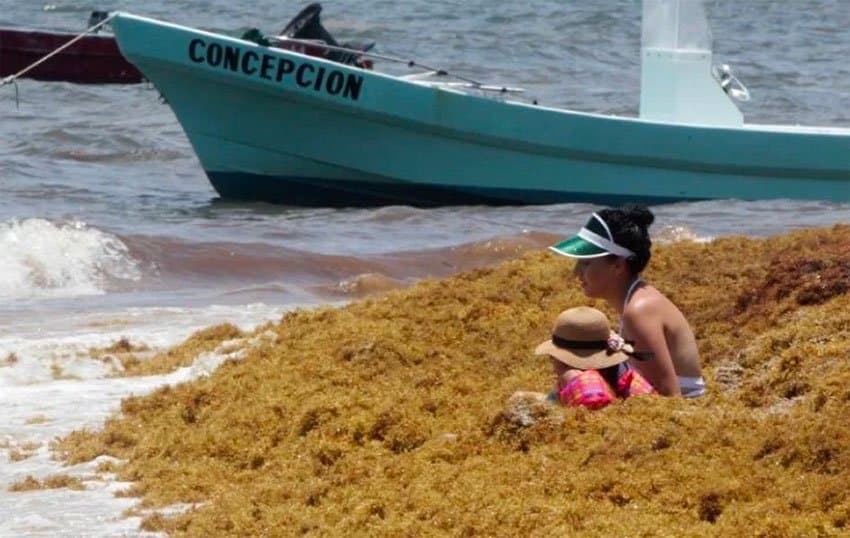
A plan to combat this year’s expected million tonnes of sargassum on the beaches of Quintana Roo is beginning to take shape.

The state government has announced emergency sargassum protocol that will divide the state into nine zones where efforts will be concentrated on preventing the seaweed from accumulating on beaches.

Environment Secretary Alfredo Arellano will head the initiative intended to keep the beaches clean and find a sustainable use for the collected plant matter.

The state has identified beachfront hotel owners and businesses that might be affected by the algae’s arrival, all of whom received a summary of the state’s plan, which outlines cooperation with business owners and residents to erect retention barriers and organize clean-up crews.

In a Friday meeting with hotel owners in Zone 7, which extends from Punta Maroma to Playa Mamitas in Solidaridad, Tourism Secretary Marisol Vanegas Pérez related the state’s plan and stressed the importance of federal support to combat the problem.

This morning, President López Obrador announced a Tuesday meeting with Fonatur director Rogelio Jiménez Pons, Quintana Roo business owners and Governor Carlos Joaquín to discuss solutions for the sargassum, which is expected to continue arriving over the next few months.

Asked at his daily press conference if the federal government will provide economic assistance to industries affected he said “we are going to help.”

The arrival of sargassum over the weekend didn’t quite live up to the forecasts but those are expected to be fulfilled over the next 72 hours, affecting beaches from Holbox in the north of the state to Xcalak near the border with Belize. Authorities are actively monitoring the situation’s progress with the help of satellite images and drones.

The Cancún sargassum monitoring network reports that beaches in Puerto Morelos, Solidaridad (Playa del Carmen) and Tulum are the most affected.

In Solidaridad, paid and volunteer workers have been removing more than 100 tonnes of sargassum a day from the beaches.

Source: Milenio (sp), El Financiero (sp), Notimex (sp)

Have something to say? Paid Subscribers get all access to make & read comments.
Manzanillo, Colima, México, 13 de marzo de 2026. La doctora Claudia Sheinbaum Pardo, presidenta Constitucional de los Estados Unidos Mexicanos en conferencia de prensa matutina, “Conferencia del Pueblo” desde Colima. La acompañan Indira Vizcaíno Silva, gobernadora Constitucional del Estado de Colima; Omar García Harfuch, secretario de Seguridad y Protección Ciudadana (SSPC); Raymundo Pedro Morales Ángeles, secretario de Marina (Semar); Bulmaro Juárez Pérez, divulgador de lenguas originarias, presentador de la sección “Suave Patria”; Ricardo Trevilla Trejo, secretario de la Defensa Nacional (Sedena); Jesús Antonio Esteva Medina, secretario de Infraestructura, Comunicaciones y Transportes; Bryant Alejandro García Ramírez, fiscal general del Estado de Colima; Fabián Ricardo Gómez Calcáneo; Rocío Bárcena Molina, subsecretaria de Desarrollo Democrático, Participación Social y Asuntos Religiosos de la Secretaría de Gobernación; Efraín Morales López, director general de la Comisión Nacional del Agua (Conagua); Marcela Figueroa Franco, secretaria ejecutiva del Sistema Nacional de Seguridad Pública (SESNSP) y Guillermo Briseño Lobera, comandante de la Guardia Nacional (GN). Foto: Saúl López / Presidencia

Mexico’s week in review: Congress deals Sheinbaum her first legislative defeat

0
The week of March 9 in Mexico was marked by standoffs between allies in Congress and adversaries at the airport. Here's what you missed.
A soldier displays seized handguns

The US and Mexico, growing together and growing apart: A perspective from our CEO

1
From a historic drop in homicides to opposite bets on electric vehicles, Mexico News Daily's CEO breaks down where the U.S. and Mexico are converging — and where they're not.
Veracruz Gov.

Veracruz governor blames private vessel for 200-kilometer Gulf Coast oil spill

1
The spill, which has spread to over 200 kilometers of Mexico's Gulf Coast beaches, has been traced to a private oil tanker off the coast of Tabasco.
BETA Version - Powered by Perplexity