The governors of three states have warned the federal government that it is negotiating with criminal gangs and not self-defense groups as the López Obrador administration claims.
Interior Secretary Olga Sánchez Cordero said Tuesday that her department is in talks with armed groups “and they have told us that they do not want to continue” to engage in violence.
She said that Interior Secretariat (Segob) officials have met with groups in Guerrero, Tamaulipas and La Huacana, Michoacán, “that have been fighting each other but have now expressed their intention to disarm” and contribute to the pacification of Mexico.
The Interior Secretariat quickly clarified that Sánchez was speaking about “authentic self-defense organizations” rather than criminal groups.
“The federal government does not have nor will have dialogue with any organized crime group,” Segob said on Twitter.
President López Obrador also denied that his government is engaged in dialogue with criminal organizations.
However, Governor Silvano Aureoles of Michoacán was skeptical, charging that “there are no self-defense groups” in the state “but rather criminals who call themselves self-defense.”

He added that it is “a mistake” for the federal government to seek agreements with such groups.
Guerrero Governor Héctor Astudillo said the federal government needs to reveal exactly who it has negotiated with because there are groups in the state that “disguise themselves” as self-defense” but are in fact allied with organized crime.
Francisco García Cabeza de Vaca of Tamaulipas asserted that there are no self-defense groups at all in the northern border state – only armed criminal groups that are trying to take control of certain regions.
If the government is making agreements with “armed groups or whatever they want to call them,” it must be completely transparent and [they must] announce what deals have been made, he said.
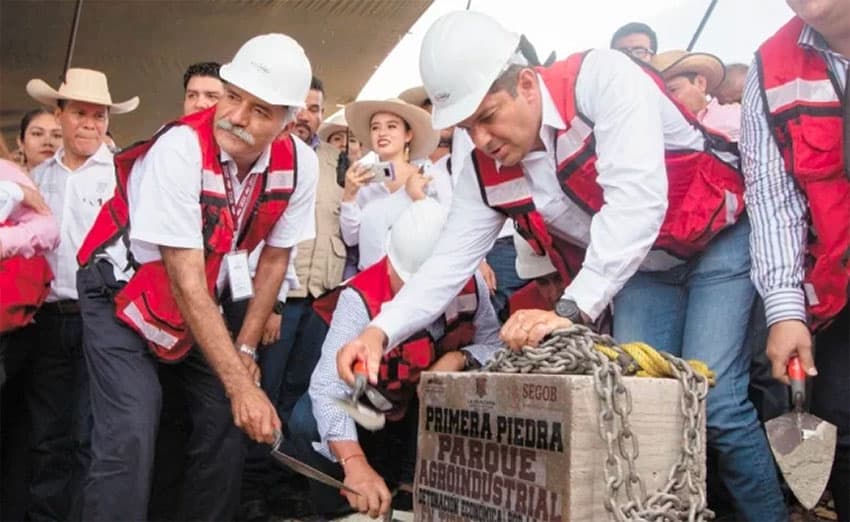
Aureoles also criticized the visit yesterday by Segob undersecretary Ricardo Peralta to the Tierra Caliente municipality of La Huacana, where he laid the symbolic first stone for a new agro-industrial park.
With that act, the undersecretary has “empowered” criminals and “given resources” to them, the Michoacán governor charged, recalling that in May so-called self-defense force members detained and disarmed soldiers deployed to La Huacana.
Military intelligence reports indicated that members of the Jalisco New Generation Cartel had in fact led the disarmament and detainment of the soldiers.
“It concerns me that we’re going around rewarding criminals,” Aureoles said.
“. . . In general, the self-defenses forces have a high criminal content. It pains me that those who insulted, abused and humiliated the soldiers of Mexico, one of our most beloved institutions – the Mexican army – are being rewarded . . .” he said.
Peralta, who was accompanied during his visit to La Huacana by former self-defense force leader José Manuel Mireles, denied that the project was part of a pact with criminal groups.
“We don’t make deals with anyone from organized crime . . . people who are committing crimes, the only meeting they’re going to have is with justice,” he said.
He also denied that the government was negotiating with criminals.
“. . . It was suggested that what we were doing was meeting with organized crime groups. Here, in this place, I don’t see anyone other than hard-working people, people’s representatives, representatives of the state government, mayors . . .” he said.
Peralta rejected the claim that public resources would benefit criminals, pointing out that the government is not even investing in the construction of the agro-industrial plant.
He did, however, assert that the project will help to change the course of a region that has been plagued by violence.
“This is not the first stone for the agro-industrial plant in La Huacana, this is the first stone to change the history of the stigmatized towns and regions of our country because stigmatizing a region is re-victimizing it for what it already suffered in the past,” Peralta said.
Meanwhile, Mireles said that the “brave men and women of the Tierra Caliente” region are hard-working people, not “violent people.”
“. . . When we’re given the opportunity, we’re going to work for the development of our people,” he said.
Source: Milenio (sp), El Universal (sp)