Statue of indigenous woman to replace Christopher Columbus in Mexico City

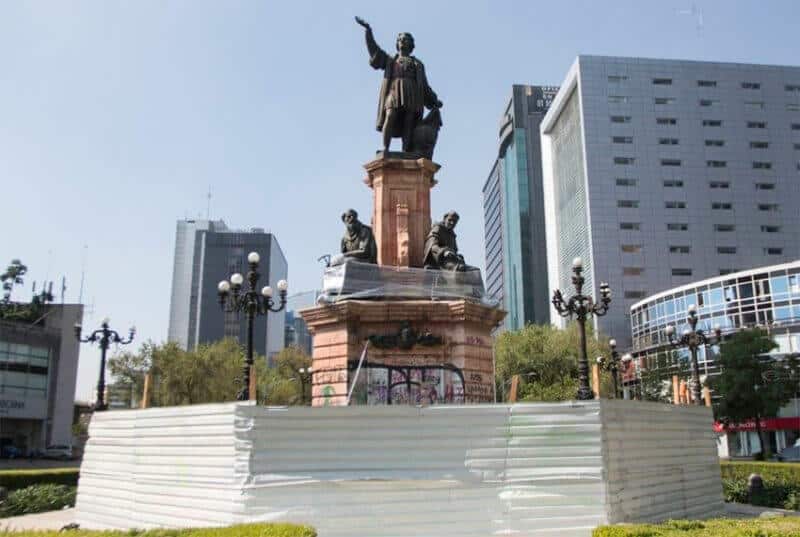
A statue of an indigenous woman will be installed on a Mexico City avenue at a location where a statue of Christopher Columbus previously stood, Mayor Claudia Sheinbaum announced.

Speaking at an event on Sunday – International Day of the Indigenous Woman – Sheinbaum said that the Columbus statue removed from Paseo de la Reforma for restoration last October will not be returned to the capital’s most emblematic boulevard.

Removed two days before Día de la Raza (Day of the Race) amid threats from protesters to topple it, the almost 150-year-old statue made by French sculptor Charles Cordier will be relocated to Parque América, a park in Mexico City’s affluent Polanco district.

Sheinbuam said the base of the Columbus statue will also be removed to make way for a statue of an Olmec woman made by the artist Pedro Reyes.

“… The Columbus statue will be moved to a worthy place with the authorization of the INAH [National Institute of Anthropology and History] and in its place there will be recognition of the women in our history, especially indigenous women; that’s social justice,” she said.

“Pedro Reyes, who is a great Mexican sculptor, is making a sculpture of the Olmec woman, who is the origin of the origin,” Sheinbaum said.

The Olmec civilization is known as the “mother culture” of Mesoamerica because most scholars believe it was the first in the region and influenced those that emerged in later years.

Sheinbaum acknowledged that the idea to erect the new statue on Paseo de la Reforma – home to numerous monuments and “anti-monuments” – originated in the federal Senate. She rejected any claim that the removal of the Columbus statue is an attempt to erase the history of the Europeans’ arrival in Mexico.

The relocation of the statue is not about “hiding” it, she asserted while acknowledging Columbus as a “great” and “universal” personage.

“Some people think that the Spanish brought civilization to Mexico [but] that’s not true,” Sheinbaum added. “We have centuries of history and that which comes from outside isn’t better. We’re a multicultural nation.”

With reports from Milenio and El País  

Have something to say? Paid Subscribers get all access to make & read comments.
Manzanillo, Colima, México, 13 de marzo de 2026. La doctora Claudia Sheinbaum Pardo, presidenta Constitucional de los Estados Unidos Mexicanos en conferencia de prensa matutina, “Conferencia del Pueblo” desde Colima. La acompañan Indira Vizcaíno Silva, gobernadora Constitucional del Estado de Colima; Omar García Harfuch, secretario de Seguridad y Protección Ciudadana (SSPC); Raymundo Pedro Morales Ángeles, secretario de Marina (Semar); Bulmaro Juárez Pérez, divulgador de lenguas originarias, presentador de la sección “Suave Patria”; Ricardo Trevilla Trejo, secretario de la Defensa Nacional (Sedena); Jesús Antonio Esteva Medina, secretario de Infraestructura, Comunicaciones y Transportes; Bryant Alejandro García Ramírez, fiscal general del Estado de Colima; Fabián Ricardo Gómez Calcáneo; Rocío Bárcena Molina, subsecretaria de Desarrollo Democrático, Participación Social y Asuntos Religiosos de la Secretaría de Gobernación; Efraín Morales López, director general de la Comisión Nacional del Agua (Conagua); Marcela Figueroa Franco, secretaria ejecutiva del Sistema Nacional de Seguridad Pública (SESNSP) y Guillermo Briseño Lobera, comandante de la Guardia Nacional (GN). Foto: Saúl López / Presidencia

Mexico’s week in review: Congress deals Sheinbaum her first legislative defeat

1
The week of March 9 in Mexico was marked by standoffs between allies in Congress and adversaries at the airport. Here's what you missed.
A soldier displays seized handguns

The US and Mexico, growing together and growing apart: A perspective from our CEO

1
From a historic drop in homicides to opposite bets on electric vehicles, Mexico News Daily's CEO breaks down where the U.S. and Mexico are converging — and where they're not.
Veracruz Gov.

Veracruz governor blames private vessel for 200-kilometer Gulf Coast oil spill

1
The spill, which has spread to over 200 kilometers of Mexico's Gulf Coast beaches, has been traced to a private oil tanker off the coast of Tabasco.
BETA Version - Powered by Perplexity