Governors have not yet reached an agreement with federal authorities about the criteria for making changes to the stoplight colors allocated to each state to determine which coronavirus restrictions can be lifted.
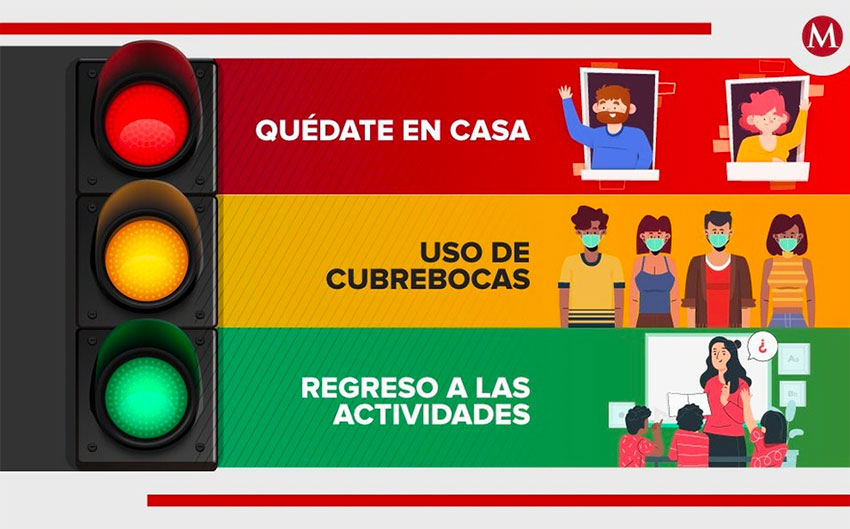
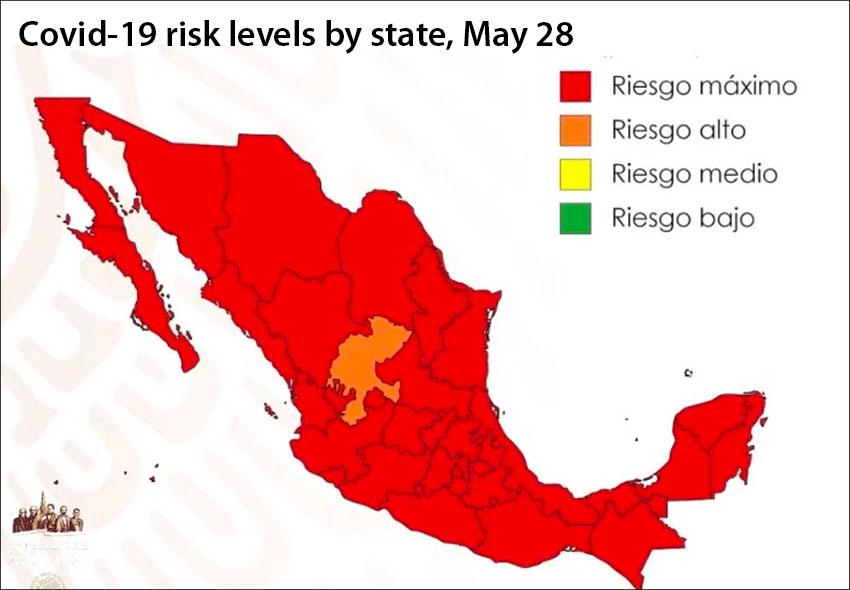
Every state except Zacatecas was allocated a “red light” on the stoplight system last Friday. As a result, few if any changes were made to the restrictions implemented during the national social distancing initiative, although the construction, mining and automotive sectors were given the green light to resume their activities because they are now classified as essential.
The federal government was scheduled to update the stoplight map on Friday with the corresponding restrictions to take effect in each state starting Monday.
The government has said that four factors are taken into account to determine the risk level and corresponding stoplight color for each state: case number trends (whether new infections are increasing, decreasing or stable), hospital admission trends for coronavirus patients, hospital occupancy levels and positivity rates (the percentage of people tested who are confirmed to have Covid-19).
According to a report today by the newspaper La Jornada, some governors believe that their states should not have been allocated a red light.
Given that the coronavirus pandemic has not affected Mexico uniformly, it does appear odd that the risk of infection was deemed to be at the maximum level in 31 of the 32 federal entities.
Colima, for example, currently has just 43 active Covid-19 cases but shares the “red light” rating with Mexico City, the country’s coronavirus epicenter, which has almost 4,000 active cases. Only 8% of hospital beds with ventilators are currently occupied in Guanajuato but it has the same maximum level risk rating as Baja California, where 66% of such beds are in use.

Despite the discrepancies, a group of governors is in favor of each state’s stoplight risk rating remaining unchanged for next week, La Jornada said. If they get their way, the vast majority of Mexico will continue to be a sea of red on the stoplight map, with Zacatecas appearing as a conspicuous island of orange.
Other governors argue that the infection risk in their states is below the maximum level and therefore restrictions on economic and everyday activities should be eased.
The governor of Quintana Roo, where the tourism sector is preparing to reopen on Monday, said that reactivating the state’s economy won’t imply “dropping its guard” in the fight against coronavirus.
Carlos Joaquín said that if a reopening causes coronavirus cases to spike significantly, as Deputy Health Minister Hugo López-Gatell has said could occur, he is prepared to reimpose restrictions.
Four states where the red light is certain to remain in place next week are México state, Morelos, Puebla and Hidalgo.
Mexico City Mayor Claudia Sheinbaum said that authorities in those states have agreed to share the same risk rating as the capital because of their interconnectedness in terms of the movement of people and goods.
She said Friday that a red light will apply in Mexico City all of next week because hospital occupancy levels are still above 65%. More than 3,400 coronavirus patients are in general care beds in the capital and just over 1,000 are in intensive care on respirators.
Querétaro and Tlaxcala were also invited to be part of the central states to be allocated a sole color but their governors declined.
“We will continue … attending to the reality of our state during the evolution of the Covid-19 crisis,” said Querétaro Governor Francisco Domínguez.
His counterpart in Tlaxacala, Marco Antonio Mena Rodríguez, rejected the single stoplight proposal, asserting that each state in central Mexico is going through a different phase of the pandemic and that the capacity of the healthcare system in each one is not the same.
Source: La Jornada (sp), El Universal (sp), El Financiero (sp)