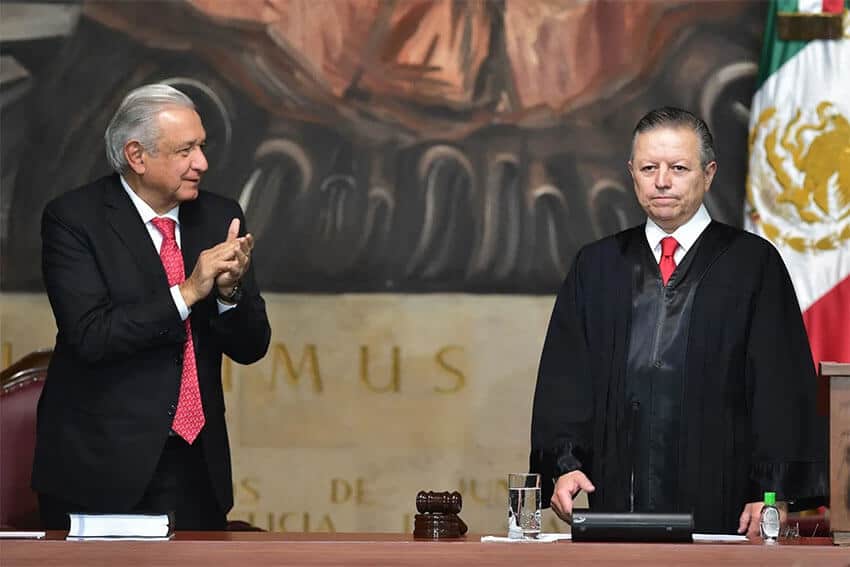
The Supreme Court (SCJN) has confirmed that the most important articles of a controversial electricity law can be implemented, delivering a ruling that is a significant victory for President López Obrador in his quest to reform Mexico’s energy sector.
The Electricity Industry Law (LIE), which gives power generated by the state-owned Federal Electricity Commission (CFE) priority on the national grid over that produced by private and renewable energy companies, was passed by Congress in March 2021.
However, its enforcement was prevented by injunctions granted to private energy companies. The latest challenge to the LIE was brought by opposition party senators, the Federal Economic Competition Commission and the state of Colima.
Seven of 11 Supreme Court justices held that the LIE violates the right to free competition in the energy sector and hinders the transition to clean energy sources, upholding a federal court ruling that suspended the law shortly after it took effect.
But their opinions were insufficient to invalidate the law as eight votes were needed for its revocation.

The key article that the SCJN ruled is valid is that which gives electricity generated by the CFE priority on the national grid.
The state-owned company relies heavily on coal and oil to produce electricity, meaning that Mexico’s greenhouse gas emissions are likely to increase as a result of the LIE. The federal government is pursuing a separate reform that would guarantee the CFE 54% of the electricity market, a significant increase over the share it currently holds.

The Supreme Court also ruled that several other LIE articles that benefit the CFE are valid, including one that eliminates a requirement to buy power from the supplier selling it at the lowest price.
With the law declared constitutional by the country’s highest court, injunctions preventing its implementation will have to be lifted.
But the United States government believes the ruling is unlikely to end legal challenges to the LIE.
“The U.S. government respects Mexico’s sovereignty and democratic processes. It is in that vein of cooperation and respect that we are concerned that the 2021 electricity law is likely to open the door to endless litigation, creating uncertainty and impeding investment,” Ambassador Ken Salazar said in a statement on the Supreme Court’s decision.
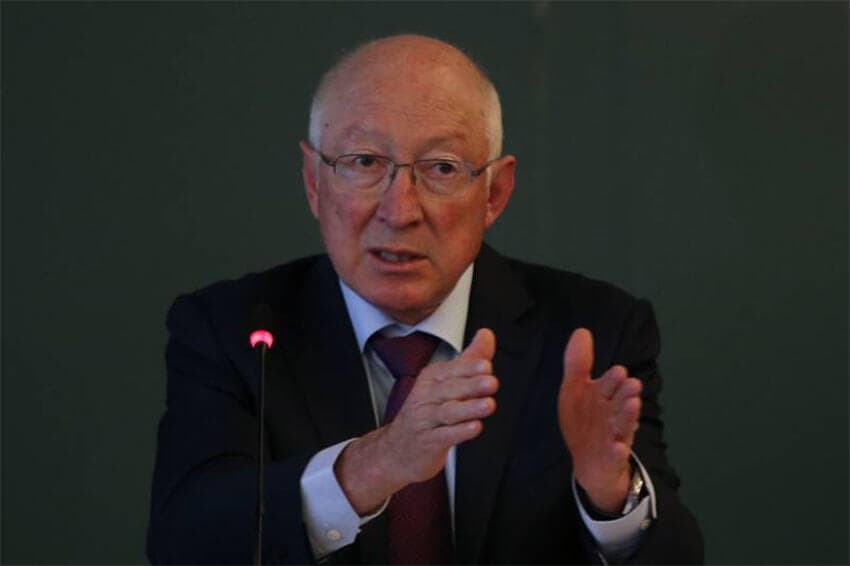
He noted that the measures now before the Mexican legislature – the proposed reform that would guarantee the CFE over half the electricity market – have impacts on North American competitiveness.
In that context, Salazar said, “we hope that the legal framework that emerges will support the creation of a North American clean energy powerhouse, protect current and future U.S. business investments in Mexico in accordance with Mexico’s obligations under the United States-Mexico-Canada Agreement [USMCA], and protect the integration of U.S.-Mexico supply chains for the prosperity of our region.”
In a letter sent to Economy Minister Tatiana Clouthier last week, United States Trade Representative Katherine Tai warned that over US $10 billion in U.S. investment in Mexico was at risk due to the country’s energy policies.
Kenneth Smith, a former trade official who headed up Mexico’s negotiating team in USMCA talks with its North American free trade partners, warned that the United States and Canada could use the trade pact to take action against Mexico if the proposed electricity reform passes Congress in its current form.
The United States says that the bill – to which López Obrador has ruled out making changes – violates competition provisions in the USMCA.
If the bill becomes law, the U.S. and Canada could use chapter 31 of the USMCA to challenge it via an arbitration panel, Smith said, noting that that chapter sets out mechanisms to resolve disputes between countries.
“The decision of a panel could result in significant trade repercussions and retaliation against [Mexican] export products … [to] cover the damage caused,” he said.
Responding to Thursday’s court decision, analyst Carlos Petersen of Eurasia Group said it creates some legal uncertainty for businesses whose confidence has already been adversely affected by policy and political uncertainty in Mexico.
“That will likely discourage investment,” he told the Financial Times.
Lawyer José Maria Lujambio of Cacheaux, Cavazos & Newton said the situation could become chaotic. “There’s a whole salad bowl of arguments, so collegiate courts and judges can take whatever they want from it.”
With reports from Reforma, El Economista, Financial Times and Milenio