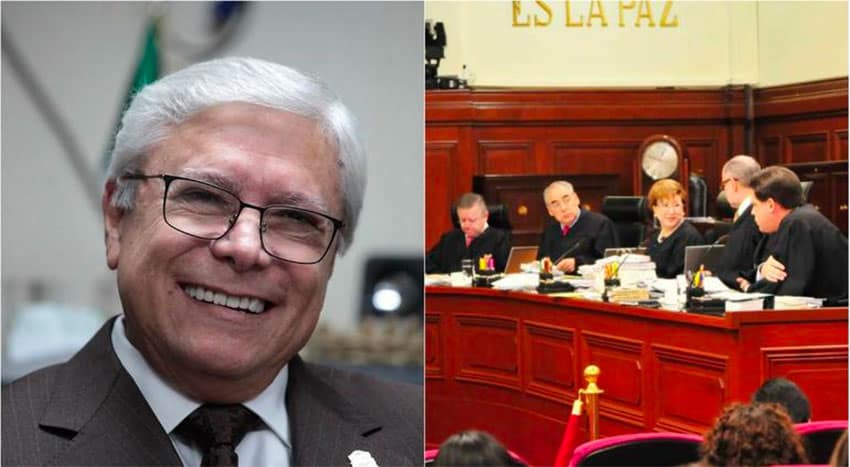
The Supreme Court (SCJN) has scuttled the plans of Baja California Governor Jaime Bonilla to remain in office for five years instead of two.
The court on Monday invalidated a reform ratified by the Baja California Congress last July that extended Bonilla’s term by three years. The so-called “Bonilla law” was endorsed by more than 80% of people who participated in a vote on it last October.
However, the SCJN justices voted unanimously to nullify the reform, meaning that the Morena party governor must leave office on October 31, 2021. Bonilla was elected for a two-year term in elections last year and can not stand for re-election.
The purpose of the shortened term – past Baja California governors remained in office for six years – was to align the state’s election for governor with the federal mid-term elections.
Supreme Court Chief Justice Arturo Zaldívar said that the whole process to extend Bonilla’s term violated the Mexican constitution. The actions of Baja California lawmakers constituted “grand” constitutional fraud, he said.
Zaldívar said that lawmakers in the Morena-controlled Congress executed a scheme that sought to “make a mockery” of the will of the people of Baja California, who elected their governor for a period of two years not five.
They used “the tools of democracy to violate democracy, unequivocally corrupting the democratic principle,” he said.

Opposition parties celebrated the Supreme Court’s decision while even the national leader of Morena expressed support for it. A senior Baja California official said that the state government will abide by it.
Institutional Revolutionary Party national president Alejandro Moreno described the ruling as “historic” and said that it put a “full stop” to an “abusive” quest for power, while National Action Party national president Marko Cortés said that “constitutional order” had “triumphed over dirty play.”
Morena national president Alfonso Ramírez Cuéllar offered his support for the court’s decision in a Twitter post.
“I welcome the SCJN ruling with respect to the term of Jaime Bonilla. An illegal reform with which the will of the people of Baja California was violated could not be permitted. This decision affirms respect for legal order,” he said.
Lorenzo Córdova, president of the National Electoral Institute, also tweeted about the ruling, stating that it “preserves democracy and the separation of powers” and upholds the legal framework that “gives certainty and legality to our electoral system.”
Baja California government secretary Amador Rodríguez Lozano said that the court’s decision carries the full “force of the law” and will be respected.
“[The SCJN] is the highest court [in Mexico] and that means that we have to comply with” its ruling, he said.
Source: Milenio (sp)