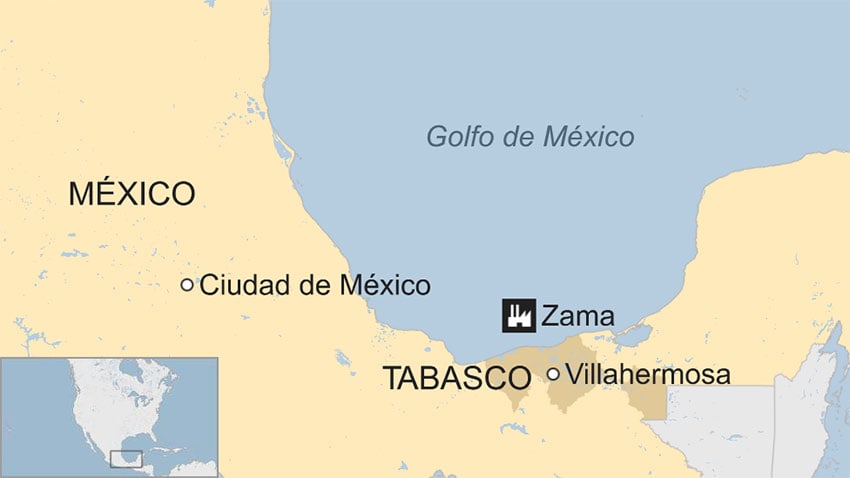
A United States energy company has submitted notices of dispute to the federal government over a decision to take away its control of a shallow water oil field in the Gulf of Mexico.
Houston-based Talos Energy intends to fight the decision by the Energy Ministry (Sener) to designate the state oil company Pemex as the operator of the Zama field, which contains almost 700 million barrels of oil.
Talos, leader of a consortium that discovered the field in 2017, said in a press release that Sener’s decision caused damage to the company as an investor and offshore operator in Mexico.
It also said Sener’s actions violate the United States-Mexico-Canada Agreement, or USMCA, and the bilateral investment treaty between Mexico and the Belgo-Luxembourg Economic Union. The company noted that Sener designated Pemex as the operator of Zama just three days after the ministry received a letter from the state oil company arguing for operating rights.
“Under Mexico’s own unitization guidelines, Sener was required to ‘consider the principles of economy, competitiveness, efficiency, legality, transparency, best practices of the industry and the best use of hydrocarbons.’ Disregarding the company’s formal requests, Sener has not demonstrated how these legal principles were followed,” Talos said.
The firm said its notices of dispute provide the opportunity for an initial phase of negotiation and consultation between the parties in an attempt to resolve the controversy.
“If successful, this would avoid the need for further legal action, including international arbitration. Talos will diligently seek a fair and mutually beneficial agreement and will continue to engage in good faith with the institutionally appointed representatives of the government of Mexico,” the company said.

Talos noted that it has attempted over a period of almost three years to work constructively with Pemex and Sener to “finalize a unitization and unit operating agreement … for the Zama field that follows international best practices.”
The company, which noted that it and its partners have already invested US $350 million in Zama, said it has “repeatedly sought a positive outcome for all parties and will continue to do so under this process.”
The federal government’s seizure of control of Zama was based on its claim that just over half the field is on acreage owned by Pemex.
Despite the ownership designation, Talos remains “hopeful that a negotiated outcome that fully respects the rule of law is achievable,” said the company’s president and CEO Timothy S. Duncan.
“The filing of these notices of dispute, along with the concrete, mutually-beneficial proposals we have presented to Pemex and Mexican authorities in the past, demonstrates our commitment to maximize value for all stakeholders, including Mexico,” he said.
Talos made it clear that it believes it would be a better manager of the field than Pemex.
“The company’s operated efforts between 2017 and 2019 were under budget, ahead of schedule and without any safety incidents. In contrast, despite the statements from Pemex executives and Mexican government officials asserting that Pemex would drill a confirmation well on their neighboring contractual area to provide complementary geological data, Pemex repeatedly delayed the well for several years until ultimately canceling all plans to drill it just a few weeks before Sener designated Pemex as the operator of the yet-to-be-finalized unit,” it said.
Talos said it has “consistently demonstrated its commitment to the optimal development of the field, having advanced a complete front-end engineering and design study, which is now investment ready.”
The company estimates that the project could generate over $30 billion in total revenue for Mexico in addition to Pemex’s own share of the revenues and profits of their ownership interest in Zama.
“The platforms that are required to be installed at Zama will be the deepest facilities ever installed in Mexico, at approximately 550 feet (170 meters) of water. Talos is very experienced in these situations and currently operates multiple platforms at these and greater water depths.”
Mexico News Daily