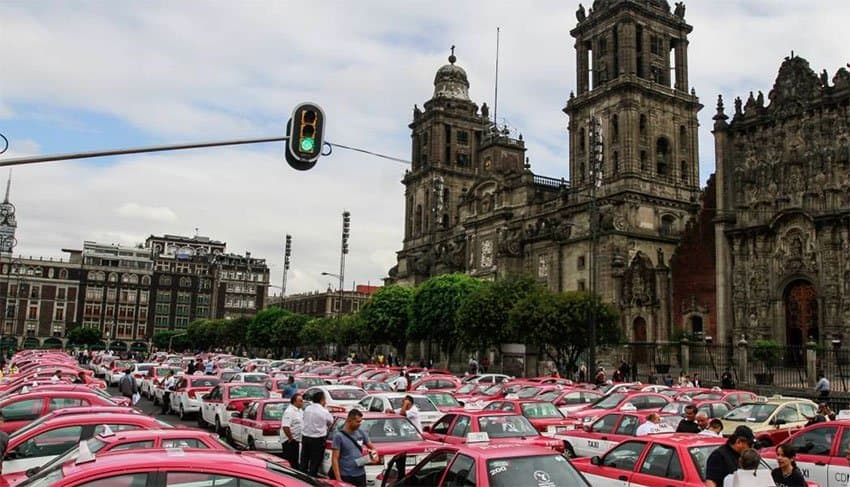
Taxi drivers began blocking streets across Mexico City on Monday morning, protesting what they say is unfair competition from ride-sharing services like Uber, Cabify and Didi.
Taxis started congregating in the zócalo around 6:30am, while roadblocks started going up at 10:00am and were expected to remain until noon. The city government said affected thoroughfares will include access points to the capital, such as the México-Pachuca, México-Toluca, México-Querétaro and México-Cuernavaca highways.
Members the National Movement of Taxi Drivers (MNT) are also suspending service in various municipalities in the state of México.
The drivers complain that inconsistent regulation creates an uneven playing field for them to compete with ride-sharing, and want more robust regulation of their competitors.
Mexico City MNT leader Ignacio Rodríguez Mejía told El Universal that taxi drivers have to pay fees and fulfill requirements that do not apply to drivers working with ride-sharing applications.
“The application drivers have all year to get their license, and it’s free,” he said. “But the taxi drivers have to pay, and if they don’t, they can get fined up to 10,000 pesos (US $506).”
According to the MNT, taxi drivers need to pay 713 pesos for a permit, 1,635 pesos for an evaluation and 2,565 pesos for a safety course, all fees that ride-sharing drivers do not pay.

Rodríguez added that taxis must be painted a certain way, which can cost around 2,500 pesos.
In a press conference on Sunday, Mexico City Mobility Secretary Andrés Lajous said that government representatives held more than 150 meetings with taxi drivers’ groups during the month of May to hear their concerns and look for solutions. The Mobility Secretariat (Semovi) has agreed, among other things, to simplify the paperwork that is required for taxis.
Lajous said the government remains open to dialogue.
“We’re not interested in playing politics with them,” he said. “Semovi’s mission is to improve the quality of transportation for people.”
Source: El Universal (sp), Publímetro (sp), La Jornada (sp)