As teachers across Mexico celebrated el Día del Maestro (Teachers’ Day), President Claudia Sheinbaum announced a 9% pay increase retroactive to Jan. 1 with an additional 1% boost starting Sept. 1. The move came amid a march organized by one of Mexico’s largest teachers unions in Mexico City.
Sheinbaum said she regretted not being able to offer a higher pay raise, but noted the across-the-board increase represents 36 billion pesos (more than US $1.8 billion). The increase is similar to the pay bump teachers received last year.
The president also said teachers’ contracts would include an additional week of vacation.
“Since we adjusted the school calendar, [teachers] barely get vacation time,” she said, acknowledging that they often work after the school year ends, and return a week or so before the school year starts.
Sheinbaum also confirmed she was freezing the legal minimum retirement age for teachers — 56 for women and 58 for men. Earlier this year, Congress was considering a bill introduced by the president that would have gradually raised the legal minimum retirement age.
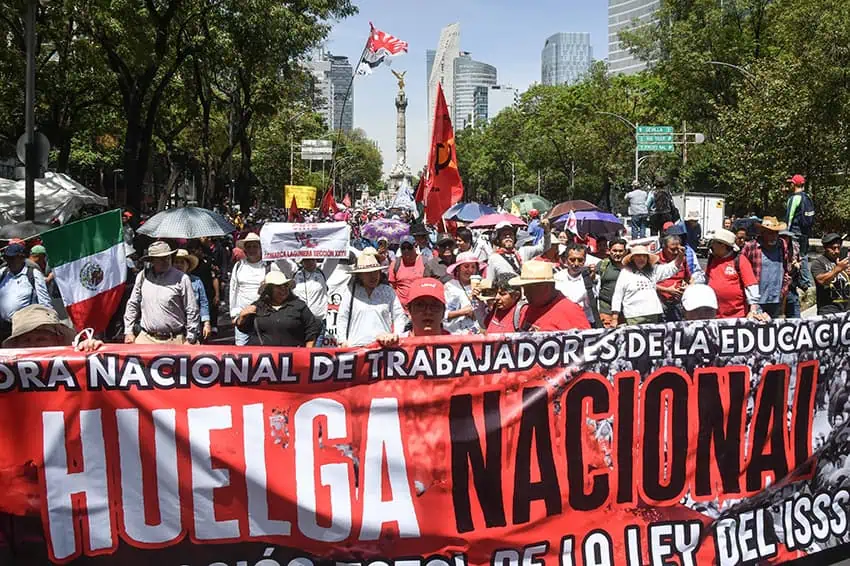
At the same time, the dissident CNTE teachers union staged a large march in Mexico City that snarled midday traffic in the capital. Police rerouted traffic in the Historic Center in an attempt to limit commuters’ inconvenience.

CNTE members — primarily from the states of Chiapas, Oaxaca, Guerrero and Mexico City — started gathering at the iconic Angel of Independence monument on Reforma Avenue around 8 a.m., beginning their march before 11 and arriving at the Plaza de la Constitución in front of the National Palace just over two hours later.

CNTE leaders are demanding a larger pay increase than was offered, better retirement benefits, bigger budgets for rural schools and the reinstatement of teachers fired after the controversial 2013 education reform.
Shortly after arriving in the Zócalo, the teachers began to pitch tents in the plaza and along adjacent streets while calling for national strikes. CNTE’s strike threats in March appear to have prompted Sheinbaum to withdraw legislation that would have gradually increased the mandatory retirement age.
Pedro Hernández, CNTE spokesman in Mexico City, said more dissident teachers would be arriving in coming days to join the protest on the streets of the capital.
“We have no option but to strike, because seven years of talks with this administration and the previous one have failed to satisfy our concerns about our pension plan,” Yenny Pérez, leader of the CNTE union in Oaxaca, said.
While the tent city expanded beyond the Zócalo just two blocks away, Sheinbaum was feting teachers at the Education Ministry and handing out the prestigious Maestro Manuel Altamirano and Maestro Rafael Ramírez awards. The former is for 30 years of service, the latter for teachers with 40 years on the job.
With reports from Reforma, El Financiero, Uno TV and Infobae