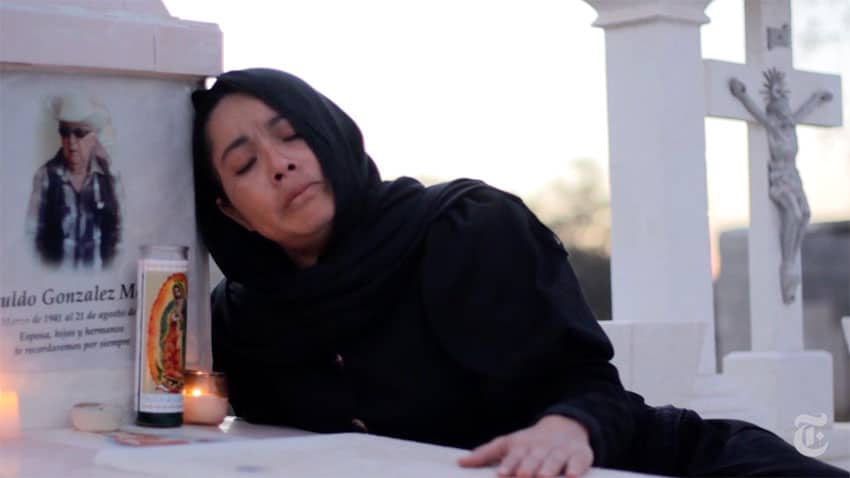
There is plenty to cry about in 2020 as the coronavirus pandemic continues to take a heavy toll on Mexico and many other countries around the world.
Accordingly it’s perhaps not surprising that an annual Day of the Dead mourning contest in Querétaro attracted double its usual number of participants this year.
Held virtually due to the risk of coronavirus transmission, the San Juan del Río Concurso de Plañideras (Mourners Contest) received video entries from 27 contestants.
First held 14 years ago, the contest, which is sponsored by a local funeral home, was created to pay tribute to women known as plañideras who were once hired by well-off families to cry at the burials of loved ones.
The San Juan Tourism Bureau announced last month that it would accept entries by email this year and soon after the tears started flowing and the videos flooded in.
The quality of entries was high, leaving the panel of judges with a difficult job to select a winner but they eventually settled on Princesa Katleen Chávez Arce of La Paz, Baja California.

Chávez, who won a prize of 3,500 pesos (US $167), submitted a slickly produced video which shows her clad in black and sobbing while lying beside a dead man’s tomb.
“But to forget you? Never, never, never, never,” she says before breaking down.
Chávez, an actor who moved home after the pandemic affected her work opportunities in Mexico City, said that she had never cried professionally before but admitted she shed a lot of tears after returning to La Paz in September.
“The crisis hit me,” she said. “So yes, I cried, and for about a week I did absolutely nothing,” she said.
The second place winner was María Silveria Balderas Rubio of Tequisquiapan, Querétaro.
According to the New York Times, Balderas’ daughters heard about the mourning contest and convinced their mom to enter. The 58-year-old runner-up said that she took inspiration for her performance from inconsolable mourners she has seen at funerals.
Balderas’ entry was shot on a cellphone in a single take, the Times said, adding that although there is no coffin in the footage, her “anguished weeping, hyperventilated breathing and insistence that she ‘just saw him yesterday’ seem startlingly real.
Juan Carlos Zerecero, a theater teacher and member of the judging panel, noted that “the the video is very homemade, and all she does is cry” but added: “That’s what we’re asking them to do, no? To me, she’s crying in a very truthful way.”
María Ofelia Ramírez Arteaga, a local San Juan del Río woman, took third place for her mock mourning of the death of the local mayor – who is still very much alive.
According to local news outlet Crónica Regional, her performance was filled with comedic and sarcastic elements.
An Aguascalientes woman also put in a comedy-filled performance, bewailing the onset of menopause and addressing her laments to her absent period.
“You were always so punctual and then one day, without saying anything, you never came back,” she bemoaned.
Another entrant was Brenda Anakaren Torres Villarreal, who submitted a video that the Times described as “perhaps the most relatable entry.”
The 31-year-old took inspiration for her mourning from 2020, a year she said left people “depressed, out of work and in quarantine.”
“It is without a doubt one of the worst years that we have ever lived,” Torres said, explaining her inspiration. “If you’re not crying about 2020, you’re not crying about anything.”
She added that the idea wasn’t to dwell on misery but to laugh at it. “Mexicans always have the capacity to find comedy in tragedy – to find the good part of it, even if that doesn’t exist.”
Similarly, the head of the San Juan del Río Tourism Bureau said that “laughing at death is part of Mexican culture.”
“It’s a way of confronting the problem and feeling less vulnerable,” Eduardo Guillén said.
He said that only women have been invited to participate in the mourning contests due to tradition but added that local authorities are open to allowing men to compete in the future.
Any would-be wailers have just about a year to get ready for next year’s event, which will hopefully be held once again in front of a live audience.
Source: Crónica Regional (sp), The New York Times (en)