In a congressional hearing this week, Mexican journalist and UFO enthusiast Jaime Maussan and other researchers said that a pair of preserved specimens – presented in the Chamber of Deputies September as extraterrestrials – were real, once-living organisms.
However, they declined to certify that the mummified remains were those of alien beings.
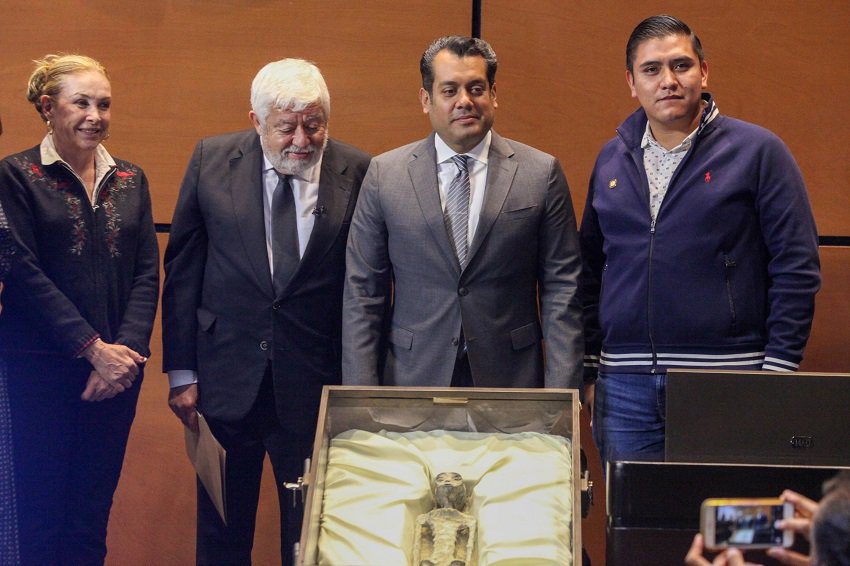
The two tiny bodies with large heads, big eyes, long necks and three fingers on each hand — resembling the archetypal depiction of a gray alien — were allegedly found in Peru.
Maussan brought them to Congress on Sept. 13 for a first-of-its-kind hearing on UFOs, which these days are usually termed Unidentified Anomalous Phenomena (UAP), or FANI in Spanish. He insisted the bodies were 1,000-year-old corpses of extraterrestrials.
At that time, experts dismissed his presentation as a stunt, pointing to studies on similar remains that concluded the specimens were modified using animal and human bones.
On Tuesday, over the course of three hours in a room of the Chamber of Deputies, Maussan presented a string of doctors and scientists, plus photographs and X-ray images of what he called a new “non-human being.”

“They’re real,” said anthropologist Roger Zúñiga of San Luis Gonzaga National University in Peru, noting that researchers had studied five similar specimens. “There was absolutely no human intervention in the physical and biological formation of these beings.”

Argentine surgeon Celestino Adolfo Piotto said he reviewed data and images, concluding that the bodies were an evolved version of today’s human beings. He called them “our descendants.”
Zúiñga presented a letter signed by 11 researchers from his university declaring the bodies to be non-human, but the letter made clear they were not implying the bodies were extraterrestrial.
“None of the scientists say [the study results] prove that they are extraterrestrials, but I go further,” Maussan said, suggesting that the bodies could be evidence of non-Earthly life forms, or a “new species” due to their lack of lungs or ribs.
He previously claimed the specimens had big brains and big eyes that “allowed for a wide stereoscopic vision,” and that they lacked teeth, so they likely only drank and did not chew.
“All ideas and all proposals will always be welcome,” Deputy Sergio Gutiérrez Luna stated, “to debate them, to listen to them and to agree — or not.”
With reports from El Financiero and Reuters