Authorities in Michoacán have been unable to resolve a pay dispute with teachers despite receiving more than 1.6 billion pesos from the federal government last month to cover unpaid salaries.
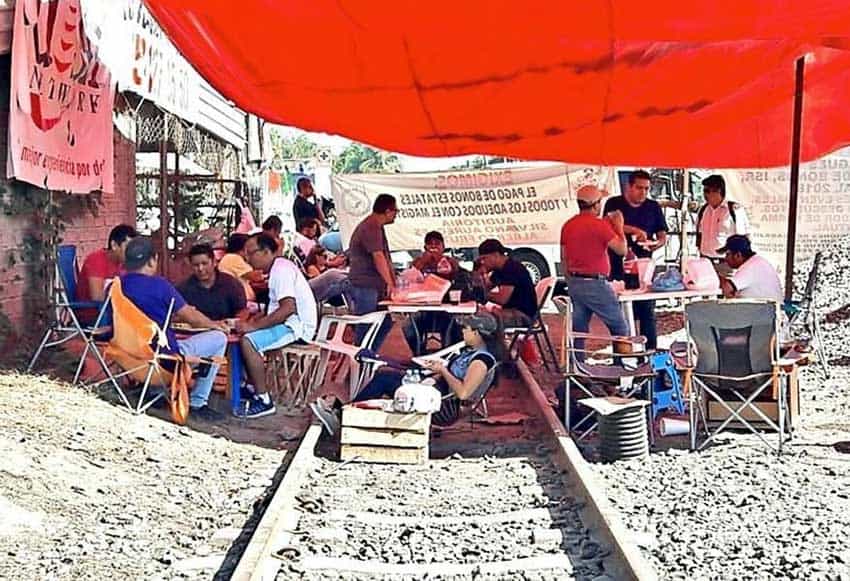
Teachers affiliated with the CNTE and SNTE unions continue to block railroad tracks in the state, demanding payment of money they say they are owed by the state government along with other concessions.
The blockades, which started at the beginning of last week, have halted more than 140 trains, preventing the transport of a range of goods including 300,000 barrels of gasoline bound for Jalisco, where fuel shortages persist.
Héctor García, head of the administration and finance division of the Secretariat of Public Education (SEP), said that 1.65 billion pesos (US $87 million) was allocated to education authorities in Michoacán to pay salaries, bonuses and other benefits to teachers.
“[Michoacán] is the state that has received the most money from President Andrés Manuel López Obrador,” he said.
“[The money] helped the teachers’ movement a little bit and we resolved [the problem to some extent] but not in the way we wanted, it’s a problem that’s been going on for 30 years,” García added.
Now, authorities in Michoacán are asking for an additional 1.2 billion pesos (US $63.4 million) and for the federal government to assume responsibility for the payment of teachers’ salaries, he said.

García explained that due to the “seriousness of the problem,” the government could provide that amount of funding but the SNTE union has indicated that even if the money is forthcoming, it intends to maintain the blockades.
“There is an economic offer on the part of the federal government for more than 1 billion pesos to confront the education problem in our state but we won’t accept it because our demands are as much economic as administrative and political and those [demands] aren’t included in the offer,” the union said.
García said that federal authorities have held meetings with Michoacán Governor Silvano Aureoles at which it has been suggested that an “administrative reengineering” is needed to solve the pay dispute.
If the teachers’ railroad blockades continue, the economic losses, already estimated to be in the hundreds of millions if not billions of pesos, will continue to mount.
Among the industries that will be hardest hit is petroleum.
Mexico’s refineries transport a lot of fuel oil to Lázaro Cárdenas, Michoacán, by rail for export to Asia.
But if they can’t get the product to the port city, it will accumulate in storage tanks at the refineries which, according to a former Pemex official, could force them to stop producing gasoline.
“If the tanks fill up, the refineries would have to go into a technical stoppage,” he said, a situation that would exacerbate fuel shortages, especially in the Bajío region.
Source: Reforma (sp)