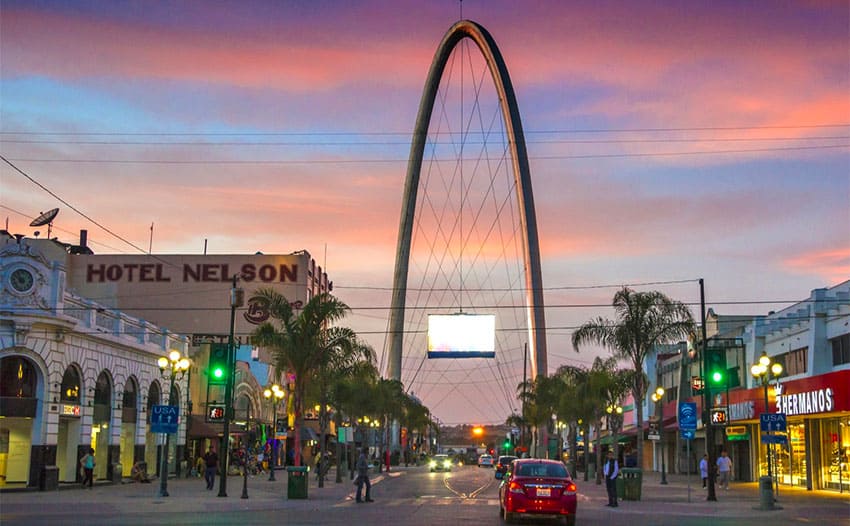
Residents of Tijuana, Baja California, received more money in remittances sent home by Mexicans living abroad in 2019 that those of any other municipality, according to a report by the bank BBVA.
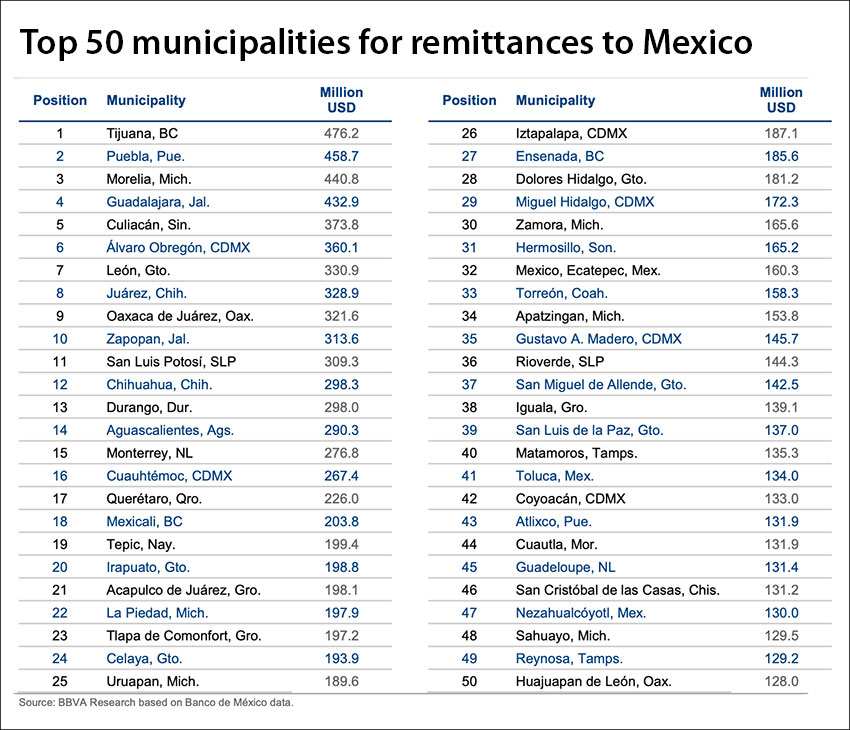
Completed by the bank’s research division, the report shows that US $476.2 million in family remittances was sent to the northern border city last year.
Puebla city ranked second, with residents receiving $458.7 million, followed by Morelia, Michoacán, $440.8 million; Guadalajara, Jalisco, $432.9 million; Culiacán, Sinaloa, $373.8 million; Álvaro Obregón, Mexico City, $360.1 million; León, Guanajuato, $330.9 million; Juárez, Chihuahua, $328.9 million; Oaxaca city, $321.6 million; and Zapopan, Jalisco, $313.6 million.
The top 50 municipalities in terms of remittances received – among which were also large cities such as Monterrey, Acapulco and Hermosillo as well as municipalities with much lower populations – accounted for 30.7% of the total of just over $36 billion that was sent to Mexico from abroad in 2019.
Just under 95% of remittances came from the United States, BBVA said, noting that the monetary transfers exceeded their historical peak for the fourth consecutive year.
Michoacán, Jalisco and Guanajuato were the biggest beneficiaries among Mexico’s 32 federal entities, receiving $3.58 billion, $3.5 billion and $3.29 billion respectively.
“In general, the states that receive most remittances are those that have seen the most migrants depart over the last 50 years,” BBVA said. “For at least 15 years, Michoacán, Jalisco and Guanajuato have been the country’s top three recipients of remittances.”

Residents of México state and Oaxaca received $2 billion and $1.8 billion in remittances, respectively, to rank fourth and fifth. Rounding out the top 10 were Puebla, Guerrero, Mexico City, Veracruz and San Luis Potosí.
The five states that received the lowest amounts in remittances were, in order, Baja California Sur, Campeche, Quintana Roo, Yucatán and Tabasco. The states with the highest growth in remittances received in 2019 were Chiapas (21.4%), Tabasco (19.6%), Mexico City (18.6%), Chihuahua (13.2%) and Sinaloa (13.1%).
BBVA also reported that California was easily the largest state of origin for remittances. Just over $10.5 billion was sent from the Golden State, a figure that accounts for almost a third of the $34.11 billion in remittances from the United States.
Texas ranked second with remittances of $5.56 billion followed by Illinois, Florida, New York and Georgia, with amounts of between $1.2 billion and $1.5 billion each.
BBVA said that total remittances to Mexico could grow 6% this year to $38.2 billion, which would ensure that a new record is set for a fifth consecutive year.
While more money is flowing into the country in the form of remittances, less is leaving, the BBVA reported.
The bank said that remittance outflows, or remittances sent from Mexico to another country, decreased by 1.9% to $981.2 million in 2019.
The United States is the main destination for remittances from Mexico, receiving 40% of the total last year, followed by Colombia, China, Peru, Honduras and Guatemala.
Mexico News Daily