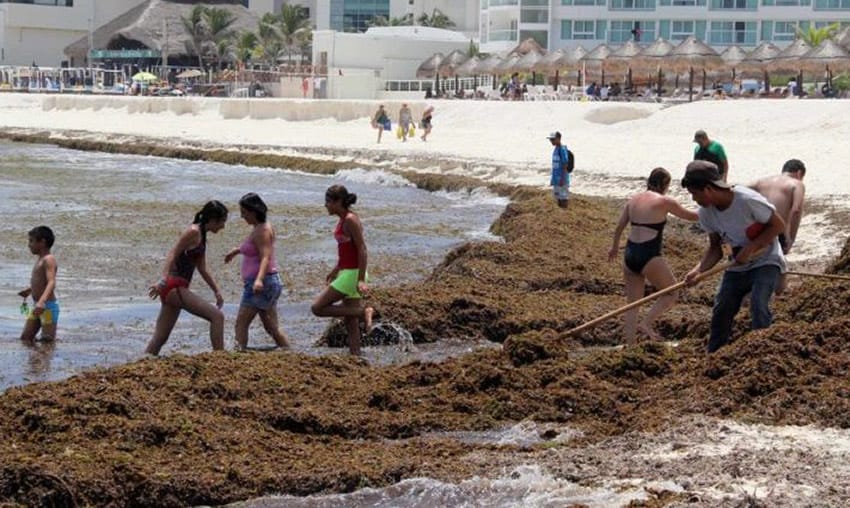
Tonnes of sargassum left by Subtropical Storm Alberto between May 21 and 28 are being removed from beaches in seven municipalities of Quintana Roo, part of a coastal clean-up of organic and inorganic residues.
Complying with sargassum removal regulations, personnel from the state Secretariat of Ecology and Environment (Sema) started the efforts at the kilometer nine mark of the hotel zone of Cancún; the lighthouse zone in Mahahual in the municipality of Othón P. Blanco; and in Punta Piedra and Medial Luna Bay, in Tulum.
The work, carried out by hand and with the help of machinery, included the residential areas of Playacar Fase II and Punta Bete in Playa del Carmen in the municipality of Solidaridad; at Chen Río Beach, Cozumel; the Muelle de Pescadores of Puerto Morelos; and the North Beach of Isla Mujeres.
The federal government is paying for the removal project with 62 million pesos (US $3.08 million) from the federal disaster fund, Fonden. As of yesterday, the efforts had recovered more than 100 tonnes of both organic and inorganic material, said Sema chief Alfredo Arellano Guillermo.
According to a diagnostic report by Sema, the affected surface in Cozumel was 6,750 meters long, affecting 12 beach zones.
In Solidaridad, 10,600 meters of beach were affected by sargassum, 3,300 meters in Punta Bete and 7,300 in Playacar.
In Tulum, the impacted area was 6,750 meters long, encompassing Media Luna Bay and the Pescadores, Mezzanine and Tulum National Park beaches, and from the 8.2 to the 9.5-kilometer mark at Punta Piedra.

The storm also affected beaches to the south, leaving sargassum on 5,000 meters of coastline at Mahahual, Xcalak and Uvero.
Sema explained that the seaweed comes from the Sargasso Sea and is a phenomenon that affects the entire Caribbean Sea.” It also said a massive amount of sargassum is expected this year, more than was seen three years ago, which was also a bad year.
The sargassum’s presence on Quintana Roo beaches is not good for a state that relies heavily on tourism. One hotel operator said there have been some reservations cancelled, but the number is not high.
Source: El Universal (sp), Notimex (sp)
LA CONTINGENCIA DEL SARGAZO A VUELO DE DRON I:
INUTILIZA EL SARGAZO PLAYAS DE CANCÚN: Se agudiza el masivo recale de algas y ahuyenta al turismo; destinan 62 mdp para enfrentar la contingencia y limpiar arenaleshttps://t.co/YUNNnuKMX2 pic.twitter.com/ivYhihl4li
— Noticaribe (@Noticaribe) June 22, 2018