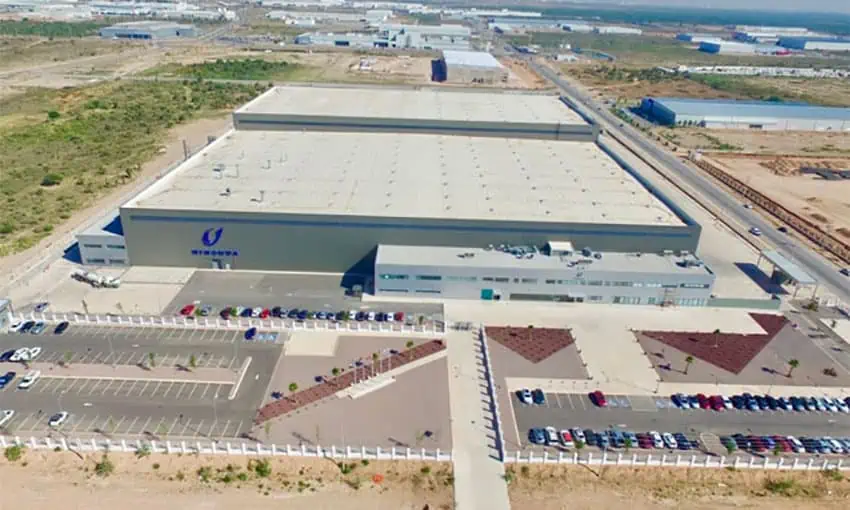
Ratification of the new North America free trade agreement will trigger an invasion of Chinese auto parts manufacturers in Mexico, according to three experts.
Ratified by Mexico in December and the United States Senate last week, the United States-Mexico-Canada Agreement (USMCA) stipulates that 75% of automotive content must be made in the three countries in order for a vehicle to qualify for tariff-free status in the region.
The figure is 12.5% higher than that set by the rules of origin under the 25-year-old NAFTA, which will be replaced by the USMCA once all three countries have completed their ratification processes.
The aim of the higher content rule is to reduce the quantity of parts that manufacturers operating in North America use from countries such as China, India, Brazil and eastern European nations. By opening factories in Mexico, Chinese auto part manufactures will be able to circumvent the stricter rule.
Once the USMCA is in effect, Chinese companies will seek to increase the quantity of parts they make in Mexico, said Enrique Dussel, coordinator of the Center for China-Mexico Studies at the National Autonomous University (UNAM).
He noted that a number of Chinese auto parts makers have already established operations in Mexico, such as Minth, which supplies Nissan, Ford, Honda, Mazda, Audi, Fiat Chrysler and General Motors. Chinese investment in Mexico’s auto parts sector increased by almost 350% between 2008 and 2018 to just over US $6 billion.
In 2019, Hangzhou XZB Tech opened a new factory in Nuevo León and Minghua started operations in San Luis Potosí.

A supplier of a range of parts to Audi, Ford and General Motors, the former invested US $9 million in a plant in a new industrial park in the municipality of Salinas Victoria, located north of the state capital Monterrey. The company has plans to expand its facility to 20,000 square meters, the newspaper El Universal reported.
Minghua, which supplies BMW from its San Luis Potosí plant, will invest 633 million pesos (US $33.9 million) in a factory in Puebla, El Universal said, to supply parts to Volkswagen and Audi.
In addition, the Zacatecas government has announced the construction of a new industrial park for Chinese auto parts manufacturers and is currently in talks with Guangdong Automotive Component with a view to luring the company to the state.
Arturo Orozco, a professor at the IPADE Business School and director of its auto summit, said the new North American trade deal gives greater certainty to the automotive industry and provides the opportunity to attract more Chinese suppliers to Mexico.
He added that Mexico is also an attractive country in which to make auto parts because wages in China have risen in recent years. Exporting to automakers in the United States from Mexico is easier and cheaper due to the country’s proximity to the U.S. and the trade war between Washington and Beijing.
The president of Mexico’s auto parts industry association INA said that Chinese companies are anxious to start operations in Mexico.
However, Oscar Albin said the government hasn’t provided the same incentive to Chinese companies as it has to those from other Asian nations such as Taiwan, Thailand, Vietnam and Malaysia.
In that context, Dussel of UNAM’s Center for China-Mexico Studies said that the federal government must be more proactive in its efforts to attract Chinese companies to Mexico.
Source: El Universal (sp)