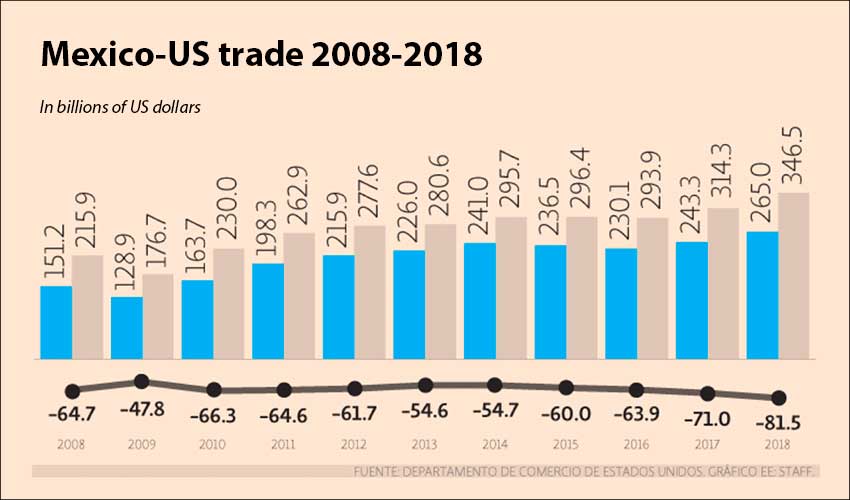
Trade surplus with US hit a record high US $347 billion in 2018

Mexico recorded its highest ever annual trade surplus with the United States last year amid uncertainty surrounding the new North American trade agreement and tariff tensions.

Data published yesterday by the United States Department of Commerce shows that Mexican exports to the U.S. increased by 10.3% in 2018 to reach just over US $346.5 billion while Mexico paid $265 billion for imports from north of the border, 8.9% more than in 2017.

The net result: a surplus for Mexico of just over $81.5 billion, 15% higher than the $71 billion surplus of 2017.

It was the fifth consecutive annual surplus increase for Mexico with its northern neighbor, while the United States’ global deficit hit a record $891.3 billion even though U.S. President Donald Trump has pledged to reduce it.

Almost half of the United States’ deficit was generated via a trade imbalance with China while just over 9% is a result of the surplus achieved by Mexico.

The positive result for Mexico came despite the United States government’s tariffs on Mexican steel and aluminum, which were imposed on June 1 last year.

Mexico responded swiftly with a range of “equivalent measures” on some U.S. imports including pork, apples and a range of cheeses.

During most of 2018, there was also uncertainty about whether Mexico, the United States and Canada would reach an updated trade deal to replace the quarter-century-old NAFTA.

Trump repeatedly threatened to pull out of the three-way accord and raised the possibility that the United States would enter into separate bilateral deals with its neighbors.

However, a new deal – the United States-Mexico-Canada Agreement (USMCA) – was eventually signed on November 30, Enrique Peña Nieto’s last day as president.

The agreement, which sets stricter rules of origin for the automotive sector among other modifications to NAFTA, must be ratified by the legislatures of the respective countries before it takes effect.

But trade officials in Mexico have indicated it will not ratify the deal unless the U.S. withdraws the metal tariffs.

Source: El Economista (sp)

Have something to say? Paid Subscribers get all access to make & read comments.
Manzanillo, Colima, México, 13 de marzo de 2026. La doctora Claudia Sheinbaum Pardo, presidenta Constitucional de los Estados Unidos Mexicanos en conferencia de prensa matutina, “Conferencia del Pueblo” desde Colima. La acompañan Indira Vizcaíno Silva, gobernadora Constitucional del Estado de Colima; Omar García Harfuch, secretario de Seguridad y Protección Ciudadana (SSPC); Raymundo Pedro Morales Ángeles, secretario de Marina (Semar); Bulmaro Juárez Pérez, divulgador de lenguas originarias, presentador de la sección “Suave Patria”; Ricardo Trevilla Trejo, secretario de la Defensa Nacional (Sedena); Jesús Antonio Esteva Medina, secretario de Infraestructura, Comunicaciones y Transportes; Bryant Alejandro García Ramírez, fiscal general del Estado de Colima; Fabián Ricardo Gómez Calcáneo; Rocío Bárcena Molina, subsecretaria de Desarrollo Democrático, Participación Social y Asuntos Religiosos de la Secretaría de Gobernación; Efraín Morales López, director general de la Comisión Nacional del Agua (Conagua); Marcela Figueroa Franco, secretaria ejecutiva del Sistema Nacional de Seguridad Pública (SESNSP) y Guillermo Briseño Lobera, comandante de la Guardia Nacional (GN). Foto: Saúl López / Presidencia

Mexico’s week in review: Congress deals Sheinbaum her first legislative defeat

1
The week of March 9 in Mexico was marked by standoffs between allies in Congress and adversaries at the airport. Here's what you missed.
A soldier displays seized handguns

The US and Mexico, growing together and growing apart: A perspective from our CEO

1
From a historic drop in homicides to opposite bets on electric vehicles, Mexico News Daily's CEO breaks down where the U.S. and Mexico are converging — and where they're not.
Veracruz Gov.

Veracruz governor blames private vessel for 200-kilometer Gulf Coast oil spill

1
The spill, which has spread to over 200 kilometers of Mexico's Gulf Coast beaches, has been traced to a private oil tanker off the coast of Tabasco.
BETA Version - Powered by Perplexity