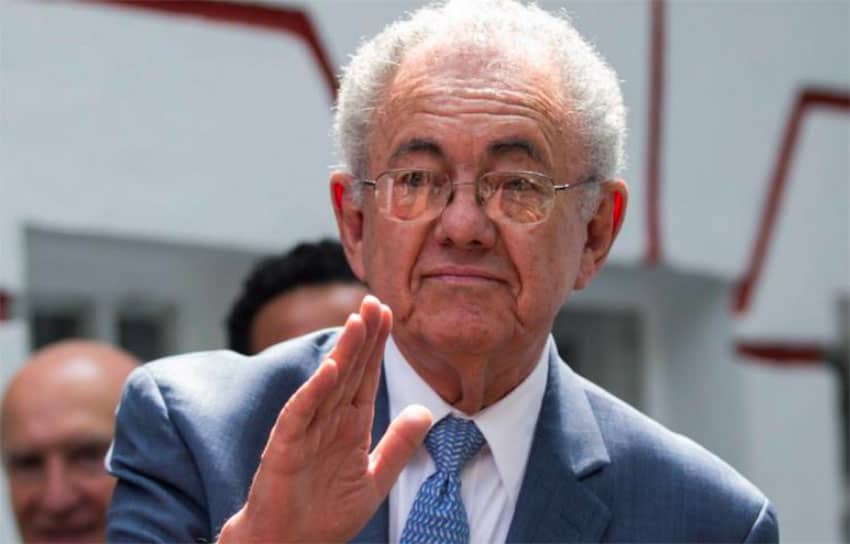
Communications and Transportation Minister Javier Jiménez Espriú resigned on Thursday because he disagreed with President López Obrador’s decision to put the military in charge of ports and maritime customs.
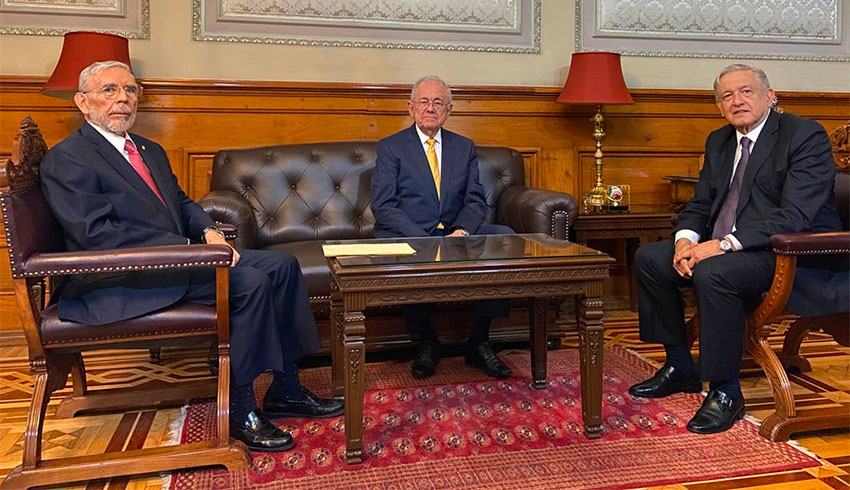
López Obrador said in a video posted to social media that he had accepted Jiménez’s resignation and announced that Jorge Arganis Diáz Leal, a civil engineer and former infrastructure director with the Mexico City government, would replace him.
The president described Jiménez as an “honorable person” and an “outstanding professional” but said he and the outgoing minister had a dispute over who should manage the nation’s ports.
López Obrador said that Jiménez believes that the Ministry of Communications and Transportation should be in charge whereas he thinks that the military should have control due to their high levels of corruption.
“I am very, very, very concerned about the entry of drugs, fentanyl, all this is coming in through the Pacific ports,” López Obrador said while sitting alongside Jiménez and his replacement at the National Palace.
“We need to avoid the entry of drugs so an institution like the navy is needed. … All the ports will be managed by the Ministry of the Navy,” he said, adding that a modification to the law will be made to allow it to happen.
Jiménez thanked López Obrador for the opportunity to serve in his government over the past 20 months, asserting that it allowed him to participate in projects that were important for the future of Mexico.

Despite deciding to leave his post, the outgoing minister said he remained “faithful and loyal to the goals and projects of the fourth transformation.”
The fourth transformation is a byname for the federal government, which López Obrador says is undertaking a transformative process akin to Mexico’s independence from Spain, the Mexican Revolution and the 19th century liberal reform known as La Reforma.
In addition to the dispute over who should control Mexico’s ports, the president and Jiménez have clashed over the former’s decision to cancel the previous government’s Mexico City airport project.
López Obrador cited corruption as one of the main reasons for canceling the US $14-billion airport in Texcoco, México state, but Jiménez publicly rejected the claim that the project wasn’t above board.
While the president says that his decision to scrap the previous government’s airport project and instead convert a México state Air Force base into a commercial airport will save large sums of money, the move to put the nation’s ports in the hands of the military could cost Mexico dearly, according to one expert.
Marcelino Tuero, president of the Merchant Maritime Advisory Council, told the newspaper El Financiero that military inspections of shipments arriving at the ports will cause an expensive bottleneck for foreign trade due to slow processing of imports and exports.
El Financiero said that some US $800 billion worth of foreign trade will be affected by the decision to militarize Mexico’s ports.
López Obrador claims that giving the navy responsibility will stem the flow of drugs into the country but Tuero pointed out that putting retired and on-leave navy officials in charge of the ports in Manzanillo, Colima, and Lázaro Cárdenas, Michoacán, has failed to stop the entry of narcotics.
Juan Carlos Merodio, Mexico representative on the United Nations International Maritime Organization, argued that ports, which are civilian and commercial in nature, shouldn’t be placed under military authority, a position with which National Autonomous University law professor Rogelio Rodríguez Garduño agreed.
Rodríguez said a presidential decree or agreement to put the military in charge of ports and customs would be unconstitutional and encroach on the authority of the Congress.
He acknowledged that criminal groups have practically seized control of Mexico’s ports and customs offices but added that there was no guarantee that the military will be able to change the situation as López Obrador expects.
“Unfortunately, members of the military can also be co-opted by crime.”
Source: Milenio (sp), El Financiero (sp)