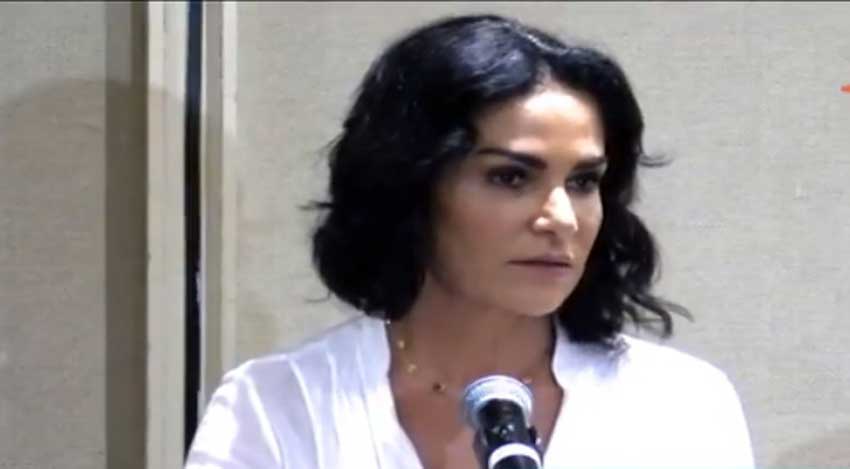
The United Nations (UN) human rights council has rebuked Mexico over the case of a prominent reporter who was kidnapped and threatened with rape by police in 2005.
The council’s resolution — its first against Mexico — determined that journalist Lydia Cacho was arbitrarily detained, subjected to torture and gender violence and had her right to free speech violated.
Cacho was detained in Cancún, Quintana Roo, on defamation charges in December 2005 by Puebla police who were allegedly acting on the orders of then Puebla governor Mario Marín and businessman Kamel Nacif, known as el rey de la mezclilla (the denim king).
Cacho’s arrest followed the publication of her 2005 book The Demons of Eden, in which she exposed a pedophile ring in Cancún that she alleged was run by businessman Jean Succar Kuri. He was later convicted of the crime.
She also mentioned that Nacif was a friend of Succar.
After Cacho was detained in Cancún, police drove her 20 hours to Puebla, during which time they taunted her, threatened her with rape, forced a gun into her mouth and debated drowning her in the Gulf of Mexico’s Campeche Bay.
Only one officer involved in the case has been prosecuted.

A recording of a telephone conversation was later leaked in which Nacif is heard congratulating Marín for arresting Cacho, ensuring that the case became a national scandal.
“We’re survivors of a national tragedy,” Cacho said.
“I was tortured, persecuted by the police, by governors and people protected by the president, for protecting the fundamental right of children.”
As part of its resolution, the UN human rights council ordered that reparation be paid to Cacho, that those responsible be held accountable and that measures be taken to avoid any repeat of a similar incident.
It also called for defamation laws that have been used to persecute journalists and whistleblowers in eight states to be abolished.
“This is a very clear message for the Mexican state, violence against the press, against women, against female journalists is unacceptable,” said Leopoldo Maldonado, deputy director of the press freedom group Article 19 Mexico.
“We have a state, which acts like a mafia, which acts to protect its own, to persecute those telling the truth, to persecute those who search for justice and to defend human rights through journalism,” he said.
Jan Jařab, the Mexico representative of the UN High Commissioner for Human Rights, said the Mexican government has 180 days to respond to the resolution.
He added that 13 years after the incident occurred, acts of torture, arbitrary detentions, gender violence, attacks on freedom of speech, impunity and collusion between the business sector and politicians continue to occur.
Mexico is also one of the most dangerous countries in the world in which to be a journalist.
More than 100 media workers have been murdered since 2000 and six journalists have been killed so far this year, according to press freedom groups.
The two most recent slayings of media workers both occurred in Quintana Roo, the same state in which Cacho was detained.
Rubén Pat, publisher of Semanario Playa News, was shot five times last month in Playa del Carmen, while one of his reporters, José Guadalupe Chan Dzib, was murdered in Felipe Carrillo Puerto in late June.
The federal Attorney General’s office (PGR) said last week it was taking over the investigation into the two assassinations.
Impunity levels in Mexico for murder and other crimes are high. A recent investigation conducted by the organization Impunidad Cero showed that only 18% of reported crimes are solved.
The low probability of conviction only serves to encourage crime against journalists, according to Jařab.
“The perpetrators feel encouraged that if threats don’t work, they can go to higher levels of violence,” he said.
“Impunity is the common denominator in many of the human rights problems in Mexico.”
Source: El Economista (sp), The Guardian (en), El País (sp)