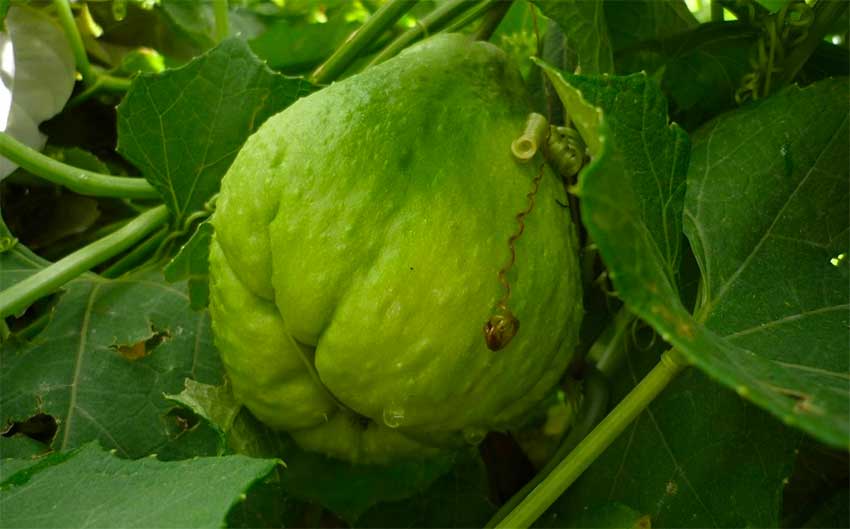
Cancer patients undergoing chemotherapy treatments are accustomed to cocktails of chemicals designed to combat malignant tumor cells, but now a Mexican scientist has developed a chayote-based alternative.
It took cellular biologist Edelmiro Santiago Osorio and his team at the Zaragoza Higher Studies School (FES) of the National Autonomous University (UNAM) a decade of research and trials to prove the effectiveness of their hybrid chayote as tumor-fighting agent.
Chayotes, also known as pear squash or mirliton, are eaten around the world, but Santiago explained that the varieties found in stores and markets would be of no use in the fight against cancer.
“We would have to eat many kilograms of market chayotes to obtain the effect we get from the hybrid,” he said.
Santiago’s chayote is the result of combining two wild varieties found in Mexico, and it becomes antitumoral after it is processed to obtain a raw extract.
He claimed that his chayote extract is 1,000 times more potent than what could be obtained from common chayote varieties, and is as effective as cytarabine, a chemotherapy medication used to treat several types of cancer.
Santiago and his team used mice to test the chayote extract and found that it greatly inhibited the proliferation of some cancer-producing cell lines.

After creating his hybrid chayote strain, Santiago is now looking to create and fund a business that can grow it commercially to bring his “super chayote” to market.
Santiago remarked that the goal of the fight against cancer is not to have a single cure-all molecule or substance, but to gather an arsenal: “We must find the way to attack the tumoral cell at different stages of its development with different molecules.”
Mexico News Daily