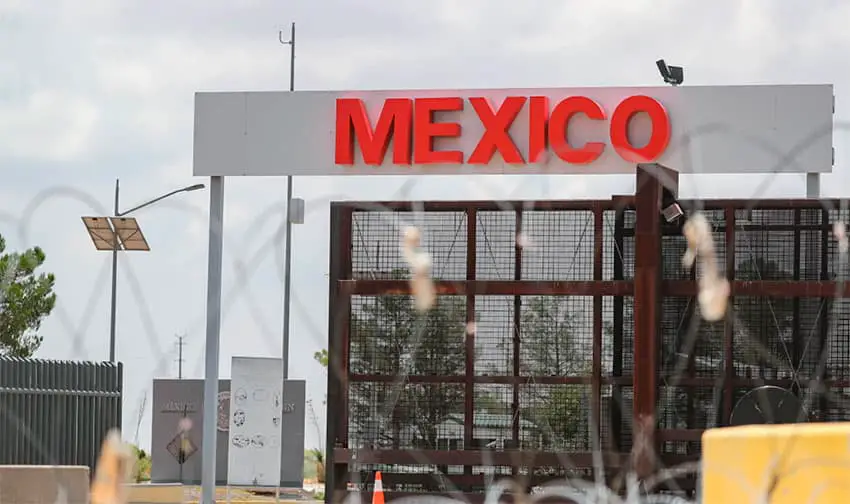
The United States has lifted its blanket warning to U.S. citizens to avoid all international travel due to the coronavirus pandemic but continues to warn Americans not to travel to Mexico.
“Do not travel to Mexico due to Covid-19. Exercise increased caution in Mexico due to crime and kidnapping. Some areas have increased risk,” says the August 6 travel advisory.
“Travelers to Mexico may experience border closures, airport closures, travel prohibitions, stay at home orders, business closures, and other emergency conditions within Mexico due to Covid-19.”
The advisory also says that violent crime – homicide, kidnapping, carjacking, and robbery – is widespread in Mexico.
“Armed criminal groups have been known to target and rob commercial vessels, oil platforms, and offshore supply vessels in the Bay of Campeche,” it adds.
The State Department also advised U.S. citizens not to travel to Colima, Guerrero, Michoacán and Sinaloa due to crime and to Tamaulipas due to crime and kidnapping.
The travel advisory says that U.S. citizens should reconsider travel to Chihuahua, Coahuila, Durango, Jalisco, México state, Morelos, Nayarit, Nuevo León, San Luis Potosí, Sonora and Zacatecas because of crime.

Notwithstanding the Mexico-wide “do not travel advice,” U.S. citizens are urged to exercise increased caution in the 16 other states.
Among those where it recommends “increased caution” are Guanajuato, Mexico’s most violent state; Quintana Roo, home to the popular tourist destinations of Cancún, Playa del Carmen and Tulum; Mexico City; and Yucatán.
More detailed information for each state is included in the travel advisory.
The advisory states that the United States government has limited ability to provide emergency services to U.S. citizens in many areas of Mexico because travel by U.S. government employees to certain areas is prohibited or significantly restricted.
It also says that U.S. government employees may not travel between cities after dark, may not hail taxis on the street, and must rely on dispatched vehicles, such as those from app-based services like Uber or from regulated taxi stands.
In addition, government employees mustn’t drive drive from the U.S.-Mexico border to interior parts of Mexico or vice versa, with the exception of daytime travel within Baja California, between Nogales and Hermosillo on federal Highway 15D, and between Nuevo Laredo and Monterrey on Highway 85D.
United States Ambassador Christopher Landau acknowledged on Twitter that the U.S. had eased its blanket advice against international travel, in place since March 19, “because some countries have relatively low infection rates.”
In another Twitter post, Landau wrote that in Mexico, “the government itself acknowledges that infection rates are still relatively high.”
“In fact, the entire country has a red or orange stoplight [on the government’s stoplight system to assess the risk of coronavirus infection]. For now Mexico (like a lot of the world) remains at level 4 [do not travel]. The warning will be continuously reviewed during the pandemic,” the ambassador said.
Mexico is one of more than 50 countries to which the Department of State is advising U.S. citizens not to travel. Other countries with large coronavirus outbreaks including Brazil, India and Russia are also on the list.
As of Thursday, Mexico has recorded 462,690 confirmed coronavirus cases, the sixth highest tally in the world, and 50,517 Covid-19 fatalities, the third highest death toll.
Unlike many countries, Mexico has not banned the entry of foreign travelers even as the coronavirus pandemic worsens here and in many nations around the world.
Mexico News Daily