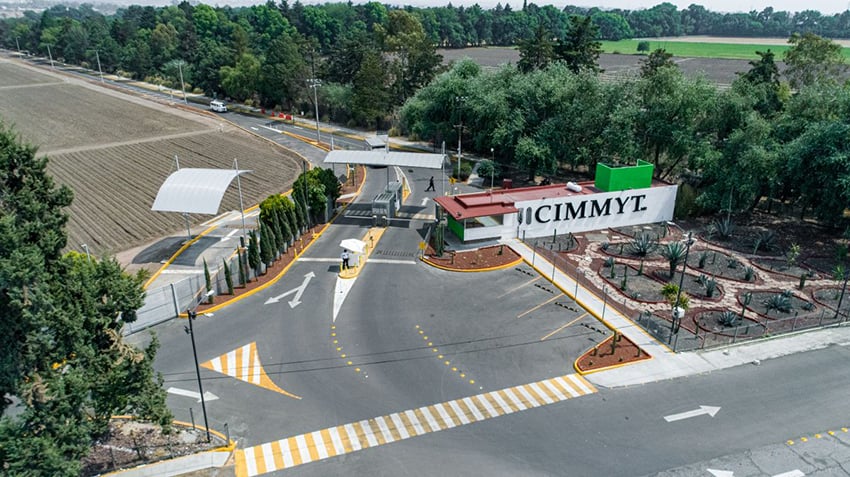
U.S. Ambassador to Mexico Ron Johnson announced Wednesday that the United States will invest US $40 million in the International Maize and Wheat Improvement Center (CIMMYT), an agricultural research center headquartered east of Mexico City in Texcoco, México state.
Johnson announced the investment in a statement posted to social media.
“Food security is strategic security. For the United States, strengthening agricultural resilience, protecting supply chains, and advancing innovation in crop science are core national priorities under President Trump’s leadership,” he wrote before announcing the investment in CIMMYT as “part of this effort.”
“… This investment reinforces American leadership in agricultural science while strengthening global food systems,” Johnson said.
According to the CIMMYT website, the International Maize and Wheat Improvement Center “grew out of a pilot program sponsored by the Mexican government and the Rockefeller Foundation in the 1940s and ’50s” that was “aimed at raising farm productivity in Mexico.”
The center developed in its early years under the leadership of prominent United States agronomist Norman Borlaug, a Nobel Peace Prize winner considered the father of the Green Revolution, a period in the mid-20th century when scientific and agricultural innovation led to a significant increase in crop yields.
Over the decades, CIMMYT scientists have developed a range of high-yielding wheat and corn varieties. The center — a non-profit organization — carries out research and development projects in dozens of countries around the world and receives funding from numerous sources, including governments and private companies.

In his statement, Johnson wrote that “nearly 60 percent of U.S. wheat acreage benefits from CIMMYT-derived varieties, strengthening productivity, climate resistance, and market stability.”
In 2024, CIMMYT’s former head of global wheat improvement, Ravi Singh, told Mexico News Daily that the center has developed wheat varieties that thrive in countries all over the world and which are resistant to deadly disease pathogens.
“Even though you are in Mexico, you can generate very competitive materials for geographies like Australia, Bangladesh, India, Nepal, Pakistan, … the Ethiopian highlands, … even Nigeria,” he said.
He left India for Mexico to solve global hunger: Meet Ravi Singh
CIMMYT welcomes funding announcement
In a statement, CIMMYT said it “welcomed an award of $40 million from the U.S. Government to advance global food security, strengthen agricultural resilience, and reinforce open scientific collaboration.”
The center said the funding “will strengthen critical platforms across CIMMYT’s research portfolio,” including development of drought- and heat-tolerant maize and wheat varieties; conservation and use of critical genetic resources; development of digital and data-driven agricultural tools; and development of early warning and global surveillance systems that safeguard crops from emerging pests and diseases.
CIMMYT said that “for more than 80 years, the United States and Mexico, together with private philanthropies and international partners, have supported collaborative agricultural research that transformed global food production.”
“This renewed investment builds on that legacy and underscores the shared understanding that resilient food systems are essential to economic stability, national security, and global prosperity,” the center said.
Johnson: ‘Innovation in food systems’ strengthens both Mexico and US
In his statement, Johnson described the United States and Mexico as “agricultural powers with deeply integrated markets,” and said that they “recognize that innovation in food systems strengthens both our nations and contributes to broader regional stability.”
“CIMMYT’s presence in Mexico reflects decades of scientific collaboration,” he wrote.

The ambassador said that under the leadership of Trump and President Claudia Sheinbaum, bilateral cooperation “continues to expand across critical sectors, delivering tangible benefits for the people of Mexico.”
Those benefits, Johnson wrote, include “access to improved wheat varieties with higher yields and stronger resistance to pests, disease and extreme weather” as well as “protection of Mexico’s maize biodiversity through support for one of the world’s largest gene banks.”
CIMMYT’s gene bank includes well over 100,000 wheat accessions as well as some 28,000 corn accessions. In recent years, Mexico has taken a range of steps to protect native corn species, including by modifying the Constitution to ban the cultivation of genetically modified corn.
Johnson said that two other benefits of bilateral cooperation in agriculture are “reduced fertilizer dependency through improved agronomic practices” and “expanded research trials and innovation hubs across Mexico” that contribute to higher “farmer productivity, boosting incomes, and supporting job creation in rural communities.”
“By leading in this space and deepening collaboration with trusted partners like Mexico, we reinforce our own resilience and expand our shared prosperity,” the ambassador added.
With reports from El País and El Universal