The United States government has imposed economic sanctions on a Sinaloa Cartel-affiliated drug trafficking organization (DTO), three of its alleged members and three companies.
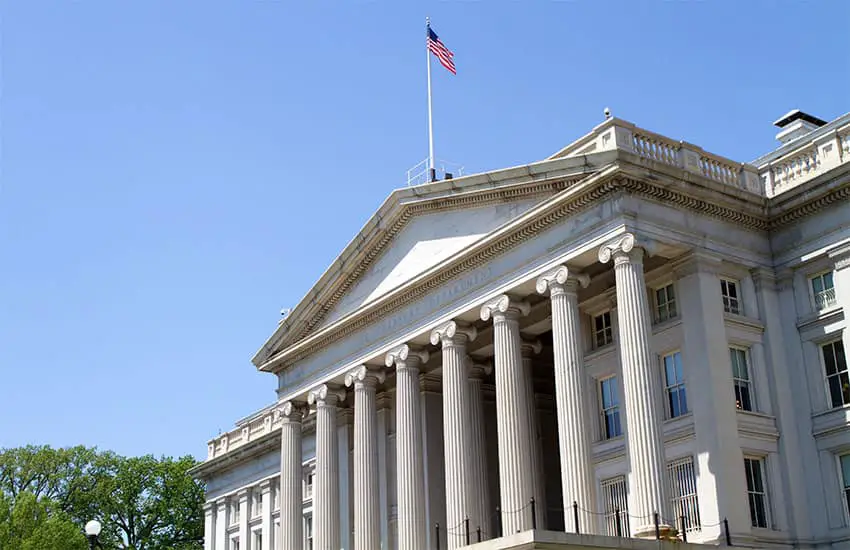
The U.S. Department of the Treasury (UST) said in a statement Wednesday that its Office of Foreign Assets Control (OFAC) had designated the Valenzuela DTO and its presumed leader Juan Francisco Valenzuela Valenzuela in accordance with a 2021 executive order — “Imposing Sanctions on Foreign Persons Involved in the Global Illicit Drug Trade.”
OFAC also designated “two Mexican nationals and Valenzuela DTO members, Héctor Alfonso Araujo Peralta and Raúl Rivas Chaires, as well as three Mexico-based transportation companies … for having engaged in, or attempted to engage in, activities or transactions that have materially contributed to, or pose a significant risk of materially contributing to, the international proliferation of illicit drugs or their means of production,” UST said.
The department said that the Valenzuela DTO was originally established as a transportation cell but evolved into a “sophistical network that became invaluable to Sinaloa Cartel leadership.”
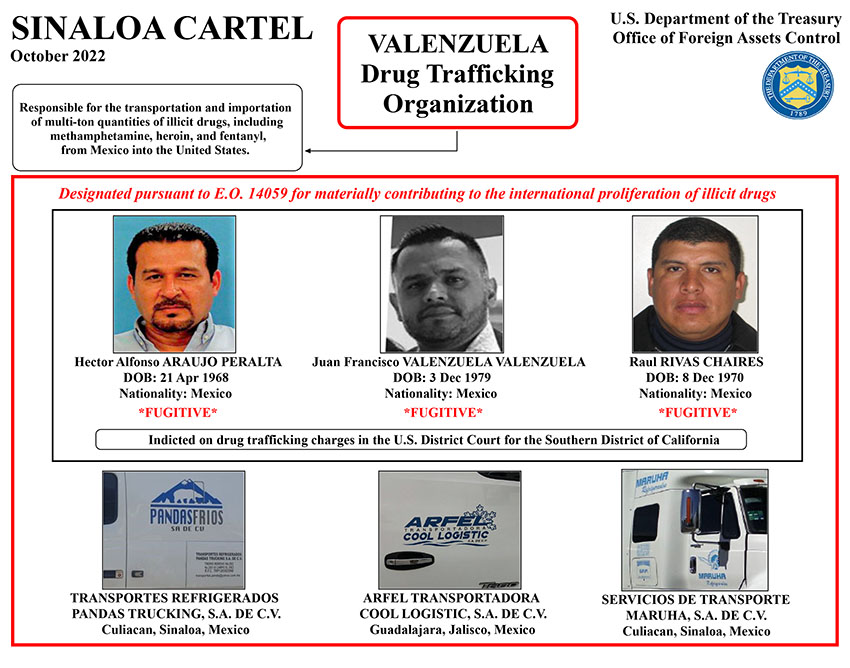
It said the organization was run by three Valenzuela siblings but Juan Francisco is “the last remaining sibling involved” due to the arrest of his brother and sister by U.S. authorities in 2020 and 2021, respectively.
UST said that “under the umbrella of the Sinaloa Cartel, the Valenzuela DTO is involved in the importation and transport of multi-ton quantities of illicit drugs, including methamphetamine, heroin and fentanyl, from Mexico to the United States.”
Juan Francisco Valenzuela, Araujo and Rivas all face trafficking charges in the U.S. but remain at large.

As a result of the sanctions imposed Wednesday, “all property and interests in property of the designated individuals and entities that are in the United States or in the possession or control of U.S. persons must be blocked and reported to OFAC,” UST said.
It also said that “persons that engage in certain transactions with the individuals and entities designated today may themselves be exposed to sanctions or subject to an enforcement action.”
“… Today’s action is part of a whole-of-government effort to counter the global threat posed by the trafficking of illicit drugs into the United States that causes the deaths of tens of thousands of Americans annually, as well as countless more non-fatal overdoses,” UST said.
Brian E. Nelson, undersecretary of UST’s Office of Terrorism and Financial Intelligence, said that the Valenzuela DTO “fuels the ongoing drug epidemic we face in the United States.”
“… Starving this network of resources will help deprive the Sinaloa Cartel of critical support it needs to traffic its dangerous illicit drugs,” he said.
Formerly led by imprisoned drug lord Joaquín “El Chapo” Guzmán, the Sinaloa Cartel is one of Mexico’s two most powerful criminal organizations, the other being the Jalisco New Generation Cartel (CJNG)
Texas Governor Greg Abbott last month designated both cartels as terrorist organizations.
Mexico News Daily