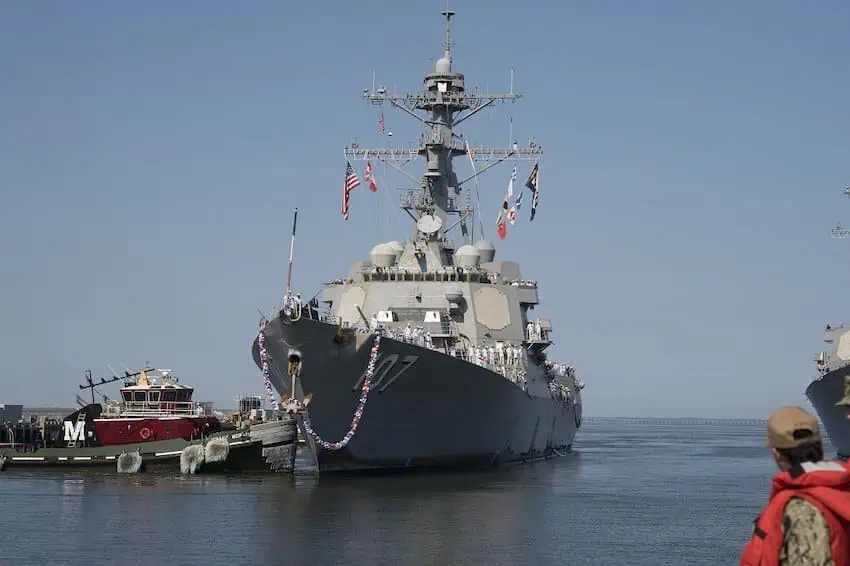
A U.S. Navy warship was deployed to the Mexico-United States border to counter illegal immigration, drug and weapons trafficking, as well as transnational crime, the Pentagon announced on Monday.
The USS Gravely departed Naval Weapons Station Yorktown, Virginia, on Saturday, embarking with a U.S. Coast Guard law enforcement detachment (LEDET) with orders to participate in operations within U.S. and international waters, according to a U.S. Department of Defense press release.
La presidenta @Claudiashein aclaró que el despliegue del buque destructor estadounidense USS Gravely en el Golfo de México tiene como objetivo vigilar aguas internacionales y aseguró que esta acción “no es contra México”. pic.twitter.com/W28xK0fXV4
— La Crónica de Hoy (@LaCronicaDeHoy) March 18, 2025
On Tuesday, Mexican President Claudia Sheinbaum said the U.S. government had informed her of the operation before the Gravely set sail. She said the U.S. warship will not enter Mexican waters and will adhere to international navigation regulations.
“[The U.S.] is within its rights to do this,” she said. “It would have been bad if they had not advised us or if they entered national waters … but this is not an attack on Mexico.”
The U.S. Department of Defense described the move as a significant shift in its approach to border control, giving the U.S. Navy a direct role in stopping threats before they reach U.S. shores.

The Gravely — an Arleigh Burke-class guided missile destroyer — previously served in the Red Seas in the Middle East, tasked with shooting down missiles fired by Houthi rebels.
“The deployment of Gravely marks a vital enhancement to our nation’s border security framework,” Admiral Daryl Caudle of the U.S. Naval Forces Northern Command, said.
According to a U.S. Navy press release, the warship is heading to the waters off the U.S. Gulf Coast as part of the military’s response to U.S. President Donald Trump’s executive order and national emergency declaration to secure the nation’s border with Mexico.
#México El Pentágono ha desplegado el destructor USS Gravely, equipado con misiles Tomahawk, al Golfo de México para labores antinarcóticos, según confirmó el general Alexus G. Grynkewich, director de operaciones del Estado Mayor Conjunto. pic.twitter.com/aKuWJQmfZ9
— Gildo Garza (@GildoGarzaMx) March 18, 2025
Pentagon spokesperson Sean Parnell said Monday that the goal is to achieve “100% operational control” over the United States’ southern borders, adding that “the naval presence is part of the mission of the USS Gravely to secure maritime routes and defend our southern borders.”
Lt. Gen. Alex Grynkewich, the operations boss for the Joint Staff, who was briefing alongside Parnell, said that the ship will “be involved in the interdiction mission for any of the drugs and whatnot that are heading in.”
Pentagon officials did not offer details as to why a Navy destroyer, and not a Coast Guard cutter, was chosen for the mission, especially after U.S. Defense Secretary Pete Hegseth said he wouldn’t rule out conducting air strikes over Mexico.
The Arleigh Burke-class of destroyer features an Aegis Combat System and is able to conduct anti-aircraft warfare with surface-to-air missiles, tactical land strikes with Tomahawk missiles, anti-submarine warfare and anti-surface warfare with ship-to-ship missiles and guns. In all, these destroyers can carry up to 96 missiles.
The deployment of the Gravely is designed to provide support to the thousands of active-duty U.S. troops ordered to the U.S.-Mexico border since Trump took office on Jan. 20. Nearly 10,000 U.S. service members are scheduled to be deployed at the border, according to U.S. Northern Command.
With reports from NPR, El Financiero, El Universal and Military.com