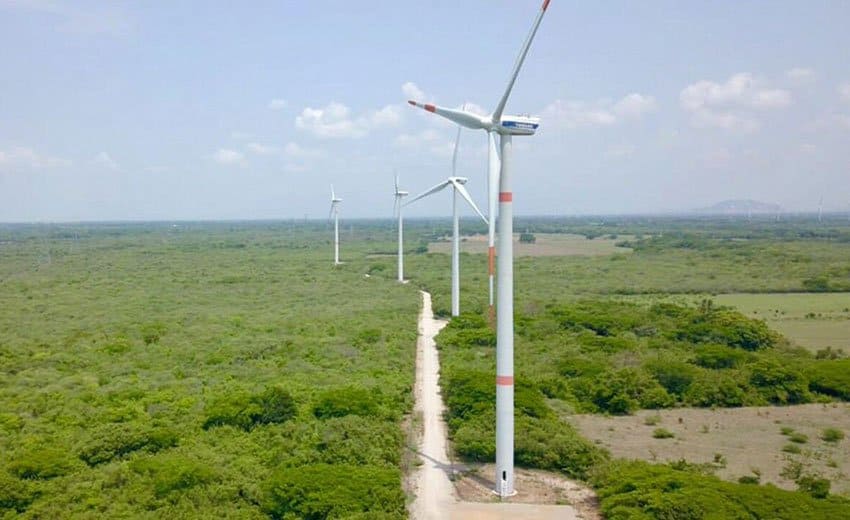
New 132-turbine Oaxaca wind farm is largest in Latin America

After years of negotiations and $1.2 billion in investment, the Energía Eólica del Sur wind farm has opened in the Isthmus of Tehuantepec, Oaxaca.

The new farm is the largest in Latin America, with 132 wind turbines and a total capacity of 396 megawatts. It covers 5,000 hectares in the municipalities of Juchitán and El Espinal.

Built by the Mitsubishi corporation, the wind farm could keep 567,000 tonnes of carbon dioxide out of the atmosphere every year, the equivalent of taking 300,000 cars out of circulation and planting 12 million trees.

It is the newest of 28 farms in the state, all of which are located in the windy Isthmus of Tehuantepec region, which generates 62% of Mexico’s wind energy.

In an inauguration ceremony, Oaxaca Governor Alejandro Murat said the project will help develop the state and make electricity cheaper.

“We’re sending a message that here in Oaxaca there are conditions to develop the state, conditions for companies like Mitsubishi to make investments,” he said.

The Institutional Revolutionary Party governor thanked President López Obrador for supporting the project and other development projects in Oaxaca, including a new gas pipeline and an improved rail line to connect the Gulf of Mexico to the Pacific Ocean.

The Energía Eólica del Sur farm was approved in a consultation of nearby indigenous populations between 2014 and 2015, although national and international organizations criticized the consultation, saying it did not comply with international law on indigenous consultations.

One group of indigenous Zapotecs sued Energía Eólica del Sur, arguing that their right to prior consultation under international law had been violated because the consultation took place after construction had already started.

The Supreme Court initially ruled in favor of the Zapotec community, ordering construction to be temporarily suspended. However, the court later allowed the project to go ahead.

Source: El Universal (sp), El Sol de México (sp)

Have something to say? Paid Subscribers get all access to make & read comments.
Brush fires from afar in Puerto Vallarta/Bahía de Banderas

Brush fires mostly contained in Bahía de Banderas

0
Brush fires that broke out Sunday in Lago Real and Bucerías have been extinguished; however, emergency crews are still working to control hot spots in La Cruz de Huanacaxtle.
Manzanillo, Colima, México, 13 de marzo de 2026. La doctora Claudia Sheinbaum Pardo, presidenta Constitucional de los Estados Unidos Mexicanos en conferencia de prensa matutina, “Conferencia del Pueblo” desde Colima. La acompañan Indira Vizcaíno Silva, gobernadora Constitucional del Estado de Colima; Omar García Harfuch, secretario de Seguridad y Protección Ciudadana (SSPC); Raymundo Pedro Morales Ángeles, secretario de Marina (Semar); Bulmaro Juárez Pérez, divulgador de lenguas originarias, presentador de la sección “Suave Patria”; Ricardo Trevilla Trejo, secretario de la Defensa Nacional (Sedena); Jesús Antonio Esteva Medina, secretario de Infraestructura, Comunicaciones y Transportes; Bryant Alejandro García Ramírez, fiscal general del Estado de Colima; Fabián Ricardo Gómez Calcáneo; Rocío Bárcena Molina, subsecretaria de Desarrollo Democrático, Participación Social y Asuntos Religiosos de la Secretaría de Gobernación; Efraín Morales López, director general de la Comisión Nacional del Agua (Conagua); Marcela Figueroa Franco, secretaria ejecutiva del Sistema Nacional de Seguridad Pública (SESNSP) y Guillermo Briseño Lobera, comandante de la Guardia Nacional (GN). Foto: Saúl López / Presidencia

Mexico’s week in review: Congress deals Sheinbaum her first legislative defeat

1
The week of March 9 in Mexico was marked by standoffs between allies in Congress and adversaries at the airport. Here's what you missed.
A soldier displays seized handguns

The US and Mexico, growing together and growing apart: A perspective from our CEO

1
From a historic drop in homicides to opposite bets on electric vehicles, Mexico News Daily's CEO breaks down where the U.S. and Mexico are converging — and where they're not.
BETA Version - Powered by Perplexity