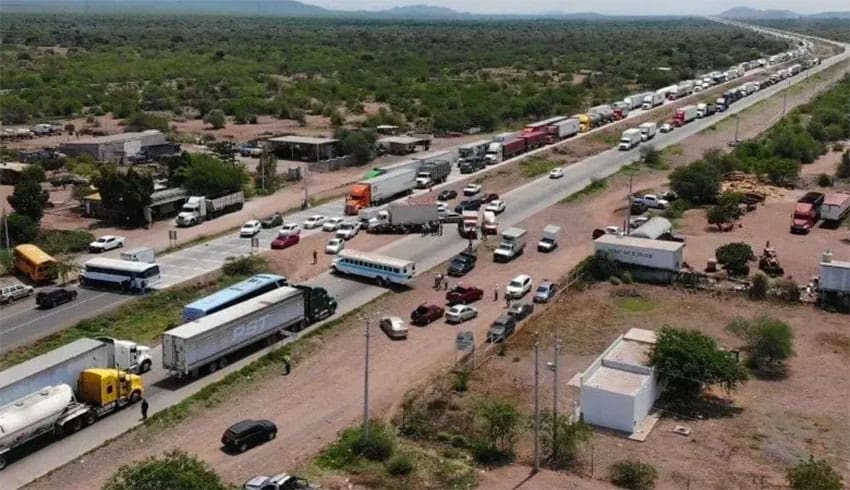
Indigenous Yaqui people in Sonora continue to block a rail line and federal Highway 15 despite a federally-brokered agreement in late July.
The blockades are affecting Mexican exports to the United States and generating millions of pesos in losses, said an industry organization.
Residents of one of eight Yaqui towns have mounted two roadblocks on the section of the highway that connects Ciudad Obregón with Guaymas and placed obstacles on train tracks connecting Nogales, Sonora, to Nogales, Arizona.
The Yaqui people are demanding that the government compensate them for ceding land for the construction of a range of infrastructure projects and fulfill commitments for the social development of its eight towns: Cócorit, Bácum, Vícam, Pótam, Tórim, Huírivis, Ráhum and Belem.
The current railroad blockade in the community of Vícam, between Ciudad Obregón and Guaymas, began on August 5.
A first railway blockade in July was briefly lifted after President López Obrador met with Yaqui representatives and pledged to create a justice commission that will be responsible for returning expropriated land, delivering basic services and rerouting a gas line.
In addition, he said he will offer a public apology on behalf of the Mexican government for historical abuses that the Yaquis have suffered.

But for those leading the protests, the president didn’t go far enough.
The blockade of the railway, in particular, is affecting trade with the United States, Confederation of Industrial Chambers (Concamin) president Felipe Peña explained, as cargo shipments must be offloaded and transferred to trucks, generating significant cost overruns.
Peña said 2,176 train cars were stranded with 87 million pesos (US $3.96 million) worth of grain, 284 million pesos (US $12.9 million) worth of auto parts, 64 million pesos (US $2.9 million) worth of consumer products and 126 million pesos (US $5.7 million) of supplies for the beer industry.
“There are more than 83,500 tonnes of materials, supplies and merchandise detained by this blockade, with direct economic losses of more than 45 million pesos for the transportation service, without considering the even greater economic effects for industries and businesses that use the freight train service,” Peña stated.
With the school year set to start August 24, education is also being affected.
The delivery of 79,000 free textbooks to primary schools in Sonora is being held up by the protesters, the Mexican Railway Association (AMF) said.
The highway blockade, meanwhile, turned violent on Wednesday.
A video has surfaced of several Yaqui protesters climbing into the cab of a truck and beating the driver for allegedly refusing to pay a toll.
Yaqui leaders say the video is misleading.
Juan Luis Mátuz González, captain of the traditional guard of the Yaqui ethnic group, said it was the driver who was the aggressor when he tried to ram a crowd of protesters and hit one of their vehicles. According to his version of events, members of the tribe climbed into his truck to take his keys when he attacked them with a bat. The Yaqui protesters then extracted him from the cab, subdued the man and gave him sugared water to calm him down.
The company that employs the injured driver, Transportes Barceló from Ciudad Obregón, has announced it will file a lawsuit against the tribe.
The Yaqui protesters are demanding a 150-peso (US $6.82) toll from vehicles traveling through the highway blockades in Vícam and Danzante.
Source: Reforma (sp), El Universal (sp), Sin Embargo (sp), Milenio (sp)