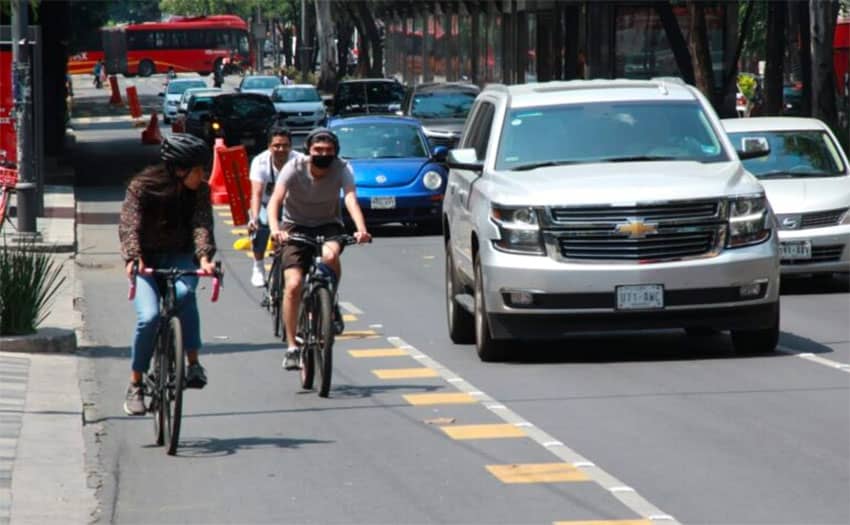
Avenida de los Insurgentes runs for nearly 30 kilometers through Mexico City and although I’ll go almost anywhere on my bicycle to avoid the capital’s often insane congestion, I usually try to avoid it.
Jostling for space among the cars and trucks crammed into the two carriageways — there is a dedicated bus lane down the middle of the road — requires nerve-fraying dodging and too many stops and starts for someone whose patience is tested to the extreme by being stuck in traffic.
But since June, cyclists have had much of the key north-south city route all to themselves as the capital’s government, like many around the world, has rolled out emergency bike lanes to encourage safe, socially distant travel during Covid-19.
Already, the number of cyclists on the 54 kilometers of new paths down major arteries has doubled, amid ambitious goals to put cycling on the map for residents of a metropolis where you could knit nine sweaters or read Marcel Proust’s Remembrance of Things Past nearly one and a half times in the hours people spend stuck in rush hour traffic every year.
With more than 252,000 bike trips a day, according to the city government — only 2% of total journeys made in the city — the Mexican capital has further to go than most other major cities that have expanded their cycling networks during Covid. But in the past six weeks, nearly 5,000 cyclists have tried pedal power on the Insurgentes emergency cycle paths, despite Mexico City’s worrisome pollution and the fact that last year it ranked 80th out of 90 cities in an annual international survey of cycle friendliness. On a path on another major artery, cycle use has risen 64%.
Covid cases and deaths are still on the rise in the city. But the economy is fast opening up, and the center is thronged despite attempts to restrict access, making cycling increasingly appealing. But even pre-coronavirus, bicycles were on the city government’s radar as it planned to make one of the world’s most congested cities greener and cleaner.
Mayor Claudia Sheinbaum, a climate change expert close to President López Obrador and seen as a likely future presidential candidate, has unveiled plans to install solar panels on the roofs of 300 public buildings under a program dubbed “sun city.”

The capital’s emblematic Chapultepec park is also being expanded. A bike and pedestrian “floating path” will link sections now separated by traffic-jammed roads under a master plan designed by Gabriel Orozco, one of Mexico’s most acclaimed living artists.
Despite the volume of cars, 80% of journeys in Mexico City are made on public transport — which ranges from a dingy and limited metro service to creaking pesero minibuses, to modern double-deckers and new electric trolley buses.
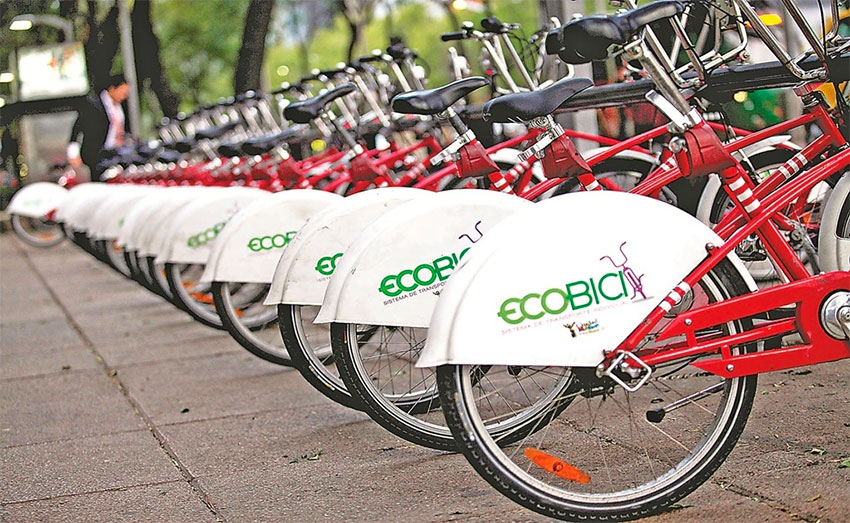
The city government sees bicycles as an extension of public transport — something many posh Mexicans wrinkle their noses at. It is rolling out Ecobici, Latin America’s biggest bike-sharing system, beyond its existing 38-square-kilometer reach and putting stations outside metro stops. By 2024, it aims to have 600 kilometers of cycle paths and to have more than doubled bike use from pre-Covid levels.
Bike-sharing should have been a no-brainer in Mexico City — it is largely flat and the weather is mostly good. But poor air quality, safety fears and the size of the city put a brake on things until Ecobici was launched in 2010. The service now has more than 330,000 registered users in the city.
Last year, Mexico City built 98 kilometers of cycle paths, and even before Covid another 70 kilometers were planned. City Transport Minister Andrés Lajous — himself a cyclist — put a bike lane down the central reservation of Reforma, another major avenue, saving cyclists from having to take their chances alongside buses that honk loudly but rarely slow down.
Will cycling stick once Covid abates? For many, the sheer distance of their commute means it is unlikely to replace other means of transport entirely; as one Twitter commentator put it “idiots, Mexico City isn’t designed for bikes.”
But Lajous is upbeat, likening cycling to the mass adoption of Zoom meetings — available and widely overlooked before the pandemic, but now essential. “People are changing their transport habits,” he said.
© 2020 The Financial Times Ltd. All rights reserved. Please do not copy and paste FT articles and redistribute by email or post to the web.