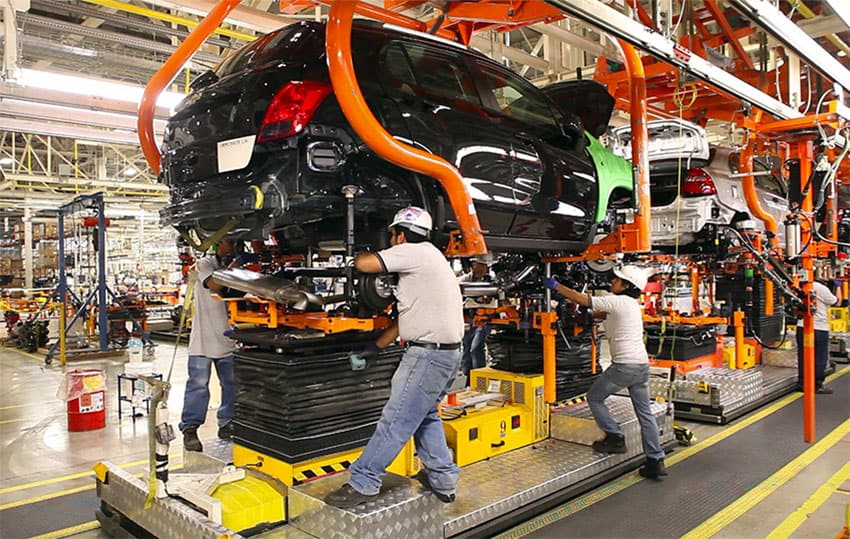
From its silver mines of the 1500s to its modern high-tech factories, Mexico’s central Bajío region has long been a success story.
Georgetown University historian John Tutino credits it with fostering global capitalism by helping meet China’s demand for silver from the 16th century and as Mexico’s pre-eminent manufacturing region, it has enjoyed growth rates more than twice the national average for the past 20 years.
But even before Covid-19, the Bajío — spanning the states of Querétaro, Guanajuato, San Luis Potosí, Aguascalientes and part of Michoacán — was seeing that stellar growth evaporate. Instead of average annual expansion of 4% to 5%, most of the region’s economy shrank in 2019-2020.
Business people partly blame President López Obrador’s policies that they say are investor-unfriendly. They cite the cancellation of a partially built airport in Mexico City and a U.S.-owned brewery project in Mexicali as well as abrupt changes to energy rules to favour state companies.
Claudia Jañez, president of Mexico’s Executive Council of Global Businesses, last year complained that the uncertainty was making it increasingly difficult for companies to persuade their head offices to invest in Latin America’s second-biggest economy.
The Bajío has felt the uncertainty. Department store Liverpool had been planning to move back-office operations to Michoacán, where it has a call center, “but national politics put the brakes on that,” said Javier Olavarrieta, commercial director of the developer Grupo Tres Marías.
Add in rising violence — the state of Guanajuato is the murder capital of Mexico, with homicide levels nearly four times the national average — and the outlook for a region which concentrates more than a quarter of Mexico’s manufacturing GDP is looking considerably less bright than in the past.

Local business leaders have decided it is time to step up — the region accounts for nearly a tenth of national GDP, so a vibrant Bajío is good for everyone.
After López Obrador scrapped Mexico’s investment promotion agency to save money after taking power in 2018, “we thought we had to be more aggressive, from the private sector,” said Marcelo López, a former economic development secretary in Querétaro. He helped pioneer the state’s development as an aeronautics hub, now home to Airbus, Bombardier and Safran. “We want to be proud of this region again,” he said.
Federico Quinzaños, a marketing specialist behind a string of successful tourism campaigns, including the “Mexican Caribbean” logo, came up with a plan to unite the private sector and rebrand the region “The Great Bajío” “to propel it towards the future and towards the world.”
Free trade with the U.S. and Canada, updated in the USMCA trade pact, has long given the Bajío a pivotal role in North American supply chains, such as in the auto sector, where it boasts a dozen car plants including Ford, General Motors, Nissan, Volkswagen, Toyota, BMW and Honda. The Bajío also churns out 4 million Gilette razors a day and three-quarters of the broccoli eaten in the U.S., according to Luis Hernández, economy secretary of Irapuato in the state of Guanajuato.
Locals now want to develop it further as a hub for information technology and biotech.
“We’ve just established three big data centers in our developments,” said Francisco Estrada, vice president of Vesta, Mexico’s leading provider of industrial parks, who added that he was seeing “exponential growth” in logistics and e-commerce in the Bajío.
But Diego Bocard, whose Grupo Argo is one of the major industrial parks suppliers in San Luis Potosí, said: “I’d venture to say that we’re still in diapers when it comes to logistics and data centers.”
Estrada saw evidence that reshoring from China, spurred by global trade tensions and the coronavirus pandemic, was also starting. And Bocard noted that while reshorers naturally wanted to be close to the U.S. border, the cost of acquiring land and rents “is much cheaper in the Bajío.”
With about 90% of lost pandemic jobs now recovered, the region is beginning to bounce back.
Midterm elections on June 6 could complicate the picture by boosting uncertainty: a strong showing could embolden the populist López Obrador; a poor one might prompt him to mount legal challenges to the results.
“However, I think we have to look at this as we did 30 years ago — for the long term,” said Hernández. “What we have built won’t disappear overnight and U.S. growth is going to create more opportunities.”
© 2021 The Financial Times Ltd. All rights reserved. Please do not copy and paste FT articles and redistribute by email or post to the web.