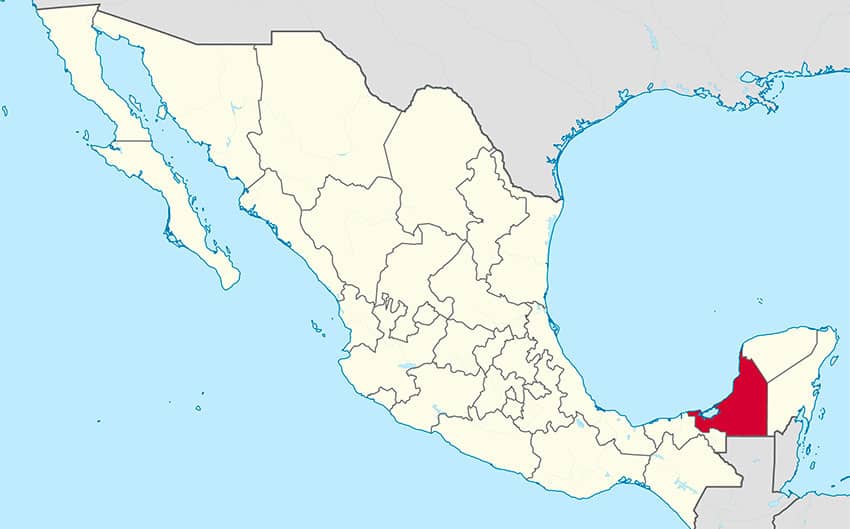
Bordered by the Petén department of Guatemala to the south, Quintana Roo to the east, Yucatán to the north and Tabasco to the west, the little known state of Campeche in the southeast of Mexico became the first in the country to be awarded the “yellow light” for coronavirus measures.
Compared to other Mexican states, Campeche is one of the least populous and most sparsely settled, with the majority of the population residing in urban areas and a significant minority of indigenous Maya continuing to inhabit traditional villages across the state.
Much of the rest of the territory is tropical evergreen rainforest, including the southern jungle, which is the largest contiguous rainforest in the Americas after the Amazon.
Campeche experiences a relative isolation, evidenced in low levels of inter-state movement, and minuscule international exchange. It remains, in fact, relatively untouched by tourism, especially when compared to the rest of the Yucatán peninsula.
As such, though not an island in the literal sense, it exhibits many of the characteristics of an island economy. Indeed, its relative isolation from broader Mexican society is nothing new, with a history of secession from the state of Yucatán in 1857 after a civil war.
Throughout living memory, these unique socio-historical conditions have been Campeche’s reality, and in a quirk of fate, they are also what has allowed the state to emerge relatively unscathed from the pandemic. The state’s belligerent independence, alongside its geographical location, has not only given Campeche an advantage in dealing with Covid-19, but has also meant that the territory regularly features as one of Mexico’s safest. The downside of this is a ubiquitous presence among the poorest performing regional economies in the country.
Given all this, it is little surprise that it is the state of Campeche which has been the first to go yellow on the federal government’s coronavirus stoplight risk map. Comprising four stoplight levels — red, orange, yellow, and green — the epidemiological alert system ranks the states according to health risks and determines the level of economic reopening allowed in a region.

The state has around 900,000 inhabitants, with 5,713 confirmed cases and 769 deaths (as of September 7), and the rate of infection has been significantly below the national average. In addition, in the early stages of the pandemic a significant proportion of the infections in the state occurred offshore and in the petroleum hub of Cuidad del Carmen, with offshore workers at the center of these transmissions, and these figures were only latterly added to official state statistics.
On the surface, the yellow light announcement may be seen as a piece of much needed good news among a slew of bad tidings and figures denoting infections and fatalities. However, it bears consideration that, though Campeche has temporarily sidestepped the worst of the pandemic, in many ways the yellow light acts as a smokescreen for a number of other socio-political issues ongoing in the region.
In a country renowned for excessive and obstructive bureaucracy, Campeche remains one of the most expensive states in Mexico within which to do business and this, in due course, hinders social fluidity and economic growth on both an individual and a community level. Moreover, rural communities in Campeche suffer from many of the structural inequalities inherent in the Mexican governmental system, which leave them isolated and with reduced access to infrastructure.
Even in recent months, the ongoing issue of the Maya Train has highlighted the state’s disregard for the needs of secluded communities; in April, the Tres Colonias de Campeche Collective, made up of residents of Camino Real, La Ermita and Santa Lucía in Campeche, presented an injunction against the process to evict them for inhabiting the tracks that would be used for the project. The injunction was not heard, with the pandemic cited as the reason for its being disregarded, effectively denying residents their constitutional right to access justice.
The yellow light, then, heralds a mixed blessing for Campeche. A glance under the surface of the Covid-19 response reveals the underlying marginalization of an entire state by the federal government, and with the rest of the country remaining tightly restricted, economic and social iniquities are amplifying with every passing day. The conclusion that Campeche is in essence an outlier state is an obvious and necessary conclusion to existing contexts — even its cuisine is far removed from that of the greater Mexican norm.
Conversely, the immediate impact of the risk classification cannot be understated. Though it goes without saying that, as is the case across the globe, the number of confirmed cases is an under-estimation of how many actual cases there have been, the moderate risk rating allows more businesses in Campeche to reopen, albeit to varying extents.
Despite the economic issues underlying Campeche’s success in controlling the virus, for many families across the state, for whom a lost day’s work can mean a lost meal on the table, the easing of lockdown restrictions will greatly ease the economic burden of the coronavirus. Moreover, rural communities are most likely to be disproportionately harmed by the downturn of the economy and a failure of supply chains due to the attendant economic implosion in evidence across the country.
Ultimately, island nations such as Palau and New Zealand, and their land-based imitations in places such as Campeche, are those most likely to have avoided the horrifying statistics which have devastated much of Latin America, and indeed the world.
But be careful for what you wish for, because most certainly before the pandemic, and undoubtedly long after it is gone, the likes of this unique little southern state will continue to feel more like a personal fiefdom than a territory which is part of a federal alliance.