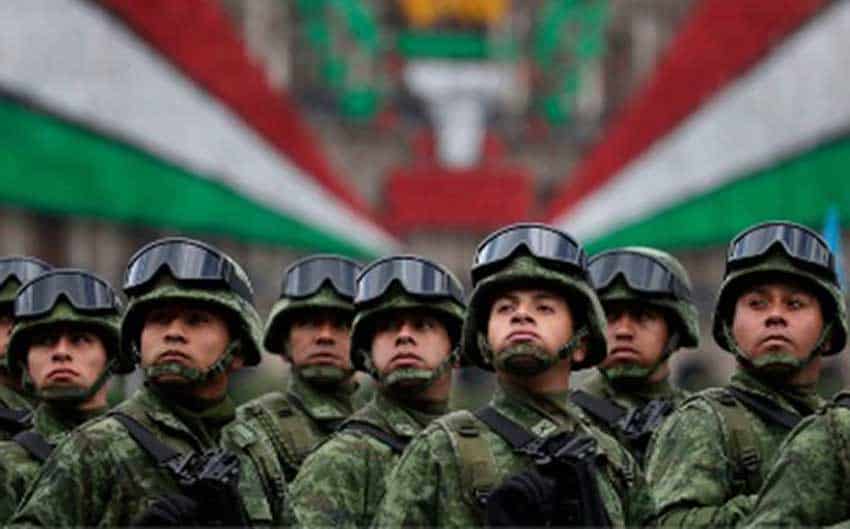
Mexico’s new national guard is another step closer to taking up arms, but the logic behind the agency’s creation and its potential for improving the nation’s security remain uncertain.
On March 13, the state legislature of Yucatán approved a constitutional reform creating the national guard, one of President Andrés Manuel López Obrador’s signature security policies. With that vote, each of the 32 states has approved the new police force, making its creation all but certain.
These votes follow the February passage of legislation in both houses of Congress that established the legal basis for the 60,000-member national guard. The López Obrador administration has allocated $767 million to fund the guard’s first year of operations, and it is proceeding with plans to build 87 bases for the new service.
The basic idea behind the creation of the national guard is to establish an alternative to the military in the fight against organized crime in Mexico. The role of the force also emphasizes citizen security.
But the new force is not a clean break from the militarized approach of the past 12 years. The national guard will initially be populated by veterans of the Mexican military and Federal Police, and though it operates under the civilian Secretariat of Security and Citizen Protection, it may be headed by a military officer.
The national guard is also coordinating closely with the army as it builds capacity. Its personnel will initially occupy army barracks as the government builds separate infrastructure. The army is also aiding in the national guard’s recruitment efforts, and the army has justified a buildup of military hardware on the basis that it will be needed to support the new national guard.
InSight Crime analysis
The national guard’s creation has sparked two related critiques within Mexico.

The first is that the national guard is a betrayal of López Obrador’s promises to deescalate the war on drugs. A man who campaigned on the slogan of “hugs not bullets” and who ridiculed the idea of “fighting fire with fire” has now made permanent the participation of a quasi-military body in domestic security.
Critics also warn that the staffing of the new force with former soldiers means that it will not be immune to the abuses characterizing military deployments, such as those seen in a scandal like the Tlatlaya massacre.
Other security policies of López Obrador also stray from true security reform. For instance, Mexico’s Congress recently voted to increase the number of crimes for which people can be held in pre-trial detention. This controversial practice is already responsible for nearly half of the nation’s prison population, and the new law promises to further boost the number of Mexicans behind bars.
Meanwhile, López Obrador’s initial budget reduces spending on the prison system by 26%, despite widespread sentiment that the poor state of the nation’s penitentiaries spurs crime.
The second major criticism is that there is nothing sufficiently different about the national guard to justify the effort and expense of creating this new agency.
Past presidential administrations, promising to revolutionize the fight against organization crime, have enacted similar sweeping institutional reforms of federal police bodies. Vicente Fox created the Federal Investigative Agency, which was to be the FBI of Mexico. Enrique Peña Nieto created the ill-defined Gendarmerie.
None of these forces had an appreciable impact on security. In fairness, this is largely because the new forces are often radically reshaped or eliminated once a new administration takes office.
López Obrador’s own words also do little to clarify the role of the new force. He recently compared the national guard to the blue-helmeted peacekeepers of the United Nations. Similarly, in a November interview shortly after the new agency was announced, he said that the National Guard was meant to “guarantee peace,” though he did not describe how it would do so.
In December, amid growing criticism, he sounded similar notes: “We are proposing . . . the national guard because we want to guarantee peace and tranquility, that there be no violence.”
At no point in his justifications has he given insights on how exactly the new force will contribute to a safer and more peaceful Mexico. Yet the nation finds itself on the precipice of another costly institutional reform, with the government asking voters to put its faith in another new uniform.
Reprinted from InSight Crime. Patrick Corcoran is a contributing writer for InSight Crime, a foundation dedicated to the study of organized crime.