In this unprecedented time of fear and economic fallout, borders have been closed and nations are taking extreme measures to battle the spread of Covid-19.
This is my first time witnessing a world crisis on this scale from outside the United States. The other week, this headline caught my eye: “Mexico cannot afford to close its border with the U.S.” This country simply cannot survive without goods crossing the border.
And, despite having fewer coronavirus cases than the United States, stopping all Americans from entering Mexico is also not a viable economic option.
But as a U.S. citizen, living in a country that cannot afford to take the same precautions as wealthier nations during a pandemic, I am reminded of not only the privilege I unconsciously take for granted, but also the economic reality of a country with fewer options available to it.
Headlines that talk about when U.S. citizens will be receiving their stimulus checks now strike me as a luxury. You can be certain that the Mexican government will not be mailing its citizens checks to cover their financial losses.
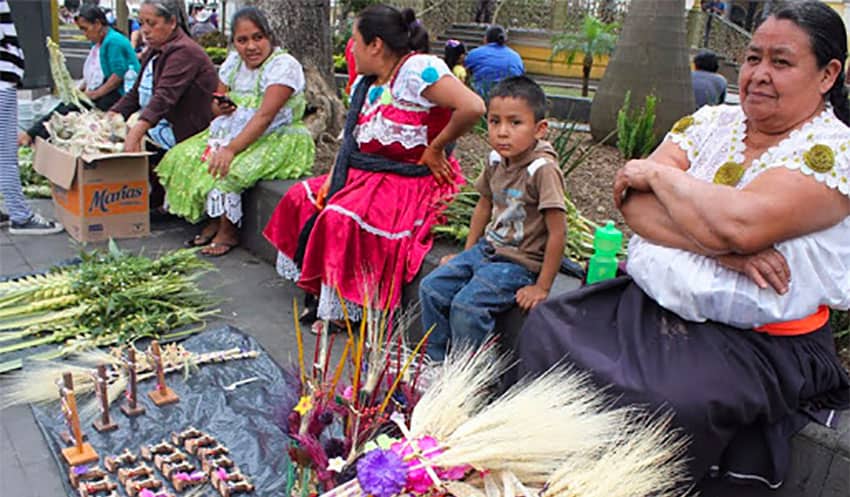
Yesterday, in the midst of walking down the street and spraying sanitizer on my hands, I passed a man sitting on the sidewalk and weaving mesh seats for chairs. The visual contrast between the two of us hit like a ton of bricks. Here I was, spraying hand sanitizer, fixated on germs and obsessing over the precautions people take when they have the resources and time to think beyond just daily survival. And here this man was, weaving chairs and hoping to sell enough of them to scrape by for that day.
I have no idea if the virus was on his radar at all. And if so, if it even mattered, given the necessity of needing to sell chairs to have enough money to buy food. Potential devastation is great for the poorest of the poor in Mexico’s small towns. They are some of the people who could be hit the hardest, in every possible way, by this pandemic.

The Mexicans I talk to have told me that the people here are generally worried about other things — economic uncertainty, loss of income, and violence — much more than the virus itself. Getting sick does not top their lists. The fixation on health is indeed a luxury of the upper classes.
Of course, health is directly related to people’s ability to work and to the economy. But you need a certain level of secure resources in order to give the full scope of your attention to warding off germs, monitoring how your body feels, and practicing the encouraged norm of social distancing.
Yet my experience of the Mexican people thus far is that, despite their country’s more precarious economic reality, they are exhibiting greater levels of peace than my American counterparts. There is a tangible sense of well-being in the Mexican culture, even in the midst of very real and difficult troubles. This is linked, at least partially, to an overall greater acceptance of life, including both illness and death.
There is less of a sense of self-preservation here than in the States. And I’m discovering that when there is less emphasis placed on self-preservation, there is less to be anxious about. Simply put, there is less to defend.
These cultural contrasts highlight a paradoxical connection between resources, wealth, and inner well-being. It seems that the more we have to defend, the more anxiety, stress, and intensity we will experience in defending it.
So as we continue to navigate our way through fearful media reports fixating on stock market losses, job losses, and other uncertainties that concern those who already possess quite a bit, let us not forget that entrenched privilege still rears its head in times of crisis and offers greater protection to some and not to others.
Let us be aware of the have-nots in our midst, whether in Mexico, the U.S., or around the globe, and work with greater urgency to address experiences of inequality. For compassion and care for all is the only way to move towards a truly healed planet and a more just world.
Karen Kinney is an artist and writer based in Los Angeles and San Miguel de Allende.