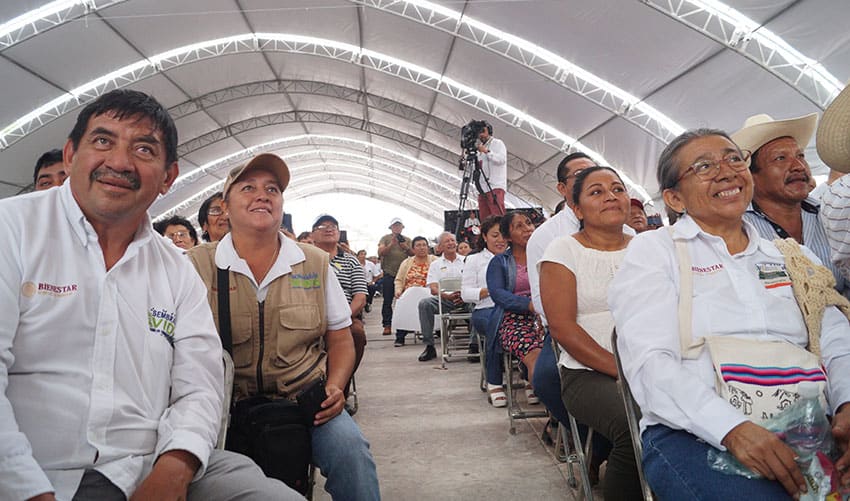
On Saturday, in just one of many similar appearances we can expect in the coming months, President López Obrador took the stage in Campeche’s capital, one of the cities due to be affected by his pre-emptive legacy project, the Maya Train.
Although he is a universally popular president across Mexico at a time when disdain and even disgust toward the political class in Latin America is at an all-time high, a question mark hung over his visit to Campeche, a state and city split by the implications of a revolutionary train network unifying the southeastern communities.
He needn’t have worried. A 20-meter walk to the stage from the motorcade took the same number of minutes, punctuated by praise-singing loyalists eager to meet his eye and shake his hand.
Amid the extensive jubilation you may be forgiven for walking away believing that AMLO’s train project lacks the contention needed to justify a presidential tour of the Yucatán. Banners declaring “Campeche with AMLO,” “Yes to the Maya Train” and “We are with you” may just about manage to obscure the groups beyond the awning — groups with concerns that aren’t as lyrical as those of the yay-sayers or perhaps just too long to fit on their banners.
The Maya Train, a project devised by Mexico’s leftist, pragmatic and socially minded president as a way of unifying the Yucatán, leveraging coastal tourism inland and connecting communities across the region, may not be as one-nation as we are led to believe.
Tensions forged in the ever-growing milieu of emotion have been heard and dismissed just as quickly as they’ve been voiced. Indigenous communities, most recently those from Calakmul and Xpujil, have been speaking against what they see as a wedge being driven through their semi-autonomous, traditionally maintained towns and villages. Fonatur (the National Tourism Promotion Fund) brushed off that claim as “not indigenous communities complaining but just a small group of people that are trying to oppose the project.”
The same is true of those protesting in the shadow of the project’s ecological impact. Researchers, standing on the shoulders of conservationists, agricultural workers, and residents of Mexico’s vast jungles, have claimed the Maya Train will be an “environmental crime.” That accusation was seemingly considered through a number of consultations throughout December in the Yucatán, but when images of construction were concurrently leaked it became hard for residents to see them as anything other than coy rhetoric.

This could be considered the most problematic aspect of the project. Whether the train will devastate the region ecologically or not, whether communities will be displaced, whether tourism will benefit or shake the inland towns, all will become moot if residents of the Yucatán doubt that the conversation is being had in anything other than a meaningful way.
Two “referendums” in tandem with his astronomical polling averages have been AMLO’s mandate and his springboard but both have been plagued with controversy over legitimacy and breadth. In the new year, for AMLO to be able to endorse the Maya Train with a clear and open conscience he’ll have to create a dialogue that not only debates the hard truths of his infrastructural reform, but convinces the people it affects that the conclusion is not already carved in stone.
It’s hard to know whether or not this divide could widen into a serious social conflict but the tension is born from a dynamic we know all too well from the history books.
The imposition of developmental initiatives into otherwise remote areas is, more often than not, a decision taken lopsidedly by those it doesn’t stand to affect, and as long as scenes like those in Campeche continue, it seems unlikely that the dissenters will be able to raise their voice to meet the cheering crowd.
Jack Gooderidge writes from Campeche.