A few years ago I bought some tweezers at a chain pharmacy. Idly, I read the packaging and was surprised to note that they were made in Italy.
Since then, but not so idly, I’ve made an effort to note the country of manufacture of many of my purchases. The effort was not a negative one to avoid any specific country, but a positive one to ask, “Why couldn’t this be made in Mexico, or even Guatemala, where I live?”
The question is asked in the context of the urgent acclaimed need for job creation in those two countries that are the source of the bulk of would-be or actual irregular migrants to the United States.
A 2016 Bloomberg inside view of an Apple manufacturing facility in China stated that factory workers at that time averaged between $650 and $850 a month in “take-home pay.” At $750 a month, this would equal almost 150 times Mexico’s less than $5 a day minimum wage, and over twice the monthly salary of a teacher or police officer in Guatemala.
Although comparisons are difficult between countries, especially those with not easily comparable labor benefits and fluctuating exchange rates, it’s probable that the lines would extend around the proverbial block if a business were hiring at $750 a month in either Mexico or Guatemala, as examples.
So why aren’t my tweezers made in Mexico or Guatemala? And my cell phone? And my plumbing fixtures, etc. etc.etc.?
My answer is that they could be.

I recently overnighted in Michoacán, one of Mexico’s most violence-plagued states, dangerous enough to be absolutely off limits for personnel from many countries’ embassies.
While economists in ivory towers equivocated and politicians pondered how much money to allocate to addressing the migration issue, the inhabitants of a tiny tongue-twisting town in central Mexico have achieved unprecedented prosperity, put a brake on emigration, and set an example for the whole nation to emulate.
In 1937 a massive landslide buried key parts of Tlalpujahua, Michoacan’s principal gold mine, Mexico’s crusading and expropriating president Lázaro Cárdenas wielded his pen and made sure the mine would never reopen, and the outlook was bleak.
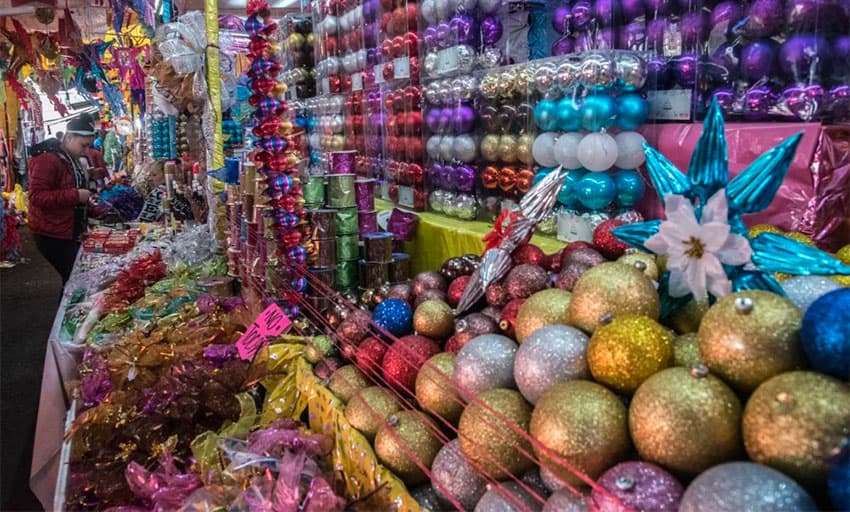
It’s 2019: the town of fewer than 5,000 is now the fifth largest producer in the world of its niche product, has prospered through exports from a weak peso, armored itself against future domestic downturns by emphasizing foreign sales and has successfully fought off an invasion of its home and foreign markets by inexpensive Chinese imitations.
It has achieved all of this while located in Michoacán, Mexico’s most notoriously cartel-dominated state.
The product is the prosaic Christmas tree ornament.
This op-ed is not about ornaments, but recognizing opportunity and acting on it.
Feliz Navidad.
The writer is a Guatemala-based journalist.