Home Blog Page 1289

40% of Mexicans would accept a government headed by the military: poll

0
armed forces
Let the military run the country, say many Mexicans

Many people argue that the armed forces already have too much power in Mexico but four in 10 Mexicans wouldn’t mind having a government led by them, according to a national survey.

Developed by the national statistics agency Inegi and the National Electoral Institute (INE), the National Survey of Civic Culture (ENCUCI) found that 16.6% of respondents totally support having a military government and 23.5% somewhat support the idea.

The remaining 60% of those polled rejected the idea of having a government led by the military, to which the current federal administration has entrusted a wide range of tasks including public security and infrastructure construction.

The survey, conducted with the occupants of more than 25,000 households in urban and rural areas of the country last August and September, also found that almost eight in 10 people are in favor of having a government headed by a strong leader.

Just over four in 10 of those polled said they agreed very much that a strong leader should be in charge of the country while 36% said that they somewhat agreed. The remaining 22.5% of respondents said they disagreed.

Although 40% of the respondents indicated that they would accept a military government, 90% of those polled said they were in favor of a government that is democratic in its decision making and included experts in a range of areas such as health and the economy.

Just over half of the respondents – 52.7% – said they are satisfied with democracy as it currently works in Mexico but 46.8% said they were not. Almost one third of those polled – including perhaps many of those who indicated support for a military government – agreed that a democratic government might not always be the best option in certain circumstances.

Among the other findings of the ENCUCI were that 61% of respondents believe that laws are not respected or barely respected in Mexico and that 45% believe that reducing corruption – a central aim of the current federal government – is not possible.

The survey also found that 76% of respondents don’t trust political parties and 50.7% believe that they serve no useful purpose.

Seven in 10 respondents said they had confidence in public universities, making them the most trusted institutions in the country, while social organizations ranked second with 51.4% saying they trusted them.

After political parties, the second least trustworthy institutions are unions. Just over half of respondents said they don’t trust business leaders while just under half said they lacked confidence in the media. Two-thirds of respondents said they don’t trust public servants and other government officials.

At the presentation of the survey on Wednesday, INE president Lorenzo Córdova acknowledged that there is still mistrust about elections in Mexico, although the democratic system has made signifiant progress in recent decades after the Institutional Revolutionary Party, or PRI, ruled the country as a virtual one-party state for much of the 20th century.

“Mistrust continues to be present in the election and is even fueled by some political actors as an electoral strategy. … The mistrust of society in the state of democracy and political institutions, on one side, and the use of a discourse of mistrust as a mechanism of political action have an impact on the elections,” he said, explaining that many people are not well-informed about the improvements made to the Mexican electoral system over the past 30 years.

Source: Animal Político (sp) 
As death toll hits 200,000, health minister criticizes media for reporting it

0
newspaper headline
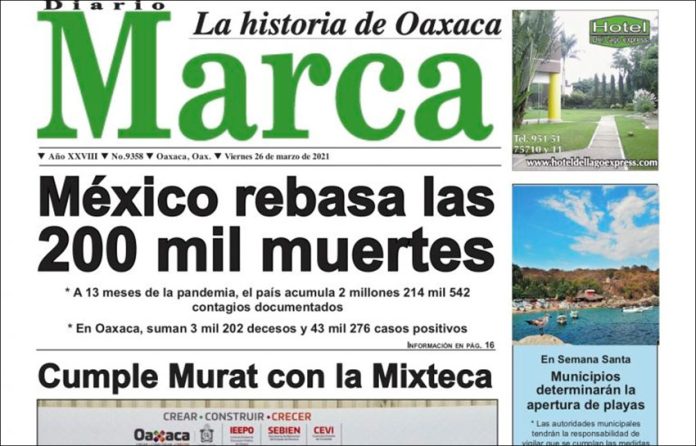
As predicted, many newspapers announced the new milestone in Covid-19 fatalities.

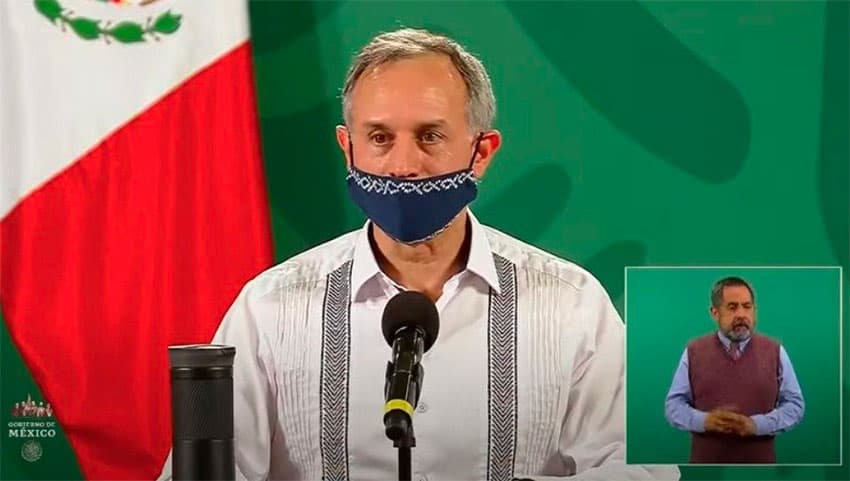
As Mexico’s official Covid-19 death toll rose above 200,000 on Thursday, Deputy Health Minister Hugo López-Gatell criticized the media for focusing on reporting “the saddest side of the epidemic.”

Speaking at the Health Ministry’s Thursday night coronavirus press briefing after it was announced that the official death toll had increased to 200,211 from 199,627 a day earlier, López-Gatell said he wouldn’t be surprised if major newspapers splashed the 200,000 figure on their front pages.

The coronavirus point man asserted that the media has a “fondness for round numbers,” noting that there was prominent coverage of the death toll when it reached milestones such as 50,000 and 100,000. He also claimed that the media has a penchant for concentrating on the “the saddest side of the epidemic.”

This “obsession” is due to several reasons, López-Gatell said, citing media outlets’ desire for higher profits and higher share prices.

The deputy minister also claimed the media, in reporting on Covid-19 deaths, has appropriated the grief, pain and sadness of people who have lost loved ones to the disease.

lopez gatell
The coronavirus point man was wearing a face mask when he arrived at Thursday’s press conference, though not in the recommended manner.

He said it appeared that media outlets were the “representatives” of people who have lost family members but added:

“I’m not sure that 200,000 families have conferred this capacity of representation to these media outlets … that, as the president has pointed out, represent different economic and political interest groups that are against the changes that are occurring in this stage of the government.”

López-Gatell also took aim at the media for not providing greater context about Covid-19 deaths in Mexico. Social and economic inequality, poverty and the high prevalence of chronic diseases are factors in the high death toll but are not sufficiently reported, he said.

“Let’s see … if these newspapers, Reforma, El Universal, Excélsiór, and the corporate radio stations … speak about all these phenomena” when reporting on the death toll exceeding 200,000, López-Gatell said.

The deputy minister said it would be desirable that nobody lost their life to Covid-19 but added that pandemics are part of the reality of the world and the human experience.

As it turned out, his prediction was correct. Media outlets did indeed announce that the 200,000 mark had been passed.

Meanwhile, Mexico’s 200,00th Covid-19 death came exactly one year and one week after the country’s first fatality of the pandemic was reported. That means that an average of more than 530 fatalities per day were reported since the middle of March in 2020.

Mexico’s death toll, officially the third highest in the world behind those of the United States and Brazil, is widely believed to be much higher due to the extremely low testing rate.

Based on official figures, almost 20% of the deaths occurred in Mexico City, about 11% were recorded in neighboring México state and 5.5% occurred in Jalisco.

The death tolls of those states, combined with those of Puebla, Guanajuato and Nuevo León – which rank fourth to sixth for total fatalities – account for more than half of the deaths recorded in Mexico since the start of the pandemic.

The average number of daily deaths reported across the country in the first 25 days of March was 580, a 40% decline compared to February and a 46% reduction compared to January, which was the worst month for both fatalities and cases.

New reported infections have also declined significantly this month but there are fears that Mexico could see a third wave of the coronavirus, which authorities say could be triggered by gatherings, parties and travel over the Easter vacation period.

Mexico’s accumulated case tally is currently 2.21 million, the 13th highest total in the world.

It is unlikely that vaccination has contributed in any significant way to the slow the spread of the virus and the decline in deaths this month because only about 4% of the population has so far received a shot.

Source: El Universal (sp) 

Elections body rejects candidates for governor after they failed to file spending reports

0
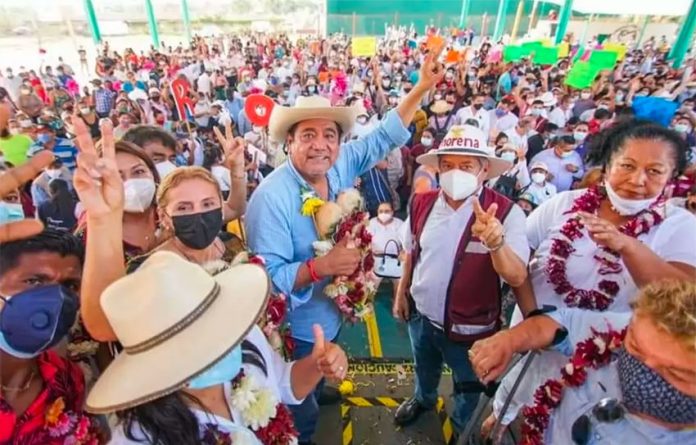
Félix Salgado at a campaign rally in Guerrero
Félix Salgado at a campaign rally in Guerrero. 'We're still in the fight,' he said despite the INE ruling.

The National Electoral Institute (INE) has barred two Morena party candidates for governor from contesting the June 6 elections in a move that is certain to inflame tensions between the agency and the ruling party.

The two are among several candidates, most of whom belong to Morena, who were disqualified because they failed to submit reports detailing their pre-campaign expenses.

Out of the running unless a court rules otherwise are Félix Salgado, a former senator who won Morena’s nomination in Guerrero despite facing several accusations of rape, and Raúl Morón, an ex-senator who left his position as mayor of Morelia in January to contest the gubernatorial race in Michoacán.

A majority of INE councilors voted in favor of deregistering the candidates in a marathon meeting on Thursday. In the case of Salgado, seven councilors voted in favor of rejecting his candidacy while four opposed the move.

A majority of councilors also voted in favor of barring former Acapulco mayor Luis Walton, current Acapulco Mayor Adela Román and the federal government’s super-delegate in Guerrero, Pablo Amílcar Sandoval, from contesting the elections because they too failed to file spending reports. That means none of the three morenistas, as Morena party members and supporters are known, will be able to replace Salgado on the ballot in Guerrero.

In the case of Morón, six councilors supported the disqualification of his candidacy while five opposed it.

The INE also barred 61 candidates for mayor and federal deputy positions from running because they didn’t report their expenses or there were inconsistencies in the information they provided. At least 42 of the disqualified candidates were nominated by Morena, a party founded by President López Obrador.

INE councilor Adriana Favela noted that any person aspiring to be a candidate at an election must submit a pre-campaign expenses report to the Electoral Institute.

Morena said that in the cases of Salgado and Morón, there were no pre-campaign events and therefore there were no expenses to report.

However, councilor Jaime Rivera said it was proven that there were costs associated with Salgado’s participation in the pre-campaign process to seek Morena’s nomination. Councilor Claudia Zavala said that there is a reporting requirement even if no pre-campaign expenses were incurred.

Uuc-Kib Espadas, one of the INE councilors who voted against disqualifying the candidates for governor, said the punishment didn’t fit the crime, asserting that barring them from running in the election was an excessive penalty.

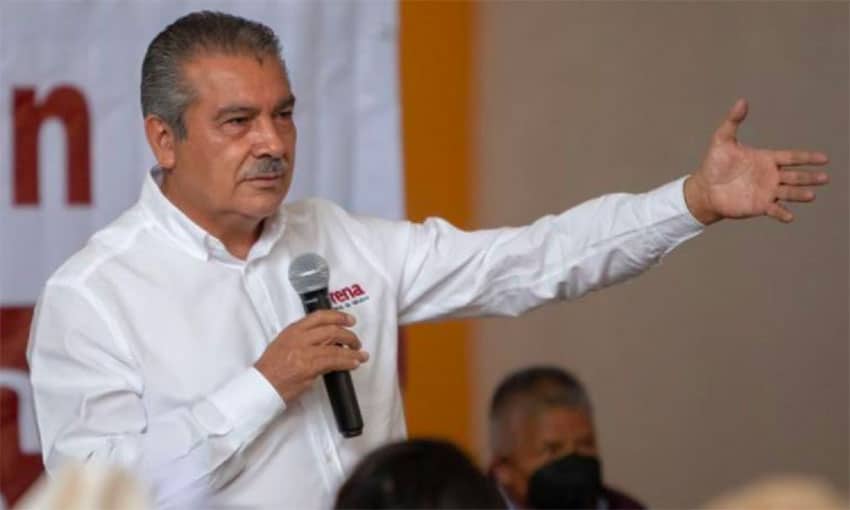
Raúl Morón, candidate for governor of Michoacán
Raúl Morón, candidate for governor of Michoacán, called the INE’s move ‘an illegal decision.’

However, councilors who voted in favor asserted that while the punishment might seem excessive, the law stipulates that candidates who fail to report pre-campaign expenses must be disqualified from running. Espadas acknowledged that the INE hadn’t acted illegally and accepted that it is not biased.

The decision to reject the candidacies of the two aspirants for governor comes after INE’s audit committee warned in late February that there was a risk of Morena party candidates being disqualified because they hadn’t submitted spending and income reports.

On February 26, the INE general council issued fines for more than 7.1 million pesos (US $345,000) to numerous parties, including Morena, that had not filed expenses reports for their pre-candidates. It gave the parties five days to do so but many Morena candidates didn’t comply with the directive.

Salgado, whose candidacy was confirmed by Morena earlier this month after it completed a new selection process amid calls for the 64-year-old alleged rapist to be dumped, said Thursday – prior to the INE councilors voting to reject his candidacy – that he would fight any such move in the Federal Electoral Tribunal, adding that he would take his case to the Supreme Court if necessary.

In a Facebook post published early on Friday, Salgado asserted that the INE  was “mistaken,” describing the decision to reject his candidacy as “objectionable and arbitrary.”

He also said that he was confident that the electoral court would overturn the decision and deliver justice. “We’re still in the fight. Everyone cheer up!” Salgado wrote.

Morón also said that he would challenge the INE decision in court.

“INE took an illegal decision. We will not allow it to trample on the will of our people; we will go to the electoral tribunal to defend democracy,” he wrote on Twitter.

President López Obrador took aim at the INE at his regular news conference on Friday, charging that it had become a “supreme conservative power.”

“It’s strange because it didn’t do it before, now it’s turned into the supreme conservative power, it now decides who is a candidate and who isn’t. It wasn’t like that before. Maybe they changed the laws or didn’t apply them before,” he said.

Source: Milenio (sp), Reforma (sp) 

Ex-governor of Tamaulipas pleads guilty to money laundering in US

0
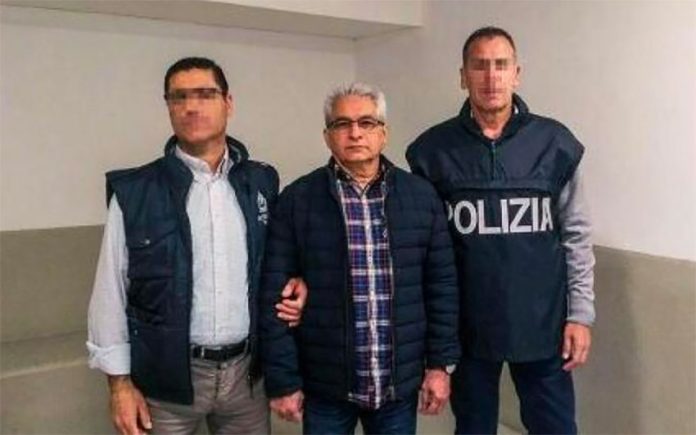
Yarrington during his arrest in Italy in 2017.

Former Tamaulipas governor Tomás Yarrington has pleaded guilty in the United States to a charge of conspiracy to commit money laundering.

Acting U.S. Attorney Jennifer B. Lowery announced Thursday that Yarrington, who was in power in the northern border state between 1999 and 2004, had admitted he accepted more than US $3.5 million in bribes and used the resources to purchase property fraudulently in the United States.

The United States Attorney’s Office in the Southern District of Texas said the 64-year-old former Institutional Revolutionary Party (PRI) governor admitted to a charge of conspiracy to commit money laundering in a “pay to play type of scheme.”

“As part of the plea, Yarrington admitted he accepted bribes from individuals and private companies in Mexico to do business with the state of Tamaulipas while he served as governor,” the statement said.

The Attorney’s Office said the ex-governor, who was a PRI pre-candidate for president in the lead-up to the 2006 election, used the bribes he received to purchase several properties.

“He had prestanombres – nominee buyers – purchase property in the United States to hide Yarrington’s ownership of the properties and the illegal bribery money used to purchase them,” it said.

The Attorney’s Office said that Yarrington admitted that one of the illegally purchased properties was a condominium in Port Isabel, a Gulf coast town 40 kilometers northeast of Matamoros, Tamaulipas. He has agreed to forfeit that property.

“He also acknowledged he knew it was against the law in Mexico to take the bribes and to hide the over $3.5 million in illegal bribe money in the United States by buying real estate, cars and other personal items,” the Attorney’s Office said.

A U.S. district judge accepted Yarrington’s plea and will set a sentencing hearing at a later date. The ex-governor, extradited to the United States by Italy in April 2018, faces up to 20 years in federal prison.

The ex-governor allegedly has ties to criminal organizations including the Gulf Cartel. He became a fugitive from justice in 2012 and was arrested in Italy in 2017 while traveling under an assumed name with a false passport

Mexico News Daily 

Beware the politics behind vaccines from China, Russia, US official warns

0
The Chinese-made Sinovac vaccine arrives in Mexico City earlier this month.

A senior United States official has warned Mexico to be wary of Covid-19 vaccines delivered by China and Russia because they are motivated by their own political interests.

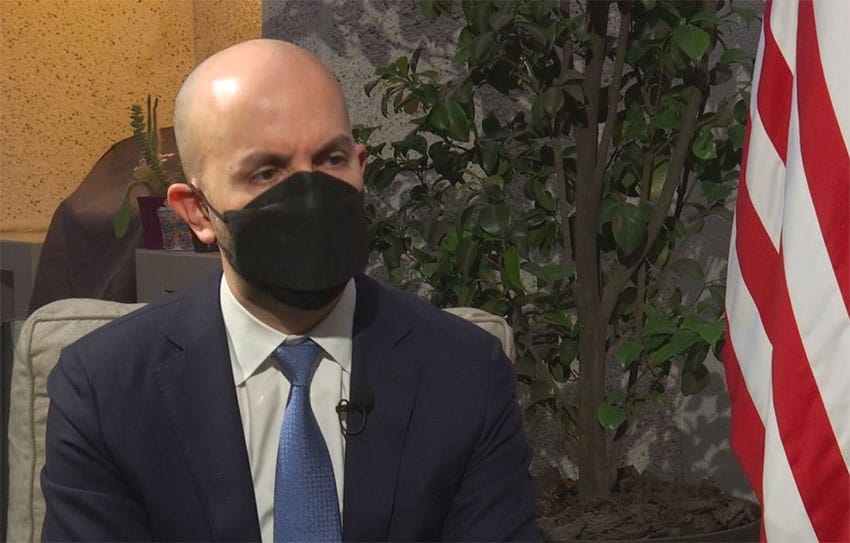
Juan S. González, the top diplomat on western hemisphere affairs on the White House National Security Council, told the newspaper Milenio that there might be geopolitical calculations and specific interests behind the delivery of vaccines from those countries.

Mexico has a deal with Russia to purchase 24 million doses of its Sputnik V vaccine and agreements to buy 35 million doses from Chinese companies Sinovac Biotech and CanSino Biologics. The Russian vaccine was developed by a state-owned research institute but the Chinese shots were developed by private companies.

Asked to explain why China and Russia appear to have more interest in supplying vaccines to Mexico than the United States – which announced last week that it would loan 2.5 million AstraZeneca doses to Mexico – González responded:

“There is a great difference here. [On] one [side there] is vaccine diplomacy in exchange for political capital while for us the motivation is the wellbeing of the Mexican people.”

Juan S. González
González: US assistance doesn’t come with conditions.

He also warned that China and Russia might not deliver all the doses they have promised.

The United States’ assistance doesn’t come with conditions, González added. The most important thing from the U.S. government’s point of view is the prosperity and safety of Mexicans, he said.

(A first shipment of 1.5 million AstraZeneca shots from the U.S. will arrive Sunday, Foreign Minister Marcelo Ebrard said Thursday.)

González also said that in contrast with other countries, Washington’s focus in distributing vaccines internationally is not commercial.

“We’re obviously focused on recovery [from the pandemic] in the United States but we’re also focused on the entire world with an emphasis on Latin America,” he said, adding that the Biden administration has donated US $4 billion to the intergovernmental Covax initiative, which aims to ensure rapid and equitable access to vaccines for all countries.

Probed further as to why the Mexican government should be wary of vaccine supply from China and Russia, González said:

“I would say that Mexicans have to decide what’s in their interest. We’re betting that there will be very close collaboration between the United States and Mexico in the future. That’s the relationship we’re looking for with Mexico, one of mutual interest. Not one in which we try to intimidate, threaten or gain a benefit for ourselves at the expense of the Mexican people.”

The official said that he couldn’t make any announcement about whether the United States would supply more vaccine doses to Mexico beyond the 2.5 million to which it has already committed but asserted that the U.S. government has a “North American plan” to combat the pandemic.

“… It’s not just vaccines, it’s the medical system and how we’re sharing information, how we’re developing vaccines, not those of today but those of tomorrow,” González said, adding that the U.S. government is also collaborating with its Mexican counterpart on border issues so that the pandemic can be controlled “without sacrificing our economic collaboration.”

He agreed that a “healthy North America” is not possible without the pandemic being controlled in Mexico, the United States and Canada.

“The president [Joe Biden] obviously made a promise to the American people that we’re going to vaccinate Americans [first]. Once we’ve done that, the focus will be on how we can help the rest of the world combat this pandemic, but that entire conversation begins in North America and that’s why the first announcement about sharing vaccines was with Canada and Mexico,” he said.

Responding to González’s remarks on Thursday, President López Obrador said that in order to obtain Covid-19 vaccines, it’s necessary to engage with all countries that could supply them.

López Obrador, who described Russian president Vladimir Putin as “genuinely affectionate” after reaching the Sputnik V supply deal in January, told reporters at his morning press conference in Campeche that “universal fraternity must prevail over hegemonies” in matters that affect people’s health.

“When it comes to obtaining vaccines to protect people we have to interact with everyone and seek solidarity and universal fraternity,”  he said.

Mexico has so far received just under 9.76 million vaccine doses, according to data presented by the Health Ministry on Wednesday night, of which about 4.55 million, or 47% of the total, were manufactured in Europe by United States pharmaceutical company Pfizer.

Sinovac has supplied 3 million doses, 940,470 CanSino shots have arrived and a shipment of 870,000 AstraZeneca doses manufactured in India reached the country last month. Only 400,000 of the expected 24 million Sputnik V doses have arrived to date.

As of Wednesday night, 6.1 million vaccine doses had been administered in Mexico, mainly to health workers and seniors. According to The New York Times vaccinations tracker, 4.2% of Mexico’s population are vaccinated and 0.4% are fully vaccinated, meaning that they have received both required doses of two-shot vaccines.

Source: Milenio (sp) 

Guerrero charity promotes whale watching that avoids stress for the animals

0
Catching a whale in the act.
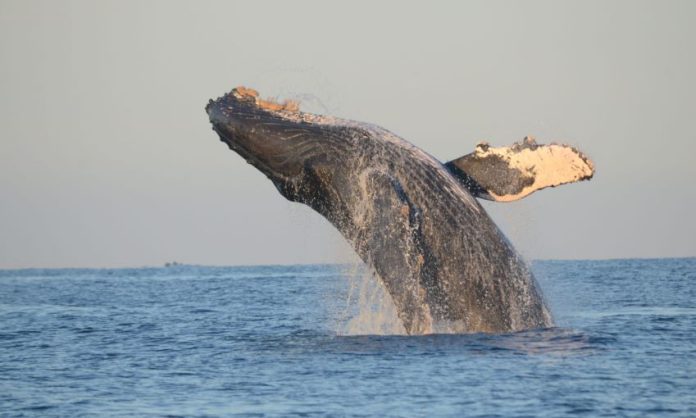
Catching a whale in the act of breaching.

Although I have lived many years in Zihuatanejo, I have never before taken the opportunity to book a whale tour in Barra de Potosí, a small community not far from there and basically in my backyard. With the Whales of Guerrero concert held recently in March, I decided it was time to take advantage of the proximity.

Whales of Guerrero is a charitable organization that facilitates community-driven conservation in the fishing village of Barra de Potosí and throughout Guerrero. Among many other initiatives, the organization trains locals to take tourists on safe whale and dolphin watching excursions. Guides trained by the charity are certified by Mexico’s Environment Ministry and gain access to a whale-spotting network, allowing them to work together to find whales and to coordinate to give the whales space and avoid causing them stress.

Some conservationists and marine mammal researchers are concerned that whale and dolphin watching drives the animals away from preferred areas and forces them to move away from their feeding zones in order to avoid boats.

Together with three other friends, we took the trek to the village of Barra de Potosí. We met our guides Raúl, Jorge and Jesús, who were already waiting for us at Restaurante Gaviotas, one of many restaurants that dotted the beach. As we donned our lifejackets and had a brief safety meeting, I was happy to see that our panga (boat), which was immaculately clean, had a canopy for shade and that the guides all wore masks, as did we.

The waters can be choppy in that area, and the swells can look daunting. I sat in the boat’s prow to take photos, which was thrilling as we maneuvered through the waves. However, our captains were proficient at steering, and it didn’t take me long to relax.

Guides take customers on a small boat and keep a respectful distance, which nevertheless allows a closer view of whales than on watches in crowded waters.
Guides take customers on a small boat and keep a respectful distance, which nevertheless allows a closer view of whales than on tours in crowded waters.

I knew from reading their website that the guides belong to an association and are continually upgrading their skills and knowledge of whales and natural habitat funded through the Whales of Guerrero organization.

The boat sliced through the water past the surf to the open sea relatively quickly. Although I was expecting that it would be some time before we would see anything, it was probably no more than 15 minutes before we got our first glimpse.

We raced towards the “blow,” and Raúl explained that you could see the whale’s “footprint” on top of the water after it breaches the surface. As we rode, he imparted more of his knowledge to our group. For instance, the song a whale sings depends on its purpose. Since we were now entering the area where they breed, he told us, the male whales sing beautifully to entice a mate. Rather romantic, I thought. Whales telling rivals to stay away sound much different.

Like people and their fingerprints, no two whales have the same design on their flukes. In this way, they are identified and tracked by conservationists when they breach. If you manage to capture a fantastic shot, as we did, you can send it to Whales in Mexico via their website and they will know if it is a whale they already are familiar with or a newcomer that you have discovered. Today, their catalog has documented more than 320 individual whales.

A few miles out from our last sighting, our captains lowered the speed and we bobbed on the waves waiting for a closer look. Fifteen minutes passed before they breached again, a truly wonderous sight to behold as we counted three whales in the pod. When the whales emerged the third time just eight minutes later, our guides told us it meant that they were not bothered by us or the other boat a little bit off in the distance.

I was impressed that the boats kept such a space between them because I recall that in Quebec, on my only other whale watching tour years ago, that was not the case. There, we found that the waters were quite congested, with several boats packed with people hoping to get a closer look and probably the reason we could only get a glimpse at a distance. But here in Mexico, it was an entirely different experience.

The author ready for a Covid-safe whale watching excursion.

After nearly two hours and numerous sightings, we headed to shore but not before stopping to watch a mother and her calf on the way back.

It was clear our seemingly determined captains wanted to make sure we got our money’s worth. And in my opinion, it was well worth the 800-pesos price, and an experience I will be sure to repeat.

Whale watching prices can range from 2,400 to 9,000 pesos, depending on the captain and the boat. Many of the crews are bilingual. Working with a trained guide increases your chances of finding whales; plus you’ll have the security of knowing that the animals are not stressed by your presence.

You can book an excursion on the organization’s website. Whale watching season has ended until next December, but in the meantime, for a US $100 donation, you can adopt a whale for the next two years, and then track it. For more money, you can even get it named after you.

The writer divides her time between Canada and Zihuatanejo.

1,100 evacuated after winds fan flames of Nuevo León forest fire

0
The Sierra de Santiago fire on Wednesday night.

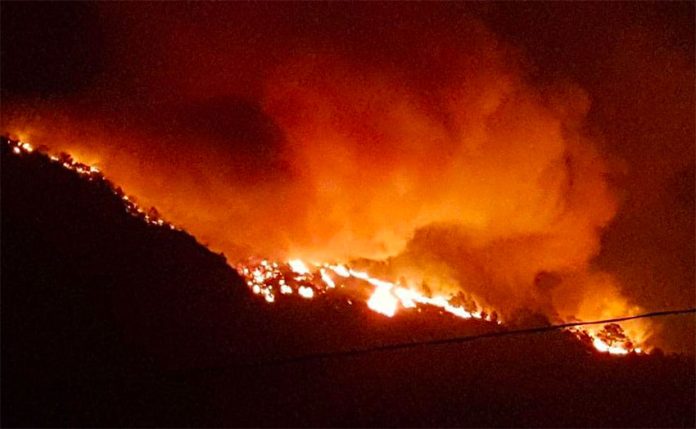
A total of 1,100 people in at least 14 communities of the Sierra de Santiago region of Nuevo León were evacuated from their homes overnight Wednesday after 90 kilometer-per-hour wind gusts refueled a 10-day wildfire that has already consumed more than 8,000 hectares of land.

Nuevo León Civil Protection officials had announced on Monday that the wildfire was 70% under control. But by Tuesday, high winds associated with cold front No. 44 and drought conditions reinvigorated the blaze, which began getting dangerously close to homes in the area on Wednesday.

Residents in communities in the blaze’s path who have not yet been evacuated are preparing for the possibility of leaving on their own, the newspaper Reforma reported.

Emergency authorities began at first by evacuating 80 people from the community of San Isidro yesterday evening. However, later into the night, as the fire advanced, authorities began evacuating larger numbers of people.

The gusts also forced firefighters to discontinue on Wednesday afternoon their efforts to extinguish the fire by helicopter.

The fire began in Arteaga, Coahuila, on March 16 and has extended over the border into Nuevo León, where authorities already have had to evacuate 400 residents in the municipality of Galeana as well as people from 19 other communities in a different part of the Sierra de Santiago.

Nuevo León firefighters have been battling four other wildfires in the state simultaneously.

Mexico is facing one of its worst forest fire seasons in a decade. Last month, the federal forestry agency Conafor issued a warning that due to drought conditions and the presence of La Niña weather phenomenon this year, Mexico was in danger of experiencing a critical wildfire season this year.

Already blazes have affected 29,559 hectares of forestlands nationwide, the third most extensive loss of forest lands in a decade, Conafor said in a report last week.

According to the most updated information available from the agency, there are currently 75 active wildfires in 20 states being fought by 3,593 emergency personnel.

Source: Reforma (sp), La Jornada (sp),  Excélsior (sp)

Farmers group says corn production likely to miss forecast by 3 million tonnes

0
corn

Corn yields in 2021 will likely be about 3 million tonnes lower than the federal government is forecasting, according to the head of one of Mexico’s largest corn farmer associations.

Juan Pablo Rojas, president of the National Confederation of Corn Producers (CNPAMM), told the Reuters news agency that the production estimate of almost 27 million tonnes by the Agriculture Ministry’s SIAP statistical agency is not reliable because budget cuts have reduced its capacity to conduct field work.

“The SIAP doesn’t have a way of knowing how much is being produced, or how much will be produced, because it doesn’t have the technical personnel that can verify the information,” he said.

Rojas predicted that corn production this year will be no more than 24 million tonnes. The CNPAMM chief said the government’s direct cash payment program that benefits more than 2 million small plot farmers, most of whom grow grains, is unlikely to lead to larger yields despite official claims that it would.

Farmers can receive up to 8,000 pesos (US $386) a year from the program’s 13.5-billion-peso (US $651.6 million) annual budget but Rojas said the amount is insufficient to boost production.

“You’re not making the land more productive with 8,000 pesos per year,” he said, adding that the payments can be used for any expense and are therefore more akin to social spending designed to increase political support for the government, which has made welfare programs a central part of its agenda.

Rojas also noted that the government’s plan to phase out use of the controversial herbicide glyphosate is likely to increase farmers’ costs.

Reuters reported that the Agriculture Ministry declined to comment on the CNPAMM president’s assertions due to their “lack of any substance.”

The ministry defended SIAP, describing it, according to Reuters, as “an accredited institution that performs essential work in the design and operation of public policies and decision-making across domestic farm supply chains.”

SIAP forecast in late February that corn production in 2021 would be 26.9 million tonnes, a reduction of about 2% from 2020 levels.

Even if that forecast were to come true, Mexico would still be moving away from, rather than toward, President López Obrador’s goal of making the country’s self-sufficient in corn by 2024.

Although the SIAP is forecasting slightly lower corn production this year, the president claimed this month that output was on the rise.

“The production of corn is growing because corn farmers are being supported,” López Obrador said.

However, drought – currently affecting about four-fifths of the country – is a major threat to farmers’ capacity to produce food, let alone boost production levels.

The CCI farmers association warned this week that low water levels in 16 dams used for agricultural purposes will limit corn production and force Mexico to increase imports of the grain.

“The low availability of water will result in a reduction in agricultural production,” said CCI president José Amadeo Hernández.

He estimated that Mexico will need to import 16.5 million tonnes of corn this year, which would represent a 9.1% increase over 2020 levels.

Hernández said that farmers in the north of Sinaloa will have to reduce the area on which they plant corn and sorghum. He also noted that farmers in Guanajuato and México state face severe drought conditions.

The 16 main agricultural dams, located in seven states, are currently only 33.7% full on average, Hernández said, adding that the level is a reduction of 51.7% compared to a year ago.

Source: Reuters (en), Excélsior (sp) 

Nearly 9 million students have dropped out during the school year

0
student studying at home
Many families didn't have the resources to allow their children to study at home.

Almost 9 million students aged 3 to 29 abandoned their studies during the 2020-2021 school year due to the coronavirus pandemic, a lack of money or because they had to work, according to the national statistics agency Inegi.

Results of an Inegi survey on the pandemic’s impact on education show that 8.8 million children, teenagers and young adults were forced to abandon their studies this academic year, which began virtually last August.

That figure is higher than the entire population of Jalisco and almost equal to that of Mexico City (excluding the greater metropolitan area).

Of the 8.8 million students who stopped studying, 2.3 million did so for reasons directly related to the pandemic, 2.9 million left their educational institutions due to a lack of resources (meaning their families couldn’t afford to pay expenses associated with online learning) and 3.6 million made the decision because they had to work.

An additional 738,000 students abandoned their studies during the 2019-2020 school year. Almost 60% of that number cited the pandemic as the reason why they left.

The Inegi survey also found that students are dedicating significantly less time to their education while studying virtually at home. Only 11.8% of students spend eight hours per day or more attending virtual classes and doing schoolwork, while 48.3% spend three to five hours studying and 23.5% dedicate fewer than three hours of their time to their education.

In addition, the survey found that more than a quarter of households where students live had to purchase electronic devices and/or install internet service so that they could study during the suspension of in-person classes.

The most commonly cited advantage of virtual classes was that students’ health is not placed at risk while the No. 1 disadvantage was that learning is not as successful as it is in the classroom.

Manuel Gil Antón, an education researcher at the Colegio de México, told the newspaper El Universal that the pandemic has deepened educational inequality in Mexico.

Mexico’s poorest children – “the forgotten ones” – have been most affected by the shift to online learning and have left schools in the greatest numbers, he said.

Gil pointed out that poor households usually don’t have computers and charged that the Ministry of Public Education (SEP) “could have done things better.”

“It could have been more creative, delivered less generalized content,” he said.

Alma Maldonado, an education researcher at the National Polytechnic Institute, said the Inegi numbers are indicative of the failure of SEP’s education strategy during the pandemic. She asserted that its online curriculums have been largely irrelevant to students’ needs and have failed to appeal to them.

Maldonado also said there has been a lack of support for teachers giving the virtual classes, although she acknowledged that educators have done their best. She asserted that it will take years to recover pre-pandemic school enrollment levels.

Schools closed due to the pandemic a year ago and have not reopened in any state in the country, but President López Obrador said Thursday morning that classes could resume soon in Chiapas, Veracruz, Sonora and Chihuahua, depending on the coronavirus risk level as established by the stoplight risk map. Sonora, Campeche and Chiapas are already green, the color at which schools may reopen.

A large association of private schools, many of which have seen their revenue plummet during the pandemic due to students moving to public schools, called for its members to reopen on March 1 but the Education Ministry quickly warned that reopening would be a violation of government policy.

Source: El Universal (sp) 

Residents close Oaxaca tourist destination, claiming only outsiders benefit

0
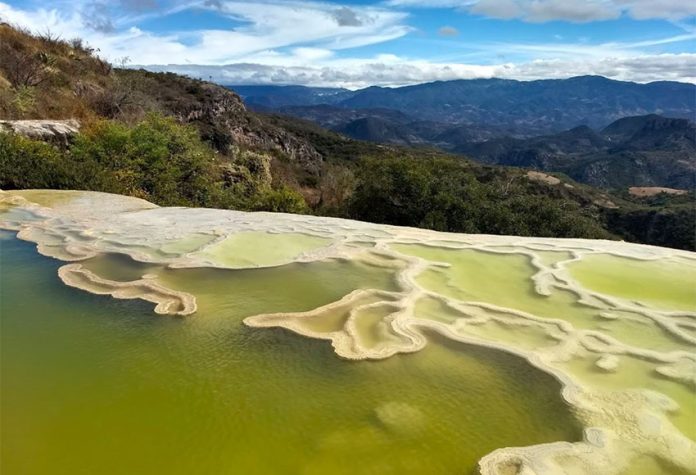
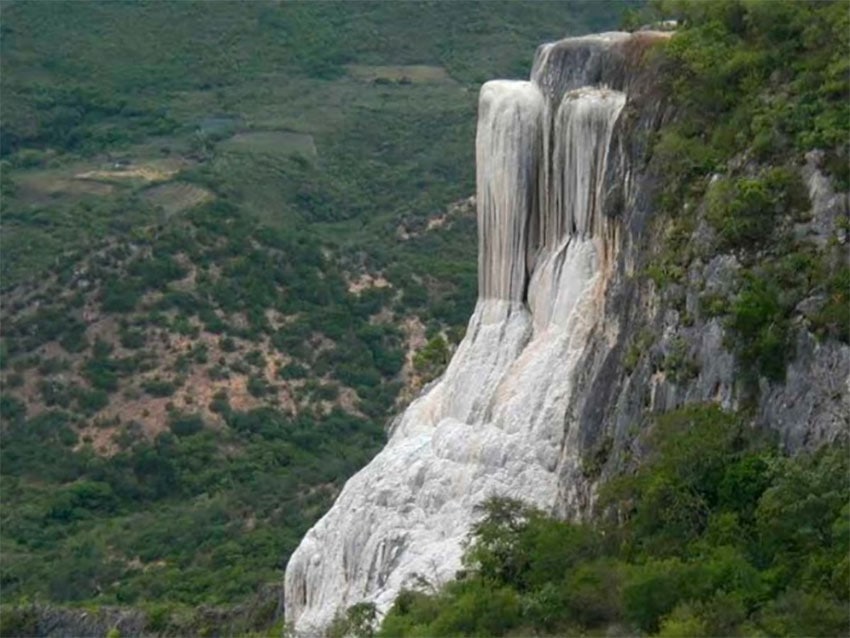
Unusual rock formations are the attraction at Hierve el Agua.

Community landowners in San Lorenzo Albarradas, Oaxaca, have announced the closure of the Hierve el Agua tourist attraction because the revenue it generates hasn’t benefited the local area.

A lawyer for the landowners told a press conference Wednesday that access to the site, which includes natural rock pools and a petrified waterfall, will be closed to both tour groups and visitors who arrive independently.

Eder Salinas Cortés said that local residents have fought for 18 years against political groups and tourism companies that benefit financially from the site, located about 70 kilometers southeast of Oaxaca city.

“It’s political groups and tourism companies that receive all the royalties … and the community remains mired in poverty; there are no roads, no schools, no drinking water. The situation is alarming,” he said.

“The people are tired, this [press] conference is to advise domestic and foreign tourists that [Hierve el Agua] will be closed. Don’t let yourself be fooled because nobody … will be allowed to enter,” said a representative for the residents.

Rock formations look like waterfalls at the Oaxaca tourist attraction.

Salinas said Governor Alejandro Murat, who has been in office for more than four years, made a promise while on the campaign trail in 2016 to address the tourism revenue issue if elected.

“I think he forgot or who knows what happened,” he said, adding that other government officials have also failed to respond to requests for meetings.

Salinas said that cronyism and political protection has allowed political parties and political figures to benefit from the Hierve el Agua site. Among the beneficiaries he cited were the Social Democratic Party and Jorge Vargas Franco, a former secretary general of the Oaxaca government.

“… In the end they have prevented the population from receiving the benefits,” Salinas said.

The Hierve el Agua site generates about 2 million pesos (US $96,000) per month in revenue, according to landowners, but none of that money is spent in the local area.

“We’re asking for an apology, … it’s not fair that about 2 million pesos a month that could be used to pave streets or help the community is used to enrich politicians and fund political campaigns,” Salinas said.

Landowners said the situation could lead to violence. “Any … act of violence there is, we will blame the state governor, Alejandro Ismael Murat,” they said.

Source: Infobae (sp)