Home Blog Page 1338

Millennials represent nearly half of all new Covid cases; new records set Thursday

0
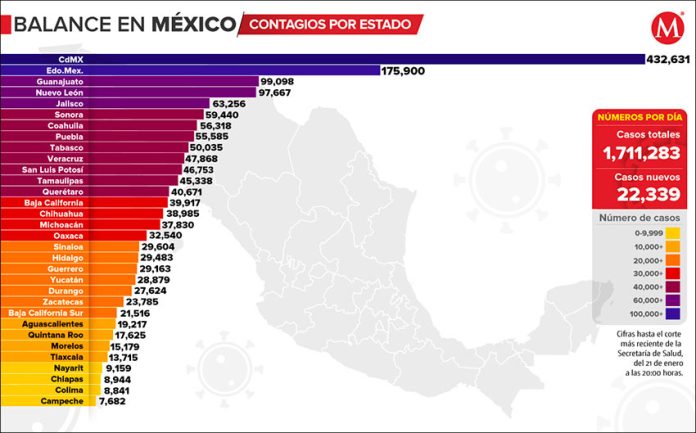
Covid case numbers as of Thursday night
Covid case numbers as of Thursday night. milenio

Mexico recorded new single-day peaks for both Covid cases and deaths on Thursday while data shows that infections among young adults have driven the country’s high case numbers over the past two months.

The federal Health Ministry reported 22,339 new cases on Thursday night, pushing Mexico’s accumulated tally to 1.71 million. The daily case tally exceeded the previous single-day high of 21,366 by 973, or 4.5%.

The official Covid-19 death toll reached 146,174 with 1,803 additional fatalities registered. The number of deaths reported Thursday surpassed the previous record of 1,584 fatalities – set two days prior – by 219, or 13.8%. The Health Ministry has reported more than 1,500 fatalities on each of the past three days.

Mexico’s coronavirus pandemic has intensified since the middle of November, and people aged 20 to 39 – so-called millennials – are largely to blame.

Between November 14 and January 21, Mexico recorded 708,030 new coronavirus cases, a figure that accounts for 41% of the 1.71 million cases registered since the virus was first detected here 11 months ago.

Federal data shows that 285,022 cases in the period – 40.3% of the total – were detected in people aged 20 to 39.

The cohort with the highest number of new infections over the past two months is women aged 25 to 29. Up until November 14, a total of 52,419 cases had been detected among women in that age bracket. The figure accounted for about 5% of total cases, which passed 1 million on November 14.

Since that date, an additional 40,856 women aged 25 to 29 have tested positive for the virus, almost 6% of the new cases detected since November 14.

The cohort with the second highest number of new cases is women aged 30 to 34. There were 40,094 cases, a figure that represents 5.7% of total cases in the period between November 14 and January 21.

Among young men, the 25-29 and 30-34 cohorts also recorded the highest number of new cases. A total of 74,842 cases were detected among men in those age brackets, a figure that accounts for 10.6% of all cases in the almost 10-week period.

Among women aged 20 to 24, there were 28,943 new cases while among men in the same age bracket, there were 26,417.

Two experts who spoke to the newspaper El Universal said that one factor in the high number of cases among young adults is that many continue to go to work on a daily basis. Another is that many millennials have continued to gather with friends during the pandemic, especially in the lead-up to and over the Christmas-New Year period.

“The population got fed up with confinement, young people even more so – not adolescents who wanted to go out but rather young adults who attended friends’ parties, who went out to do pre-Christmas shopping,” said Malaquías López, a public health professor at the National Autonomous University and spokesperson for the university’s Covid-19 commission.

“Unfortunately the majority of this [sector of the] population didn’t just get the virus but took it home [to parents and grandparents]. And those who have paid the consequences are the elderly,” he added, referring to higher death rates among seniors who contract Covid-19.

Miguel Ángel Toscano, head of intensive care at Mexico City’s Belisario Domínguez Hospital, also said that young adults are responsible for infecting older, more vulnerable family members.

“In these months of the pandemic we’ve treated all kinds of patients but the majority of serious cases have been in people older than 40 who have one or two chronic diseases such as hypertension and diabetes. It’s not that a young person is exempt from developing complications but statistics show that it is easier for them to recover at home. … The problem is when they infect elderly family members,” he said.

Source: El Universal (sp) 
Wednesday was second worst day of the pandemic for both cases and deaths

0
oxygen shortages
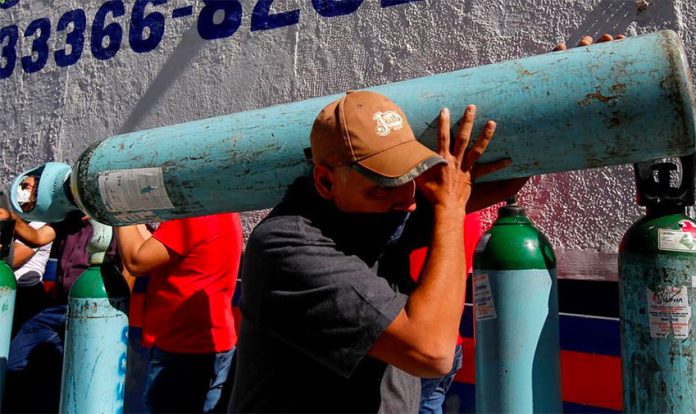
The new normal: oxygen shortages have been a challenge for families treating Covid victims at home.

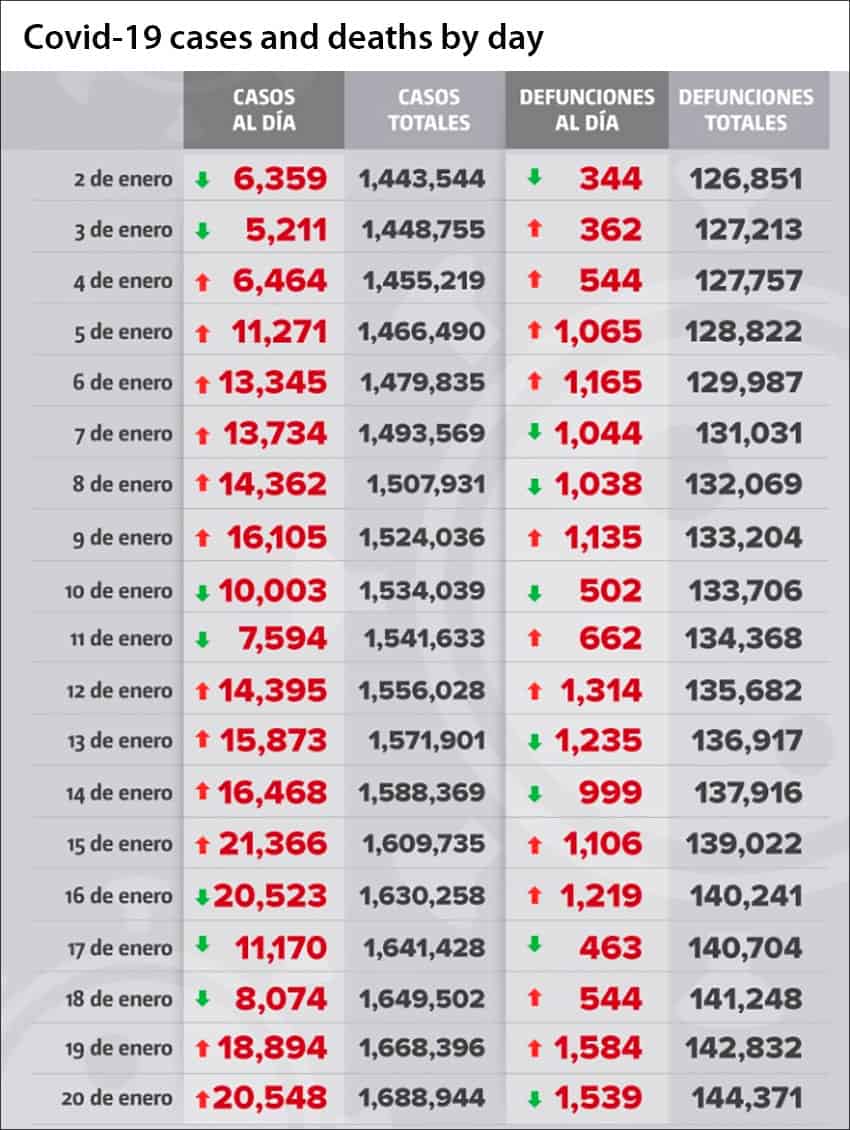
Mexico had its second worst day of the coronavirus pandemic on Wednesday in terms of both new cases and deaths.

The federal Health Ministry reported 20,548 new cases, pushing the accumulated tally to just under 1.69 million. The only day on which more cases were registered was last Friday when the daily tally was 21,366.

The Health Ministry also reported 1,539 additional Covid-19 fatalities, lifting the national death toll to 144,371. Wednesday’s tally was just 45 below the pandemic record of 1,584 deaths, which was set a day earlier.

Mexico currently ranks 13th in the world for accumulated cases and fourth for deaths behind the United States, Brazil and India.

The fatality rate is 8.5 per 100 confirmed cases, the highest rate among the 20 countries currently most affected by Covid-19, according to Johns Hopkins University.

Coronavirus cases and deaths in Mexico as reported by day
Coronavirus cases and deaths in Mexico as reported by day. milenio

Mexico’s low testing rate means that the true fatality rate is likely much lower but authorities say that high levels of chronic diseases such as obesity, diabetes and hypertension have contributed significantly to the country’s elevated number of deaths.

Mexico’s Covid-19 morality rate is currently 114.4 deaths per 100,000 inhabitants, according to Johns Hopkins University. Among the 20 countries currently most affected by Covid-19, Mexico has the sixth highest rate after the United Kingdom, the Czech Republic, Italy, the United States and Spain.

Among all countries that have recorded coronavirus cases and deaths, Mexico has the 19th highest per capita death rate.

Hospitals in many states remain under intense pressure as more and more coronavirus patients seek medical care in the wake of gatherings and parties over the Christmas-New Year period.

The occupancy rate for general care beds is 89% in Mexico City, 87% in Guanajuato, 85% in México state, 83% in Puebla, 82% in Hidalgo and 80% in Nuevo León, according to data presented at the Health Ministry’s Wednesday night press briefing.

More than 200 hospitals across Mexico are at 100% capacity for general care beds, according to publicly accessible federal data, and 140 have no unoccupied beds with ventilators.

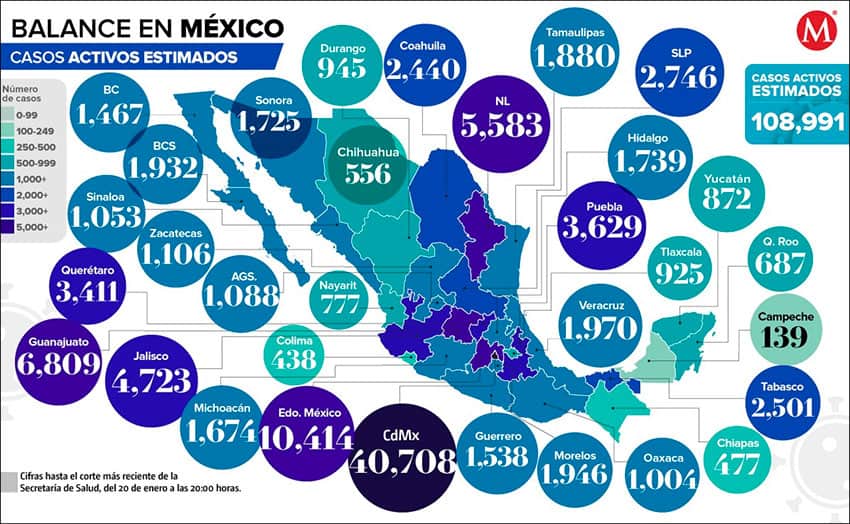
Estimated active case numbers as of Wednesday night.
Estimated active case numbers as of Wednesday night. milenio

The federal government began administering the Pfizer/BioNTech vaccine to health workers on December 24 but the national vaccination program now faces delays because a shipment of almost 220,000 doses that arrived on Tuesday will be the last until February 15.

Foreign Affairs Minister Marcelo Ebrard announced Tuesday that millions of doses of Covid-19 vaccines made by other companies will arrive in the coming weeks but even if the government achieves its goal of inoculating more than 14 million people by the end of March, the vast majority of Mexico’s population of almost 130 million will still not be protected against the infectious disease.

As of Wednesday, 501,030 shots of the Pfizer vaccine had been administered to health workers but only 11,402 such workers had received both of the required shots.

Twenty nine of Mexico’s 32 states have already administered more than 95% of the vaccine doses they have received while three – México state, Guerrero and Zacatecas – had not reached that mark by Wednesday night.

Mexico News Daily 

Covid tests for visitors: many hotels are now offering the service to guests

0
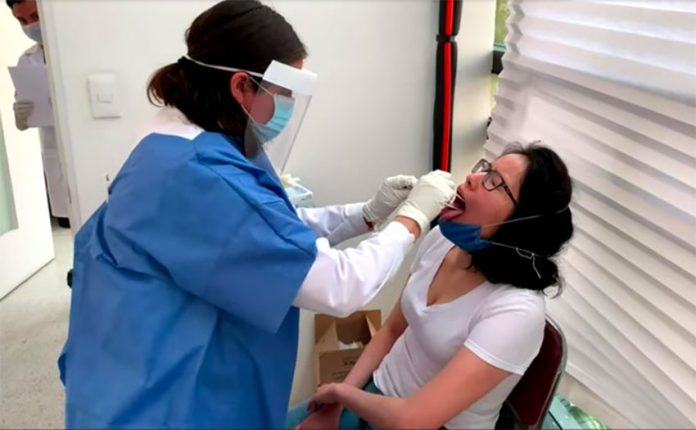
covid test

Travelers flying into the United States will not only need to provide a negative Covid-19 test but must go into quarantine as well, according to an order signed Thursday by U.S. President Joe Biden.

Details of the quarantine, such as the length of time, remain unclear.

It had already been ruled that, beginning January 26, anyone over 2 years of age entering the United States from any other country — including passengers on a return trip home to the U.S. — will be required to provide a negative Covid test administered no more than three days before their flight, or show evidence that they’ve recovered from the virus and have been cleared for travel by a licensed medical professional or public health official.

Either a PCR test or the faster and cheaper antigen tests are accepted. (Incorrect information appeared in a story published Wednesday.)

Canada also recently changed its requirements for travelers entering the country. Since January 7, airline travelers aged 5 or older are required to provide proof of a negative Covid test result to the airline prior to boarding.

The new rule is bound to create headaches for travelers wondering where to get a test in a foreign country, so hotels and tourism offices in Mexico have been stepping up to help travelers obtain the needed test with the aim of encouraging travelers to keep their reservations.

Many large hotel chains catering to American visitors have announced they will offer onsite testing or help connect customers to nearby labs and hospitals.

“Most of the hotels throughout Mexico are offering the service, and they’re even giving it to you for free,” said Hope Smith, a California-based travel adviser and owner of the Born to Travel agency.

Sandals, Melía, Marriott, Sandos and Blue Diamond are just a few of the resort chains offering free onsite viral antigen tests after January 26 in their tourist destination locations. Hotels can also connect guests with testing at nearby hospitals and laboratories.

Because other countries have already been requiring negative Covid tests from people returning from Mexico, the nation’s tourist areas already have good testing infrastructure in place, said Laura Septién, president of the San Miguel de Allende Tourism Council.

“We have the laboratories, we have the equipment to have results on time,” she said, adding that local tourism offices often can help if a traveler is having trouble finding or arranging a test.

“The cheapest antigen test I’ve found here is about US $15-$20; it’s really not that expensive,” said Carmen Joaquín, president of the Cozumel Business Owners Union. Many larger hotel chains are including the cost of a coronavirus test in the room rate, she said.

In some cases, hotels are even offering guests large discounts on reservation extensions should they end up testing positive and staying in Mexico an extra two weeks.

The Velas resort chain, for example, is allowing customers who test positive to extend their stay at a 75% discount and will accommodate guests who need to isolate from their travel party with a separate room.

Testing labs can also be found on the U.S. Embassy website, which maintains a list of laboratories and pharmacies that offer PCR and antigen tests.

Source: The Washington Post (en)

Funeral services overwhelmed by Covid victims in Tijuana

0
crematorium
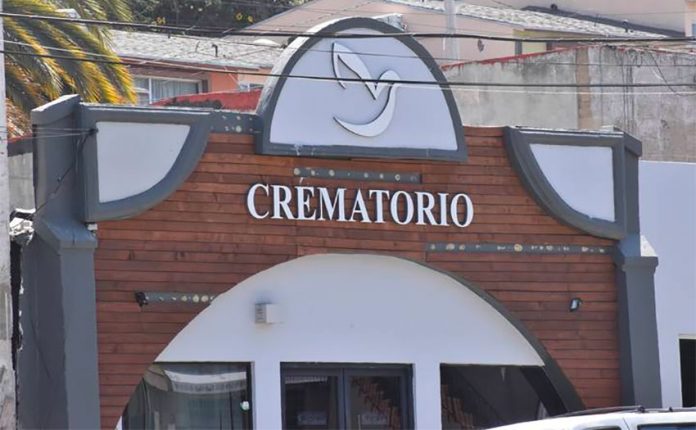
The price of a funeral has risen from 10,000 pesos to as much as 21,000.

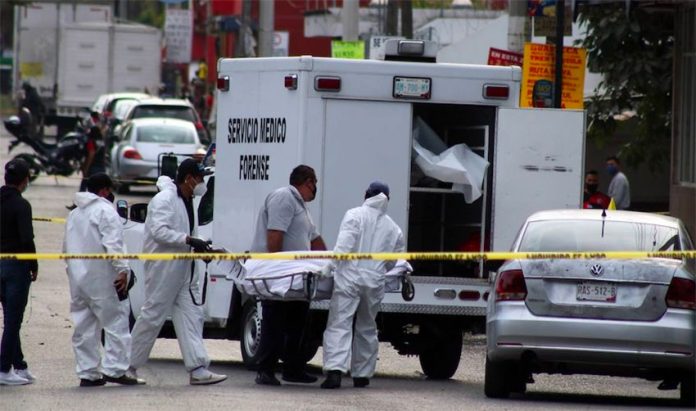
The coronavirus crisis has overwhelmed funeral services in Tijuana, Baja California, forcing family members of Covid victims to wait up to two weeks to cremate or bury their deceased loved ones and pay exorbitant prices to do so.

Crematoriums and funeral homes in the northern border city are full and turning people away, according to a report by the newspaper El Universal.

Some people who have lost loved ones to Covid-19 travel to other municipalities where funeral homes are not as busy but leaving Tijuana is not an option for others.

El Universal described the scene outside one funeral home in Tijuana: “A small line of people waits outside the business. … Some burst into tears, others … stare at the ground. Some, amid a gloomy silence, only have enough strength to embrace each other. … The response from the funeral home employee is the same for all of them: ‘There is no cremation service, we’re saturated.’”

At another funeral home the response is eerily similar. “I’m really sorry but we haven’t had any space for a week,” a clearly tired man dressed in dark clothing tells a young couple. “There’s no space, really. Maybe in about two weeks, … we’re full.”

The couple pleaded for a solution, El Universal said, explaining that the man’s father lost a battle with Covid four days ago and that they have been searching for someone to take his body ever since. But they’ve been given the same answer at every funeral home and crematorium they’ve visited: – “We can’t, there’s no space.”

“We weren’t able to say goodbye as we should have [because] in the hospital there was no way for him to see us,” the grieving man said, adding that not being able to find a funeral home to take his father’s body has only prolonged his family’s suffering.

As demand for funeral services has soared, so have prices. Funeral services including cremations that previously cost 10,000 pesos (US $505) now cost between 17,000 and 21,000 pesos (US $860-$1,060) even though companies in the sector made a commitment last year not to engage in price gouging.

Now, not only do mourning family members face long waits for funeral services, they also have to dig deeper into their pockets.

More than 6,300 people have lost their lives to Covid-19 in Baja California and more than 40% of those deaths – almost 2,800 – occurred in Tijuana, placing the municipality among the 10 municipalities with the most pandemic fatalities in Mexico.

Placing even more pressure on funeral services is the high homicide rate in the border city. There were more than 2,000 murders in Tijuana in 2020, making the municipality the most violent in the country.

Source: El Universal (sp) 
Catholic cardinal eschews public health care in favor of private hospital

0
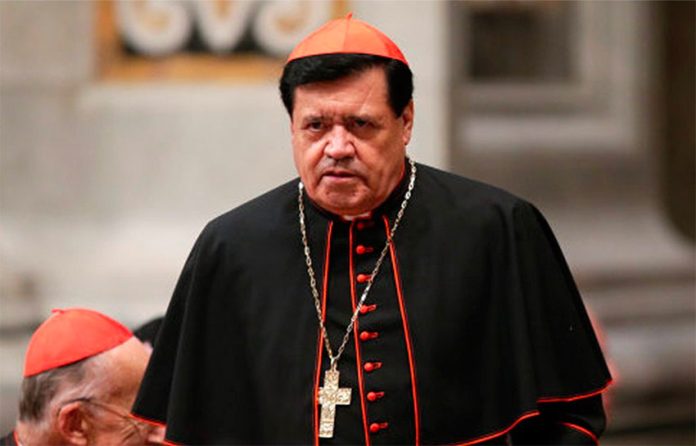
Cardinal Rivera in an undated file photo.

The former archbishop of Mexico City is undergoing treatment for Covid-19 in a private hospital by his own choice, Catholic Church officials said yesterday, explaining that Cardinal Norberto Rivera rejected the option to be admitted to a public-sector hospital.

Rivera, 78, is currently is in intensive care at an unidentified private hospital in Mexico City, paid for with his own resources, Valdemar said.

His condition became so serious at one point that he had to be transferred to a different hospital, also private, and had to be intubated and sedated. On Monday, he was administered last rites, according to his ex-spokesman, Father Hugo Valdemar. However, his condition has since improved, Valdemar told the publication Forbes México.

“[Rivera] was admitted on his own means because he is in bad health, and afterward when he was moved to another hospital, they required an economic reference, and the archdiocese said it could not cover his costs,” he added.

In its statement, the archdiocese said it had decided that all clergy would receive Covid-19 treatment in private hospitals that have made agreements with the government to admit public-sector patients or at temporary treatment spaces created for Covid-19 patients.

“Those bishops and priests diagnosed with Covid-19 who wish to be treated for their illness with other options may do so with their own resources or economic support that their next-of-kin can offer,” the statement said, adding that current archbishop of Mexico City, Carlos Aguiar, has assigned a priest to attend to Rivera’s needs and that it was Rivera’s decision to be treated in a private hospital.

The archdiocese justified its decision not to pay for private treatment costs saying it was due to the difficult economic situation the Roman Catholic Church is experiencing throughout Mexico, as well as “in communion and solidarity with what thousands of Mexicans are living through during this pandemic and whom we accompany by way of our daily prayers.”

Although Rivera was a few days ago rumored on social media to have died, his condition is improving, Valdemar said.

“Today we received a pretty positive medical report,” he told Forbes México. “He has been having good [oxygen] saturation and his whole body is doing well. He continues in to be in intensive therapy, in delicate condition, but with an optimistic prognosis.”

Sources: Reforma (sp), Forbes México (sp)

Leaked testimony links military with disappearance of 43 Ayotzinapa students

0
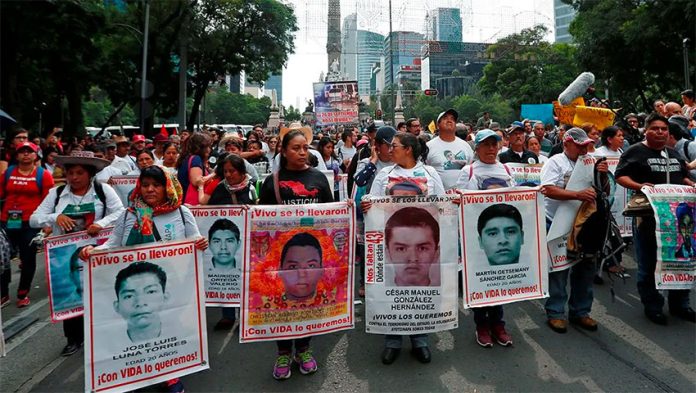
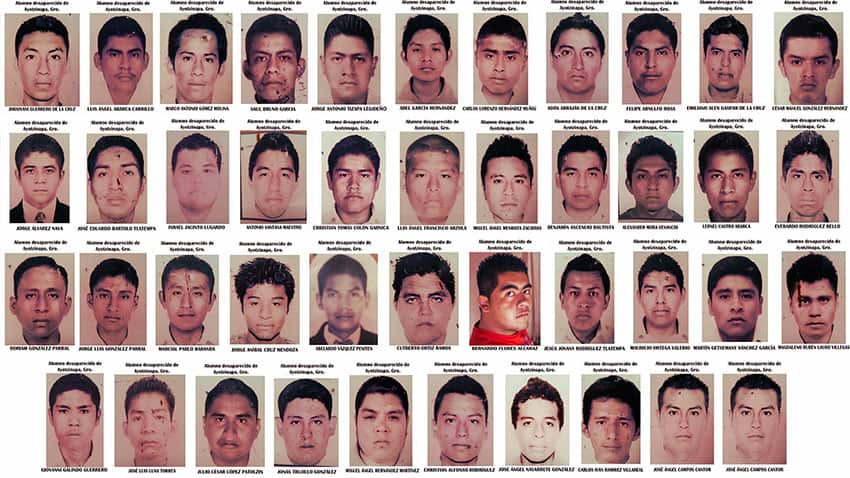
Families of the missing students and their supporters have been protesting for more than six years to press for justice in the case.

The military was directly involved in the disappearance of 43 teaching students in Iguala, Guerrero, in 2014, according to leaked testimony obtained by the newspaper Reforma.

In a report published Wednesday, Reforma said it obtained a declaration made to the federal Attorney General’s Office (FGR) in February 2020 by a protected witness identified only as “Juan.”

He was a suspected leader of the Guerreros Unidos, a drug gang allegedly involved in the disappearance of the Ayotzinapa rural teachers’ college students. According to his testimony, the 43 students and some 30 suspected members of a rival gang were detained on September 26, 2014 in an operation in which the military, police and the Guerreros Unidos were involved.

Juan told the FGR that Guerreros Unidos gangsters, assisted by the army and police, were looking for members of a rival gang who owed them money. The rival criminals were believed to be interspersed with the Ayotzinapa students, who on the day they were abducted had commandeered buses to travel to a protest in Mexico City.

Juan said three groups of students and suspected hitmen from a rival gang were detained on September 26. One group was taken away by the Guerreros Unidos, another was placed in the custody of state police and the third group was transported to an army base in Guerrero, he said.

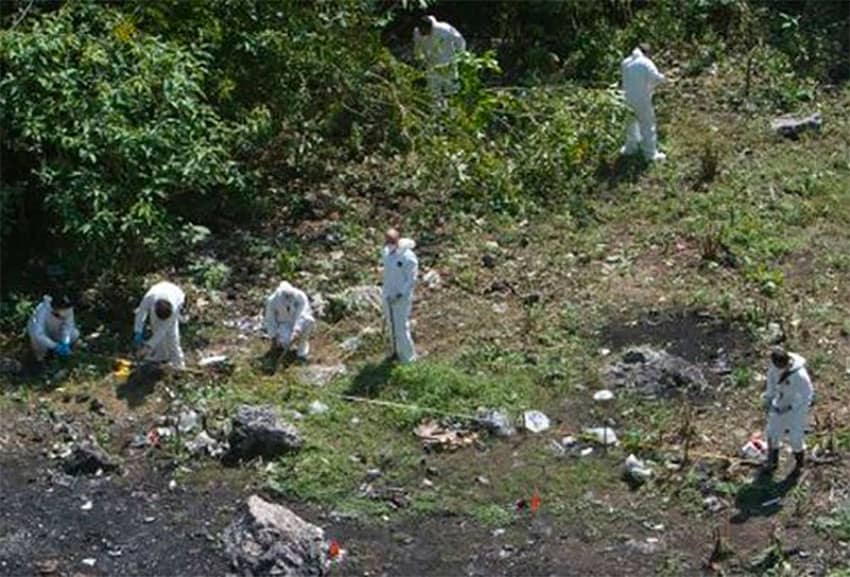
Investigators at the Cocula dump, initially identified as the location where the missing students' bodies were incinerated.
Investigators at the Cocula dump, initially identified as the location where the missing students’ bodies were incinerated.

Juan said that the group taken to the army base was interrogated before being handed over to a cell of the Guerreros Unidos. Some of the students and suspected gang members were already dead at that time, he said.

The witness said that the Guerrero Unidos killed those who were still alive and dissolved the bodies of the deceased in acid and caustic soda. Liquid remains were then poured down the drain, he said.

Other students and suspected gangsters were allegedly butchered with machetes and axes at a cartel hideout in Iguala before some of their remains were cremated at a funeral home on the outskirts of Iguala called “El Ángel.”

According to Juan, the Guerreros Unidos controlled the funeral home even though it was also used by local forensic medical authorities. The witness said the gang regularly used the facility to cremate its victims and that the local authorities knew about it but did nothing to stop it.

Juan said that body parts that were not cremated were dumped near abandoned mines in Taxco and near the town of Coacoyula, located north of Iguala. All told, 70 or 80 people including the 43 students were killed on September 26 and 27, 2014, the witness told the FGR.

According to his testimony, state police complicit with the Guerreros Unidos planted evidence – ashes of cremated students and spent bullet casings – at the municipal dump in Cocula to support a federal government narrative about what happened.

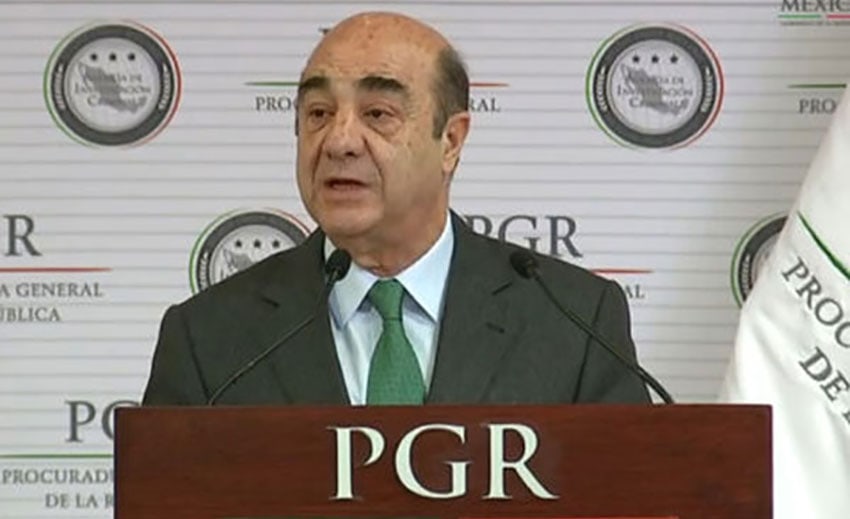
Then-attorney general Jesús Murillo Karam offers ‘the historic truth’ at a press conference in January 2015.

The previous government presented a version of events it called the “historic truth” in which the students were kidnapped by police and turned over to the Guerreros Unidos, who killed them, burned their bodies in the Cocula dump and scattered their ashes in a nearby river.

But independent forensic experts determined that it was not feasible that the students’ bodies were incinerated at the Cocula dump, and the current federal government rejected the so-called “historic truth” and launched a new investigation.

None of the bodies of the missing students has ever been found, although charred bone fragments have been identified as the remains of two of them.

As a result of Juan’s testimony, an army captain, José Martínez Crespo, was detained and warrants have been issued for the arrest of 17 soldiers. The witness said that Martínez, currently in prison awaiting trial, was directly involved in the arrest of the missing students.

Although the army has long been suspected of involvement in the Ayotzinapa case, the testimony nevertheless inflicts further damage on its reputation.

The army chief at the time of the students’ disappearance was Salvador Cienfuegos, who was arrested in the United States last October on drug trafficking and money laundering charges but subsequently returned to Mexico, where he was exonerated last week. Many observers have questioned the thoroughness of the probe into Cienfuegos, who as defense minister blocked investigators’ access to military personnel allegedly involved in the Ayotzinapa case.

The 43 students who disappeared September 14, 2014 in Guerrero.

In light of the Reforma report, the federal Interior Ministry (Segob) said in a statement that the Ayotzinapa Commission for Truth and Access to Justice, which is part of the ministry, would file a criminal complaint with the FGR in connection with the leaking of the case file.

“These kinds of leaks seek to discredit the work carried out in the investigation of the Ayotzinapa case and the credibility of the institutions that participate in it,” Segob said.

“[They also] place the truth about what happened on the night of September 26, 2014 in the city of Iguala, Guerrero, as well as the integrity of the people who are part of these investigations, at risk.”

President López Obrador weighed in on the matter on Thursday, confirming that the testimony published by Reforma is indeed contained in the FGR file.

“I don’t know how they obtained it but it’s real,” he told reporters at his regular news conference. “More people have been detained, there was an arrest of an army captain and the investigation is open. There is no definitive result yet.”

The president said that it’s becoming clearer by the day that the “historic truth” was a fabrication before adding that the government can’t say that the protected witness’ version of events is the correct one until more investigations take place and it is proven.

[wpgmza id=”282″]

“It’s not about coming up with another sham, another false version [of events] just to say the case is closed, to shelve it, no!” López Obrador said.

“The consultants, the fathers and mothers of the young men and of course the authorities have to participate” in a thorough  investigation, he said, adding that all evidence has to be collected and all suspects have to be investigated before it can be determined what happened.

One person implicated by the protected witness is Mexico City police chief Omar Harfuch, who was a security official in the previous federal government. Juan alleged he received US $200,000 a month from the Guerreros Unidos in exchange for helping the gang operate with impunity in Guerrero.

López Obrador also said Thursday that the government is committed to continuing the search for the missing students, although locating bodies dissolved in acid and disposed down drains would appear to be impossible.

“The most important thing is to find the young men. It’s quite a challenge but we have the will to do it,” the president said.

Source: Reforma (sp) 

Exonerated ex-defense chief remains on government payroll as advisor

0
Generals Cienfuegos, left, and Sandoval.

Former defense minister Salvador Cienfuegos, arrested on drug trafficking and money laundering charges in the United States last October but exonerated in Mexico last week, remains employed by the federal government as a military advisor.

Cienfuegos’ six-year term as army chief ended on December 1, 2018 – the day former president Enrique Peña Nieto left office and President López Obrador was sworn in – but he immediately became an elite advisor to current Defense Minister Luis Cresencio Sandoval.

The newspaper El Financiero reported that documents in the file that the federal Attorney General’s Office (FGR) opened to investigate Cienfuegos, who returned to Mexico in November after the United States dropped its charges against him, confirm that the former defense minister at no time ceased to be an advisor to Sandoval.

His designation as an advisor is consistent with three articles in the constitution, El Financiero said, adding that it was told by military sources that his appointment is also consistent with a presidential decree issued by former president Luis Echevvería in 1976. It is unclear how much the retired general is paid for advising his successor.

Documents in the FGR file on Cienfuegos also reveal that the government paid for his legal defense in Mexico. Lawyers who work for the Ministry of National Defense were assigned to represent the former army chief in his dealings with the FGR.

The Attorney General’s Office exonerated Cienfuegos less than two months after he returned to Mexico, raising questions about the thoroughness of its investigation.

The United States, which in a surprise move agreed to drop its charges against him while under pressure to do so from Mexico, alleged that as defense minister the ex-general colluded with the H-2 Cartel to smuggle large quantities of drugs.

United States authorities provided Mexico with the evidence it collected against Cienfuegos but the FGR concluded he never met with or colluded with the Nayarit-based cartel as the U.S. claimed.

López Obrador accused the Drug Enforcement Administration of fabricating evidence against the former defense minister and lacking professionalism. He said Monday that his government won’t remain silent in light of an “irresponsible” United States’ investigation into Cienfuegos but claimed that the matter won’t have a negative impact on bilateral relations.

Source: El Financiero (sp) 

Freddy the monarch missed the migration but stays warm in Canadian home

0
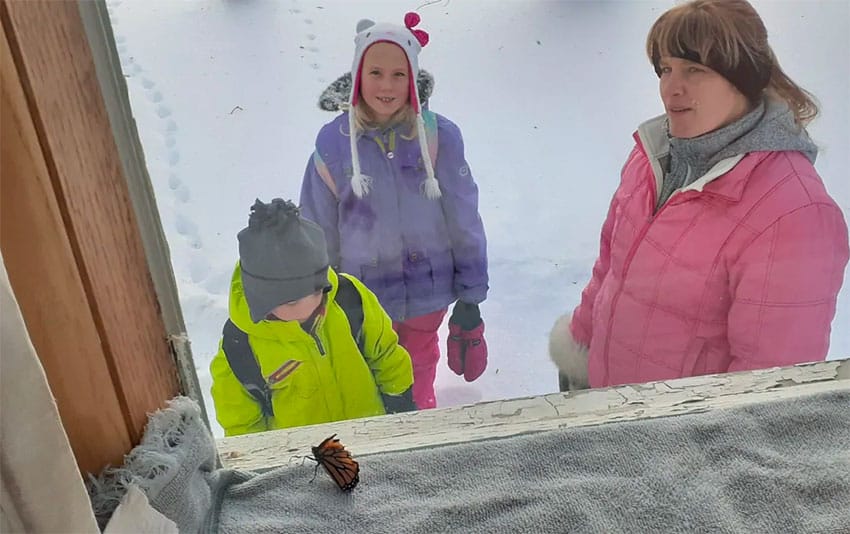
Against a Christmas backdrop, Freddy enjoys a honey and water mixture.

Whether it was a decision to buck lepidopteran instinct or simply bad luck, somehow Freddy the monarch butterfly didn’t heed the call to winter in Mexico this year like the rest of his Canadian snowbird brethren.

Lucky for him, Canadians Debbie and Tom Tonner took him in.

“We’ll sit there at the dining room table and he’s beside us on the window. It’s kind of comforting. He’s very much a part of our family now,” Debbie recently told the Canadian broadcaster CBC.

The Manitoba couple adopted Freddy after a friend found him on her driveway in 10-degree Celsius weather and couldn’t take him in due to having pets.

When the weather warmed up, the Tonners’ daughter Samantha tried putting him in a tree in her town farther south to give him a head start on his migratory journey. But when he didn’t leave the tree after 20 hours, the Tonners decided Freddy was there to stay.

Neighbors gather outside the window to check on the adopted butterfly.

“When I go to get him in the morning, he always flutters his wings and reminds me of a puppy wagging its tail. He’s always excited to get out of the enclosure and go to the window,” Debbie says.

Named for Canadian entomologist Frederick Urquhart, who documented much about the migration routes of monarch butterflies, Freddy spends much of his day on a blanket on a south-facing windowsill, taking sun and receiving his audience — curious neighbors who have heard about his arrival in town.

Between being empty nesters and the socializing restrictions of the coronavirus pandemic, the Tonners don’t see many people these days, so they say they’re glad to have him around for however much longer he survives.

“It’s 13 weeks now that we’ve had him, and that’s quite long for a butterfly in captivity,” said Debbie, who is a member of a Facebook group that shares information about attracting and caring for monarchs. “The only other ones that I know of who were raised in this area only live to be about 10 weeks. He seems to have a real will to live.”

While Freddy has had a big impact on their daily lives, he actually wasn’t the first monarch the Tonners fostered this year: a week before he arrived, Tonner took in a chrysalis given to her by a friend who discovered it on her lawn chair.

When that butterfly emerged in warmer weather, Tonner drove as close as she could to the Canada-U.S. border and released him.

“He hopefully made it to Mexico,” she said.

Source: CBC (en)

AMLO declares progress being made as 2020 homicide numbers down by 0.4%

0
homicides

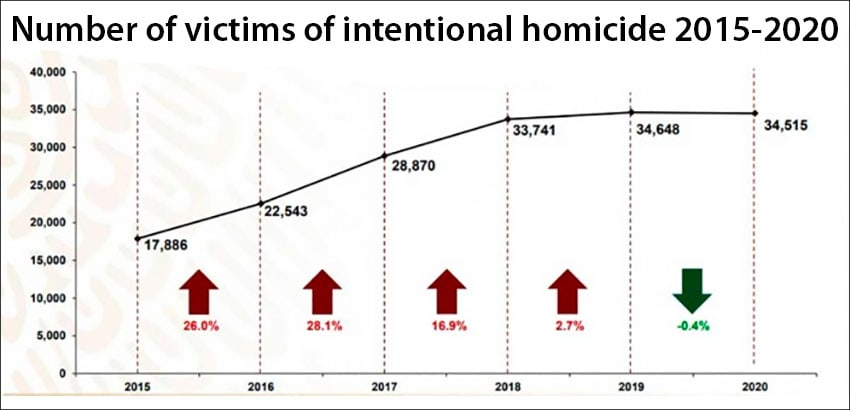
The coronavirus pandemic and the deployment of almost 100,000 National Guard troops did little to halt violence in 2020: homicides declined for the first time in years, but only by 0.4%.

The federal government reported Wednesday that there were 34,515 homicides last year, a reduction of 133 compared to 2019, which was the most violent year on record. It also reported that there were 969 femicide victims – women and girls killed on account of their gender – in 2020, an increase of 0.3% compared to 2019. The worst state for that crime was México state followed by Veracruz, Jalisco, Mexico City and Nuevo León.

The total number of homicide and femicide victims last year was 35,484, a reduction of just under 0.4% compared to 2019.  The figure equates to 97 murder victims per day, including 10 women and three children or adolescents. Almost seven in 10 victims were shot, federal data shows.

Although the reduction in the homicide rate was minimal, President López Obrador asserted that the government is making progress in improving security.

“My objective, honest assessment is that we’ve made progress. We still have a lot of things to do but there has been very significant progress,” he said.

Homicide statistics since 2015.

But the fact remains that violence remained at extremely high levels in 2020 even as people spent more time at home as a result of the pandemic and associated restrictions and the National Guard, which was created by the government in 2019, fanned out across the country in greater numbers. The number of homicide victims last year was almost double the number in 2015 when 17,886 people were murdered.

Murders increased in 11 states in 2020, government data shows, and Guanajuato remained the most violent in terms of the number of victims.

There were 4,510 homicide and femicide victims in the Bajío region state, a figure that accounts for almost 13% of the total number of people murdered in Mexico last year.

Compared to 2019, the number of victims in Guanajuato, which is plagued by cartel violence, rose by almost 1,000 or 25%. The leader of the Santa Rosa de Lima Cartel, a major fuel theft, drug trafficking and extortion gang, was arrested last August but his capture didn’t result in a sustained reduction in violence. Authorities estimate that 80% of murders in Guanajuato, where the Jalisco New Generation Cartel also has a strong presence, are linked to organized crime.

After Guanajuato, the most violent states in terms of the number of murder victims were, in order, Baja California, México state, Chihuahua, Jalisco and Michoacán.

In percentage terms, Zacatecas and Yucatán recorded the biggest increases in violence in 2020. Murders in the former state increased 67% from 645 in 2019 to 1,075 last year.

The number of homicide and femicide victims increased by the same percentage in Yucatán but violence remained low. There were 60 murder victims in 2020, an increase of 24 compared to 2019.

San Luis Potosí, where the number of murder victims rose 45.4% to 759 last year, recorded the third highest increase among the 32 states.

The other states that recorded an increase in violence last year were Guanajuato, Michoacán, Baja California, Campeche, Chihuahua, Durango, Sonora and Querétaro.

In per capita terms, Baja California, Chihuahua, Colima and Guanajuato were the most violent states. Those four, all of which are plagued by cartel violence, recorded more than 70 homicides per 100,000 inhabitants.

Across Mexico there were 27 homicides per 100,000 residents. By comparison, there were about five murders per 100,000 residents in the United States in 2018, the Associated Press reported.

In addition to homicides, kidnappings and vehicle theft were among the crimes that declined. The number of kidnappings fell 38.5% compared to 2019 while vehicle theft was down 23.9%.

Source: Animal Político (sp), Proceso (sp) 

Spaniards massacred women, children in reprisal for sacrifices, cannibalism

0
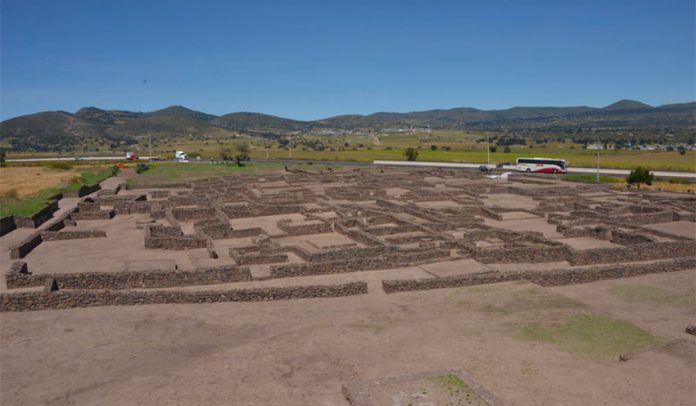
The archaeological dig at the site of the Aztec town of Zultépec.

Spanish conquistadores massacred women and children in an Aztec-allied town 500 years ago after the indigenous residents sacrificed and apparently ate a group of Spaniards they captured, according to new research.

The National Institute of Anthropology and History (INAH) has published findings from decades-long excavation work at the Tecoaque, or Zultépec, archaeological site in Tlaxcala.

INAH said in a statement that indigenous Acolhua residents of the town of Zultépec captured members of a Spanish caravan that was part of an expedition led by conquistador Pánfilo de Narváez. The governor of Cuba, Diego Velázquez de Cuéllar, sent Nárvaez to Mexico in 1520 to stop the invasion of Hernán Cortés because he hadn’t authorized it.

After capturing members of the Spanish caravan, including women and children, the residents of Zúltepec sacrificed them over a period of “eight agonizing months” as an offering to the gods, INAH said.

In around January or February of 1521 it’s probable that the Acolhuas sacrificed the last of 450 people they had captured, among whom were also Cubans of indigenous and African descent who arrived with the Spaniards, and Tlaxcaltec, Totonac and Mayan people who allied themselves with the Spanish

Remains of the European victims of sacrifice.
Remains of the European victims of sacrifice. royecto Zultepec Tecoaque

At about the same time a hill in Zultépec where the people were sacrificed came to be known as Tecoaque, which in the Náhuatl language means “the place where they were eaten.”

That suggests that the Acolhua people ate the victims of their ritual sacrifices. It is also believed that they killed and ate horses upon which the Spanish arrived.

When they were killing the last of their captives in early 1521, the residents of Zultépec knew that there would soon be revenge for their actions, INAH said.

Indeed, Cortés – who led the expedition that conquered the Aztec capital of Tenochtitlán in August 1521 – ordered Gonzalo de Sandoval to carry out a revenge attack on the town after he found out what had happened to the members of the Spanish caravan.

Enrique Martínez Vargas, an archaeologist and director of the Tecoaque-Zúltepec site, said the attack likely occurred at the start of March 1521. He said that there are references to the attack in The True History of the Conquest of New Spain by Bernal Díaz del Castillo, a conquistador, and Cortés’ Third Letter of Relation to the Emperor Carlos V.

Fearing revenge, the Acolhua people of Zultépec tried to fortify the town by building walls and other defensive constructions but they were ultimately unable to stop the invasion on horseback led by Gonzalo de Sandoval.

Human bones were found in shallow wells where they had been hidden by the locals.Human bones were found in shallow wells where they had been hidden by the locals.
Human bones were found in shallow wells where they had been hidden by the locals. Melitón Tapia INAH

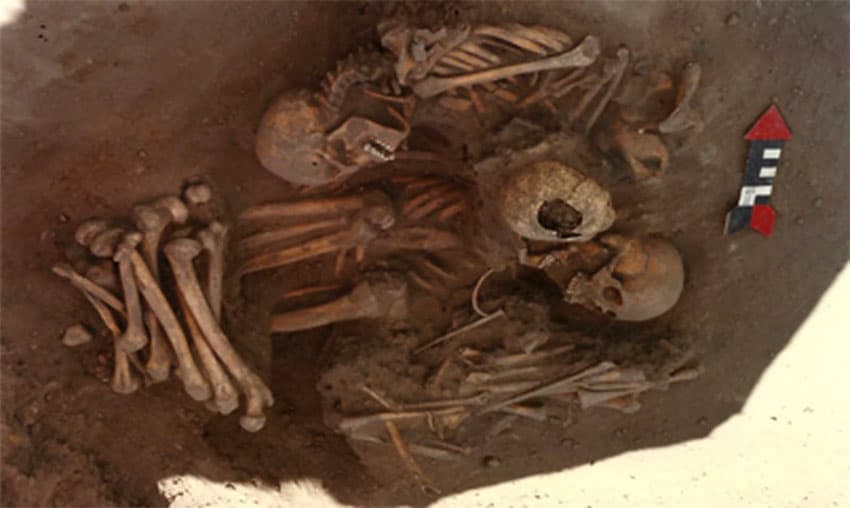
“Some of the warriors who had stayed in the town managed to flee, but women and children remained, and they were the main victims,” Martínez said. “This we have been able to demonstrate over a 120-meter stretch of the main thoroughfare, where the skeletons of a dozen women were found who appeared to be ‘protecting’ the bones of 10 children between the ages of 5 and 6 whose sex has not been determined.”

Martínez said that “women and children who were sheltering inside rooms were mutilated, as evidenced by the discovery of hacked bones on the floors.”

“The temples were burned and the statues of gods were decapitated. This is the way that this place, which represented a resistance for Cortés, was destroyed,” he said.

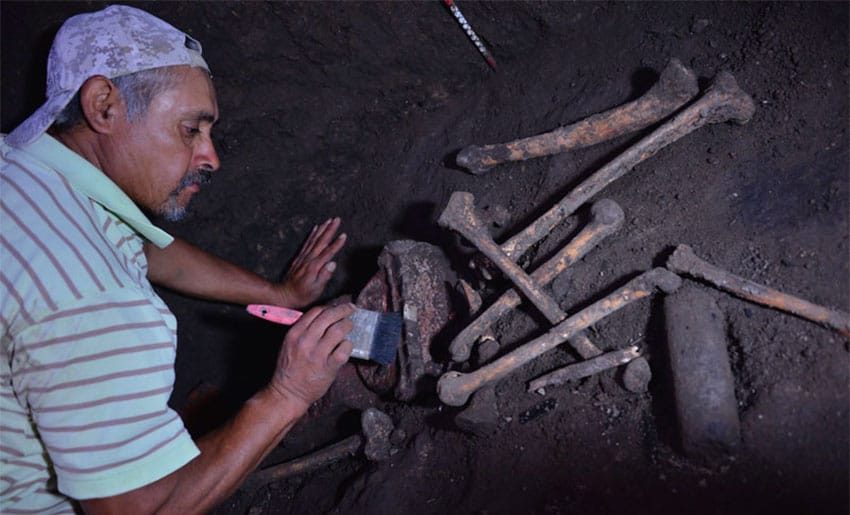
INAH said that the residents of Zultépec also hid evidence of their sacrifices in shallow wells when they became aware that a revenge attack would occur. Archaeologists have found human bones that were carved into trophies, the remains of animals brought by the Spaniards (cows, goats and pigs) and a wide range of personal objects that belonged to those captured, among other relics.

Mexico News Daily