Home Blog Page 1468

Government announces reparations for Chiapas massacre that killed 45

0
A protest by Tzotzil Maya at the National Palace in Mexico City.

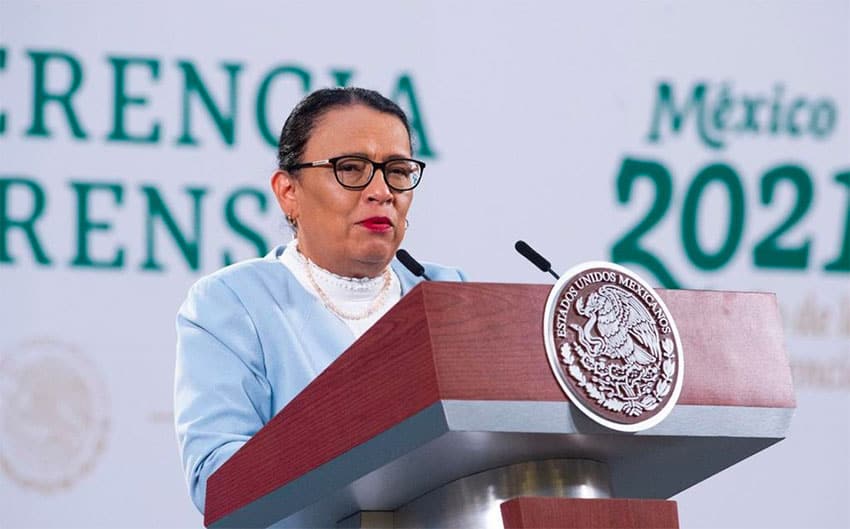
The federal government announced Thursday that it is preparing “20 actions of reparation” to compensate for a 1997 massacre in Chiapas that left 45 people dead.

Paramilitaries murdered 45 indigenous Tzotzil Mayan people — including 15 children and four pregnant women — in the village of Acteal on December 22, 1997.

Those slain were members of a Roman Catholic group known as Las Abejas (The Bees) that supported the Zapatista Army of National Liberation. They were praying in their church when they were gunned down by the paramilitaries, who were also Tzotzil Mayans.

The killers were labeled as members of the then governing Institutional Revolutionary Party, and an investigation found that local officials and police had done nothing to stop the massacre and later tampered with the evidence.

Dozens of people were arrested and convicted of the murders but most were released before serving their full prison sentences.

The Interior Ministry (Segob) said in a statement Thursday that the government is preparing “20 actions of reparation” – which it didn’t detail – for the victims of the massacre.

Segob said that its human rights department will sign a “friendly settlement agreement” with 30 victims of the massacre – family members of the deceased – that will include the provision of funds to carry out infrastructure projects in the region.

Acteal is located about 50 kilometers northeast of San Cristóbal de las Casas in the municipality of Chenalhó.

Segob said that the signing of the agreement will be a “starting point for the reconstruction of the social fabric in that area of Chiapas.”

The agreement complies with the will of the victims to move peacefully toward a range of reparation measures that include “recognition by the Mexican state of the events that led to the massacre,” the statement said.

Some of the compensatory infrastructure projects, about which no detail was given, will benefit not just the victims of the massacre but entire communities, Segob said.

“A categorical imperative for the government of Mexico is respect for the freedom and autonomy of indigenous peoples and communities,” the statement said.

“The government of Mexico firmly reiterates that the measures for the reconstruction of the social fabric are a necessary condition to move forward in favor of the pacification and cohesion of our country and, in particular, of all indigenous communities.”

Mexico News Daily 

Absent timeshare owners cost Baja California Sur economy US $150 million

0
The coronavirus has kept timeshare owners away.

While visitors are slowly starting to return, things are far from normal in Baja California Sur (BCS). The state’s Minister of Tourism, Luis Humberto Araiza, says that in Los Cabos the timeshare industry’s losses during the pandemic have amounted to US $150 million.

The destination is used to welcoming about 50,000 timeshare owners per month but there are currently around 15,000 timeshare owners in Los Cabos each month, Tribuna de Los Cabos reports.

However, at least now they have something to do. As of yesterday, 1,500 tour companies in the state were allowed to get back to business as providers of walking, diving, snorkeling, kayak and glass-bottom boat tours, among other activities, were allowed to reopen.

These businesses had been closed for four months, and in recent weeks had protested, demanding they be allowed to open. 

Confinement has been rough everywhere, and BCS is no exception. Officials report that between March and July, more than 260 people filed for divorce in the state, with 157 in La Paz and 105 in Los Cabos. 

Thirty-five people in Los Cabos have officially gone missing since the pandemic began, according to BCS Noticias

Since late March, more than 6,000 people across the state have obtained free psychological help by phone.

Of those served, 3,800 reported symptoms of anxiety and depression, 1,160 were in violent situations, 1,000 called due to addiction issues and 90 needed support for grief, Health Minister Victor George Flores said.

As of Thursday, BCS had recorded 3,482 confirmed cases of the coronavirus and 124 deaths, including that of Los Cabos Police Chief Celso Filemón Lázaro Pérez earlier this week.

Street food sanctions

Blanca Pulido Medrano, head of the State Commission for the Protection of Sanitary Risks (Coepris), said her agency has conducted 1,399 inspections of food stands and sanctioned 102 for not following proper sanitary measures, reports BCS Noticias.

'Everybody and his brother' has a food stand now.
‘Everybody and his brother’ has a food stand now.

“Right now with the pandemic many people were left without a job and now it turns out that everybody and his brother has a food stand, but this is very delicate,” Pulido said, admitting that closing down businesses in a time of crisis does not make Coepris very popular. “I spoke with business representatives, with doctors of the municipalities, and you have to be careful because the issue of food handling is a component from a health point of view, and we must take care.”

Caught

Four men were arrested for drug possession in La Paz, Comondú, Los Cabos and Mulegé, BCS Noticias reported Wednesday when they were found in possession of a total of 1,643 doses of methamphetamine. In La Paz, a 22-year-old was caught with 925 doses, and a man in Guerrero Negro was found in possession of 250 doses. In Ciudad Insurgentes, a man named Guillermo had 125 doses of meth on him, and a man who goes by the nickname “El Tortas,” or “Sandwiches,” who was in possession of  125 doses of methamphetamine as well as 218 grams of marijuana, was arrested in San José del Cabo.

Finally caught

A man who had been on the run for 16 years after he was accused of murder in July 2004 was captured by the military this week in Hermosillo, Sonora. José Atalo had been on the state’s most-wanted list for years after he allegedly committed murder on the highway between Santa Rosalia and Guerrero Negro, El Sudcaliforniano reports.

Atalo, who is now 75, was apprehended in a joint effort by the military and authorities in BCS and Sonora. He is thought to have been a leader of a criminal gang operating in the northern part of the state at the time of the murder. 

Not caught

Two thermal imaging cameras have been placed in San José del Cabo’s estuary in order to prevent vandalism, authorities say. For years the fresh-water lagoon has seen its sand bar break open, draining its water into the Gulf of California and shrinking the habitat for migratory birds. 

Some think the estuary’s sand bar has been deliberately opened in order to harm the estuary and eventually dry it up so hotels can be built on its beachfront land, and the cameras are meant to be a deterrent. The estuary is an important part of the ecology of Los Cabos, and was one of the area’s first draws for foreign visitors when centuries ago cargo and pirate ships would stop to replenish their water supplies as they traveled the trade route between Mexico and the Philippines. 

Save the snakes

After being closed for four months, the critters housed at the El Serpentario de La Paz are getting hungry. The wildlife rescue and rehabilitation center, which has been around for 20 years, is home to 600 snakes, lizards, birds and other animals, including abandoned exotic pets. 

Turtles enjoy donated food at the Serpentario de La Paz.

Normally open to school groups and other visitors, the non-profit center, which is run by volunteers, relies on ticket sales to feed their animals, which eat vegetables, fruit and chicken. Serpentarium workers are asking for community support to keep the animals they have rescued alive and in good condition.

Mexico News Daily

Life in rural Mexico: when the thunder rolls, the lights go out

0
Upon hearing the sound of distant thunder, residents of rural Mexico bring out their candle collections.

I live in the rustic community of Pinar de la Venta, located eight kilometers west of the city of Guadalajara at the edge of the sprawling Primavera Forest.

In Mexico, electricity is usually referred to as luz (light) and, in fact, within days of moving into my new home, I realized I had a light problem: all the bulbs in the house kept burning out, sometimes within a week of screwing them into the socket.

Officially, Mexican luz is supposed to be 127 volts, a rather odd number which a cynic might say was chosen at some point in the past to make sure all electrical appliances smuggled into Mexico from the United States (and made for 110 volts) would quickly burn out.

Now 127 may represent the official voltage of Mexico, but my multimeter revealed that at my home I actually had around 135 volts. I say “around” because every time I measured it, I got a different number. Now, old-fashioned incandescent light bulbs used to burn out because of the jolt their filaments received when you switched on the light, so I solved our problem by installing dimmers in every room.

The result was beyond all expectation. Instead of burning out in a week, my bulbs would last much longer than the manufacturer would ever want them to. Some of them have blazoned brightly for as long as a decade and a few are definitely going to outlast me.

A power failure, like any other mishap, can open doors and spark new awarenesses.

While excessive voltage presents a problem on some days, we are also treated to the opposite: brownouts. Of course I run for my multimeter: “What? 87 volts!” Well, that is just enough to heat up the motor in your fridge in a big way, but not quite enough to make it run properly. Better unplug it fast!

Believe it or not, a brownout is even worse than a blackout. Both, however, if they go on for more than 24 hours, will result in a fridge full of spoiled food. The Federal Electricity Commission (CFE) claims they will come and fix your power problem within four hours, but many a time it has taken them three days to show up and I wouldn’t know how to calculate how much food was thrown away on those occasions, here in my community.

Back to the wonderful dimmers that fixed my light bulb problem. These I naturally had to buy in the U.S., because at that time, in the 1980s, I couldn’t find them in Guadalajara. While on the north side of the border, I also bought a desktop computer, congratulating myself because in the U.S. I could get one for half the price I would pay in Mexico. It was, in fact, the very first computer I ever owned … but not for long.

Upon arrival at home in Pinar de la Venta, I plugged in my new desktop and turned it on.

A wisp of smoke floated out of the machine’s vents, carrying to my nose the unmistakable, acrid smell of burning electronics. I could hear a slight crackling as well.

My eyes popped. I jumped into the car and drove off to the nearby community of Rancho Contento where there was a public telephone that frequently worked.

I called a friend who knows all about computers and told him what happened.

“You — you plugged it straight into the wall socket?” he gasped.

When I said yes, my friend groaned.

“John, you have to have a voltage regulator and a surge protector … and you’ve got to buy a battery backup as well … and all of these things have to be properly grounded.”

Now it was my turn to groan.

However, I was learning how to deal with rural Mexico’s capricious current. I bought all the protective gear I would be needing and made inquiries about how to ground my system.

A canyon wall reveals the deep layer of pumice and ash found in many parts of Jalisco.

In a ferretería (hardware store) they sold me a long copper pole, half an inch wide, with a clamp at the top.

“Pound this into the earth,” they told me, “and you’re all set.”

I followed instructions and then tested my ground using the method I had learned as a radio amateur in high school. I put a 100-watt light bulb between the “hot” wire of my electrical system and my new ground.

The bulb did not light.

Eventually I learned the reason. My community sits not upon good old earth or dirt, but upon a thick deposit of volcanic ash and pumice, which was spewed out of the Primavera Caldera 94,000 years ago in a massive explosion. Underneath the homes in Pinar de la Venta you will find no earth, but plenty of what people here call jal, the jal of Jalisco, and jal is practically useless as a physical ground.

I solved the problem by digging a long, deep trench and filling it up with all sorts of metallic junk, all the pieces soldered one to the other and the whole shebang neatly buried.

Now my test bulb lit up brightly.

Having set up my full array of protective devices and measures designed to calm down and control rural Mexico’s wild and unpredictable “luz,” I drove back to the U.S. with my dead computer which, of course, was still under warranty.

I placed it on the counter. “This thing doesn’t seem to be working right,” I said.

The attendant took my computer into the back room. After a while I could hear snatches of a conversation:

“Holy mackerel, take a look at this!”

“The whole motherboard — I can’t believe it!”

“This is pumice,” says a 6-year-old, lifting a rock which, although wet, is still light.

The attendant returned.

“Er, sir … your computer has, ahem, some problems … it may take a couple hours before we have it ready.”

No problema,” I said. “I’ll just go and do some shopping.”

Over the years I’ve learned how to protect electrical devices from bizarre fluctuations of voltage, but every year when the rainy season comes and we hear the rumble of thunder in the distance, my wife and I run for our horde of candles.

“In Pinar de la Venta,” a neighbor once said, “every time somebody breaks wind, the lights go out.”

We, however, are ready to deal with this. As cave explorers, we naturally have a vast collection of flashlights and headlamps at our disposal. Nevertheless, I have to admit that we would never be able to manage in rural Mexico without the good old wax candle, for which, I understand, we can thank the Romans.

But, of course, there is, literally, a bright side to it all: when the storm is over, every room in our little house is awash with romantic candlelight and outside all the street lamps are dark, leaving us with a gorgeous view of a big sky, brimming with stars.

The writer has lived near Guadalajara, Jalisco, for more than 30 years and is the author of A Guide to West Mexico’s Guachimontones and Surrounding Area and co-author of Outdoors in Western Mexico. More of his writing can be found on his website.

Mexican Grand Prix auto race postponed until 2021

0
Mexican driver Chico Pérez: coronavirus situation is complicated.

The 2020 Mexican Grand Prix Formula 1 auto race will be postponed until 2021 due to the coronavirus pandemic, officials announced today, calling the health crisis a force majeure.

Those who have already purchased their tickets for the race — 60% had already been sold — will be reimbursed or can elect to use them next year at the event’s home track, the Hermanos Rodríguez speedway in Mexico City. Last year’s Grand Prix drew 345,694 fans.

The race, which was first held in 1962, is sanctioned by the International Automobile Association and is an official Formula 1 event.

Formula 1 has decided to eliminate the entire Americas tour. Canada was the first to announce that it would not hold a race this year, followed by Mexico, the United States and Brazil.

In a statement, Formula 1 said the decision was “due to the fluid nature of the ongoing Covid-19 pandemic, local restrictions and the importance of keeping communities and our colleagues safe.”

Race organizers had considered holding the Grand Prix without fans in attendance but felt it wouldn’t be fair to racing aficionados. 

Drivers are disappointed but seem to be taking the news in stride. Mexican driver Sergio “Checo” Pérez posted a message to social media when he heard the news. 

“It hurts for the fans, for the organization and for my whole country, because it is always a great opportunity to show how great we are. I know they support me with every lap I take and I hope I can give them a lot of satisfaction the rest of the year,” Pérez said. “This is also an example of how complicated the pandemic situation in Mexico is,” he added, while reminding people to follow coronavirus protocols. 

In return, Formula 1 added three races to its European racing calendar in Germany, Portugal and Italy. 

Source: Milenio (sp), NBC Sports (en), El Universal (sp)

Increased hospital occupancy will leave Mexico City on orange next week

0
Another patient is wheeled into a Mexico City hospital.
Mayor Claudia Sheinbaum said Friday that Mexico City will remain at the orange alert level due to a growing demand for hospital beds and fears that there could be a resurgence of coronavirus cases.

The city remains at the second-highest risk level due to the increase in the number of hospitalized coronavirus patients during the last five days, Sheinbaum explained.

“We call on all the inhabitants of Mexico City to protect themselves,” she cautioned, adding that safe distance measures and the use of face masks must continue.

Currently, 2,674 people with the coronavirus in Mexico City are in hospital, and 774 are on ventilators.

If the number of hospitalized patients with coronavirus reaches 5,000 in the Valley of México, the city will revert to the red light, or maximum risk level. 

“According to the epidemiological stoplight of the Ministry of Health, if occupancy increases to more than 5,127 beds, we would need to be taking more restrictive measures and have to return to a red light and stay like that for several weeks so that we can drop the level of hospitalization in the city,” Sheinbaum warned.

Not changing the trend of the virus could lead to exponential growth and a return to maximum-risk restrictions by October. 

Permitted activities will remain unchanged next week, although businesses in the city’s historic center, where the largest crowds of people have been seen, will close at 5 p.m. instead of 6 p.m. and will be closely monitored for compliance.

As of Friday, officials said, there have been 66,444 confirmed cases of the coronavirus in Mexico City and 8,638 deaths. Active cases currently number 4,638.

Source: Reforma (sp), Aristeguinoticias (sp), Milenio (sp)

Odebrecht paid US $10mn to fund Peña Nieto’s campaign, pay bribes: Lozoya

0
Videgaray, left, Peña Nieto, center, and Lozoya with members of the campaign team in 2012.

The Brazilian company Odebrecht funded the 2012 political campaign of former president Enrique Peña Nieto to the tune of US $4 million and gave another $6 million to his government after he took office, according to former Pemex CEO Emilio Lozoya.

The newspaper Reforma reported Friday that Lozoya, extradited to Mexico by Spain last week to face corruption charges, told the federal government about the payments before his extradition.

In a document submitted to the government and seen by the newspaper, Lozoya said the $4-million payment was used to pay foreign consultants who provided electoral advice to Peña Nieto’s campaign in the lead-up to the 2012 presidential election.

The ex-Pemex chief alleged that Luis Videgaray, Peña Nieto’s campaign manager, hired the foreign consultants. Videgaray later went on to serve as finance minister and foreign affairs minister in the 2012-18 federal government

Lozoya said Odebrecht also made a $6-million payment while Peña Nieto was president in exchange for a 3-billion-peso ($135 million at today’s exchange rate) contract for work on the state oil company refinery in Tula, Hidalgo.

Part of that money was used to pay bribes to opposition party lawmakers to ensure that the former government’s energy reform passed Congress, the former official said.

In his report to the current government, Lozoya said that while working on Peña Nieto’s campaign he attended a meeting with Odebrecht’s then Mexico chief Luis Alberto Meneses Weyll at a bakery/cafe in the upscale Mexico City neighborhood of Lomas de Chapultepec.

He said he met with Meneses on the orders of Videgaray, who instructed him to negotiate resources to cover the expenses of hiring the foreign consultants.

Lozoya said that Meneses, a Brazilian national, committed to giving Peña Nieto’s campaign $4 million and that the majority of that amount – $3.15 million – was deposited into an account of an offshore company called Latin America Asia Capital Holding.

The former Pemex CEO said he told both Videgaray and Peña Nieto that Odebrecht had deposited the funds into the account.

Lozoya said that Odebrecht – which has been embroiled in corruption scandals in several Latin American countries – transferred the $6 million to Fabiola Tapia Vargas, administrator of Construcciones Industriales Tapia, a company that collaborated with the Brazilian firm on the work at the Tula refinery.

Peña Nieto, left, and Videgaray, right, accepted cash from Odebrecht according to Lozoya.

Lozoya said that Tapia, who died in May 2014, gave him a bank card for the account into which the $6 million was deposited. He said the directive he received was to make the funds available to the federal government.

Lozoya said that just under 52.4 million pesos ($2.4 million today) was used to pay bribes to National Action Party (PAN) legislators in exchange for their support for the former government’s 2013 energy reform and other initiatives.

He said that bribes were paid to the lawmakers at an office in Lomas de Chapultepec by David Penchyna, a former Institutional Revolutionary Party senator and president of the upper house’s energy committee.

Reforma reported last week that Lozoya had agreed to hand over at least 12 videos of politicians accepting bribes in exchange for supporting the former government’s energy reform.

Lozoya says that Peña Nieto and then finance minister Videgaray directly led the bribery scheme.

The ex-official also said that Videgaray personally asked him to arrange a 6.8-million-peso payment to Ricardo Anaya, a former federal deputy who later became the PAN’s national president and the party’s candidate in the 2018 presidential election. Anaya allegedly received the money in August 2014.

Among the other legislators who allegedly received bribes paid with the Odebrecht funds are current governors Francisco Domínguez of Querétaro and Francisco García Cabeza de Vaca of Tamaulipas.

Lozoya provided information to the federal Attorney General’s Office about the Odebrecht bribes, and has agreed to collaborate with it more widely, in the hope that he will receive a reduced sentence for his role.

He is accused of money laundering, criminal association and involvement in bribery. In addition to alleged wrongdoing in relation to the Odebrecht case, Lozoya is accused of benefiting from the 2015 purchase by Pemex of a rundown fertilizer plant in Coatzacoalcos, Veracruz, at an allegedly vastly inflated price.

He was arrested in Spain in February and brought to Mexico last Thursday aboard a government plane. He was immediately transferred to a private hospital to be treated for anemia and an esophagus problem.

President López Obrador said Monday that Lozoya must be protected because he is cooperating with authorities and his life could be in danger.

He said the information provided by the former state oil company chief “will be of great public utility because it will help to banish corruption.”

Lozoya is the second high-ranking member of the Peña Nieto government to be taken into custody on corruption charges after former cabinet minister Rosario Robles, who allegedly participated in the embezzlement scheme known as the “Master Fraud.”

Source: Reforma (sp) 

Hospital occupancy at ‘alarming levels’ in Nuevo León due to virus admissions

0
The five marble statues in the Nuevo León municipality of San Pedro Garza García, known as Los Gigantes, donned face masks this week.

Hospital occupancy is at “alarming levels” in seven of eight Mexican Social Security Institute (IMSS) hospitals in Nuevo León due to increased admissions of coronavirus patients, Governor Jaime Rodríguez Calderón said Thursday.

Rodríguez told a virtual meeting with the state’s mayors that occupancy levels are between 74% and 91% in the IMSS facilities. He also said that private hospitals in the northern border state have a shortage of ventilators.

Data presented by the federal Health Ministry at Thursday night’s coronavirus press briefing showed that 78% of general care hospital beds set aside for coronavirus patients in Nuevo León are currently occupied while 55% of those with ventilators are in use.

Nuevo León has the equal highest occupancy rate for general care beds among Mexico’s 32 states and the third highest rate for beds with ventilators, according to the data.

Rodríguez, a former presidential candidate widely known as “El Bronco,” said that some private hospitals have occupancy rates above 90% and that an average of 63% of beds are filled in those operated by the State Workers Social Security Institute and the army.

Governor Rodríguez, center, says mobility needs to be reduced to control virus.

Nuevo León Health Minister Manuel de la O Cavazos said 1,341 coronavirus patients are currently hospitalized and that 44 Covid-19 deaths were reported in the previous 24 hours, the state’s highest single-day total.

The state government has recorded a total of 26,856 confirmed cases of coronavirus and 899 deaths but the federal Health Ministry is currently reporting only half that number of cases and 820 fatalities.

Federal authorities estimate there are currently 3,920 active coronavirus cases in Nuevo León, the third highest total in the country after Mexico City and México state.

Given the recent increase in case numbers, no date has yet been set for the start of the new school year, Rodríguez said, adding that classes will mostly likely be held online until the end of the year.

“We’re not going to start the school year while we don’t have the conditions [to do so],” he said. “I don’t think we’ll be able to open schools this year, it will be difficult.”

De la O told the mayors that three of the 10 indicators on Nuevo León’s “stoplight” system, used to determine which restrictions can be eased, are currently red.

The average number of new cases reported daily, the state’s coronavirus reproduction rate and the average number of daily Covid-19 deaths are the main causes of concern.

De la O said that if one more indicator switches to red, tighter economic restrictions will be reimplemented.

“I’m angry because we can do more as a society [to stop the spread of the coronavirus],” he said.

The health minister said that some people have downplayed the importance of the mitigation measures and are leaving their homes to carry out nonessential activities.

Later on Thursday, Governor Rodríguez  said on Twitter that he will order nonessential businesses to close if a fourth coronavirus indicator turns red.

“We still have three indicators on red, four on orange and three on green. As a result, we’ll continue as we were: we won’t open anything else and we won’t close anything. However, if we happen to have another indicator in red, we will have to close stores and services,” he wrote.

“We have to be stricter [in the observance of health recommendations]. Our health system is strong but our heroes are tired. We have to keep the spread of the virus under control. If we reduce mobility to the maximum, … we’ll soon be better off in terms of infections and hospitalizations and with that we’ll give our doctors a rest.”

Source: La Jornada (sp), Reforma (sp) 

World’s largest roll-on/roll-off ship berths in Veracruz

0
The Siem Confucius in Veracruz this week.

The world’s largest “roll-on/roll-off” cargo ship designed specifically for carrying wheeled merchandise such as cars docked at the port of Veracruz Wednesday in the first leg of its maiden voyage. 

Commissioned by Volkswagen, the Siem Confucius relies exclusively on liquefied natural gas (LNG) for fuel. LNG-powered vessels produce 25% fewer carbon dioxide and 100% fewer sulfur dioxide emissions.

The Siem Confucius and its sister ship, the Siem Aristotle, measure 200 meters long by 38 meters wide and have 13 car decks, meaning they can carry about 7,500 cars each when fully loaded. 

Kenneth Ross, CEO of Siem Car Carriers which built the ships, calls them the most innovative, efficient and environmentally-friendly ships in the world. “If you look at everything from their optimized design, speed reduction, the shape of the bow, even the quality of the paint – it’s a genuine breakthrough,” Ross says. 

Miguel Ángel Yáñez Monroy, director of the port of Veracruz, said the Siem Confucius offloaded 357 Audi, Volkswagen, Seat, Porsche and Bentley models from Europe and loaded 3,050 Volkswagen and 2,350 Audi vehicles produced in Puebla. They were bound for Germany after stops in the United Stated and Canada as part of its “America Round Tour” route.

The vessel, which sails at an average of 16.5 knots in “eco-mode” and 19 knots in full-service mode, left the port of Emden, Germany, on June 16, docking in Mexico on July 22.

The port of Veracruz moves about 1 million cars per year, Yáñez said, although the coronavirus has disrupted vehicle movements and demand has collapsed. 

The arrival of the Siem Confucius is a positive sign for the reactivation of the economy, he said, highlighting that the arrival of the ship indicates that, at least for the automotive industry, things are getting back to normal.

Source: T21 (sp)

Economic activity fell 21.6% in May to lowest level ever recorded

0
The services and retail sector, which employs more than half of all workers, declined 3.2%.

The coronavirus pandemic and associated restrictions ravaged Mexico’s economy in May, new data shows.

The national statistics institute Inegi reported Friday that economic activity declined 21.6% in May compared to the same month of 2019. The contraction was the worst year-over-year decline since comparable economic records were first kept in 1993.

May was the second full month in which nationwide coronavirus restrictions were in force. The economic slump in the fifth month of the year followed a 19.67% annual contraction in April.

Activity in the tertiary sector of the economy, which includes services and retail, declined 3.2% in May compared to the previous month, Inegi said. The result will have a significant impact on Mexico’s overall economic performance this year as the tertiary sector contributes to about 65% of Mexico’s GDP and employs more than half of all Mexican workers.

Secondary activities, including manufacturing, mining and construction, fell 1.8%, Inegi said.

The only bright spot was that the primary sector, which includes farming and fishing, grew 1.6%.

Mexico’s economy is forecast to suffer a deep recession in 2020 as the coronavirus pandemic continues to exact a heavy toll on the country.

The International Monetary Fund is predicting that GDP will shrink 10.5% this year, more than any other Latin American country.

The coronavirus-induced crisis is predicted to push millions of Mexicans into poverty, and human rights activists have warned that the pandemic has already deepened inequality.

Investment bank Goldman Sachs said in a note to clients that the federal government’s “underwhelming” fiscal response to the coronavirus crisis does not bode well for a strong economic recovery in the short term.

“The weak fiscal policy response to the pandemic … is likely to lead to a deeper contraction and a shallower recovery.”

Source: El Economista (sp) 

Mexico’s poorest municipality records its first coronavirus case

0
Corn dries in a yard in Santos Reyes Yucuná.

Mexico’s poorest municipality, Santos Reyes Yucuná, Oaxaca, reported its first confirmed case of the coronavirus on July 17, four months after the pandemic reached Mexico.

The virus took longer to find its way to this remote, Mixtec community located 217 kilometers from the state’s capital due to its lack of infrastructure, especially roads.

The social development agency Coneval estimates that 99.9% of the municipality’s population of 1,380 lives in poverty, most at extreme levels. There is no hospital in the area, and most residents do not have government health insurance or the means to travel to a hospital in another city, should they fall ill. 

Another town in Oaxaca’s Mixteca region, Coicoyán de las Flores, is in a similar situation with much the same levels of poverty. One case of the coronavirus was reported last month and the patient, a 25-year-old woman, died. 

Last weekend, 23 new cases of Covid-19 were registered in the Mixteca region, for a total of 482 positive cases and at least 48 reported deaths. The area’s municipal seat, Huajuapan, has the highest number of cases at 30, with three people hospitalized. 

[wpgmza id=”8″]

Earlier this week the mayor of Santos Reyes Yucuná, Sergio Francisco Amado Aja, asked Oaxaca Health Services (SSO) and the state governor to assign medical and nursing personnel and send medications and medical supplies to the town’s clinic.

“In this rainy season, there are times when children or people get sick with the flu, but it might be confused with another type of illness or Covid-19. That’s why we are asking for doctors at the clinic so that people do not have to be moved to the city of Huajuapan,” he said. “We do not have public transportation, and apart from that there is no money for transportation, and receiving care in Huajuapan is very expensive.”

Source: Expansión Política (sp), Informativo 6 y 7 (sp), Diario Marca (sp), El Imparcial (sp)