Home Blog Page 1482

BCS coronavirus deaths increase 359% since lockdown was lifted

0
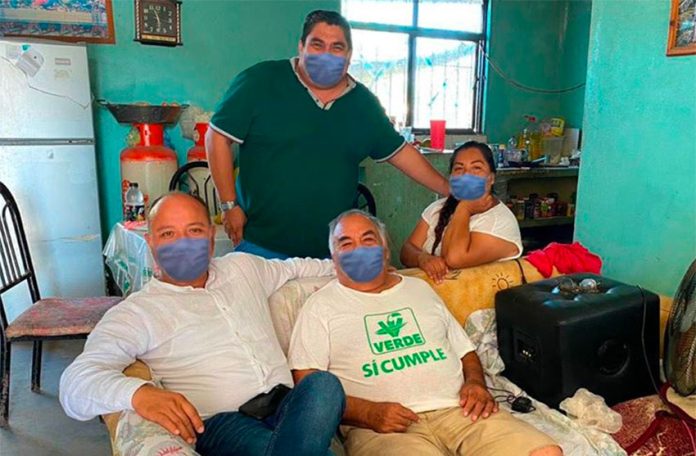
#LordPhotoshop, seated at left, posted digitally altered photos to Facebook, adding masks to people's faces.

Baja California Sur (BCS) Health Minister Víctor George Flores said this week there has been a 359% increase in coronavirus deaths in the six weeks that the state has been at the orange risk level.

Up until June 15, when the lockdown was partially lifted, the state had seen 37 coronavirus deaths, but as of Friday there have been 169.

According to state statistics, 60% were men and all had comorbidities such as diabetes (52%), hypertension (41%) and obesity (40%). 

The highest concentration of deaths was in La Paz (48%) followed by Los Cabos (27.6%), Comondú (13.5%), Mulegé (8%) and  Loreto with just 1.7%

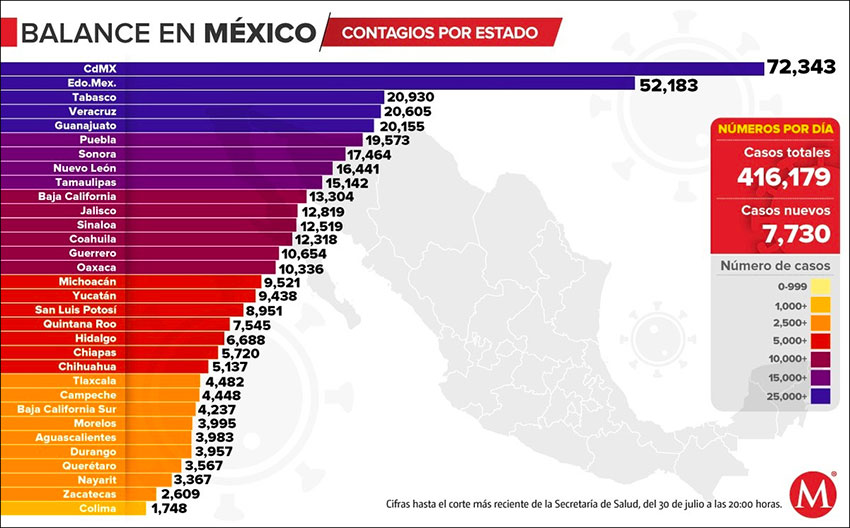
The total number of coronavirus cases recorded in the state is 4,237. BCS has the highest per capita rate of infection in the country, at 119.62 cases per 100,000 people. By comparison, Mexico City rate is 75.1 cases per 100,000. 

BCS Noticias reports that the federal government is threatening to sanction states, including BCS, that are at maximum risk yet refuse to return to lockdown.  

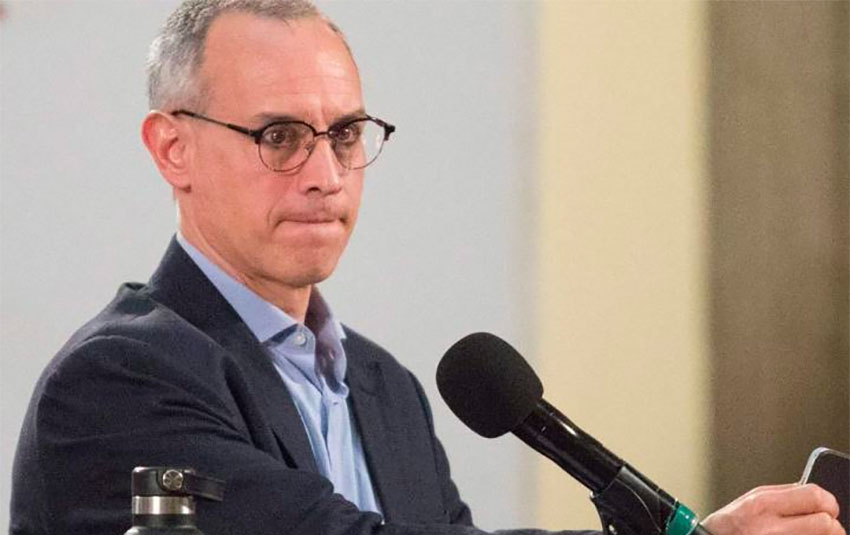
“If the federal government says you are in red and the state says it is in orange and is going to allow these other activities, the state must answer for its sovereign decisions,” coronavirus czar Hugo López-Gatell explained.

Meanwhile, despite the fact that all beaches in BCS except those in Los Cabos are closed to prevent the spread of the coronavirus, last weekend nearly 800 residents of La Paz thought the rules did not apply to them. 

Susana Rubio Lucero, head of the Federal Terrestrial Maritime Zone of La Paz (Zofemat), said that 303 vehicles and 783 people were turned away when trying to access the beach.

Also turned away was a group of people who refused to follow sanitary protocols when entering the state this week, BCS Noticias reported. 

A bus full of tourists heading south from Mulegé was detained by police at a checkpoint on the road to Santa Rosalía and forced to turn around for failing to comply with sanitary measures, Carlos Godínez of Civil Protection said. The bus had 10 more people than it could safely carry while respecting social distancing guidelines. 

Photoshop fail

Comondú Mayor José Walter Valenzuela Acosta is being mocked on social media for editing images by putting coronavirus masks on the faces of people who appear in photos on his Facebook page, El Debate reports.

“This very productive Thursday in Puerto San Carlos we visited my friends, we listened to their needs, always closely with everyone in the community, of course with healthy distance and all the measures of health and hygiene,” the mayor wrote in a post accompanied by several shots from a recent visit to the fishing village.

It is obvious that light blue face masks have been digitally added, earning him the nickname #LordPhotoshop on social media.

“How embarrassing. He should just acknowledge he wasn’t wearing a mask rather than covering up his negligence in that way,” commented a user. “I don’t know what is more false, his politics or his masks,” wrote another.

Model behavior

Canadian fashion model and former America’s Top Model contestant Winnie Harlow is in Los Cabos to celebrate her 26th birthday. Harlow, who was discovered by Tyra Banks in 2014, is also a spokesperson for the skin condition vitiligo.

The model, who has posted shots of herself poolside at the Nobu Hotel in Cabo San Lucas and riding camels on the beach for her 8.1 million Instagram followers, has been featured in Glamour, Vogue Italia, Cosmopolitan and Ebony magazines, among others.

Film shot in San Ignacio dominates

The film Polvo, shot entirely in San Ignacio, has received a total of 11 nominations for the Ariel Awards, Mexico’s version of the Oscars, including best picture, best actor and actress and best original screenplay. 

Directed by José María Yazpik, who also stars in the film, Polvo tells the story of a man who returns to his hometown after a decade to recover a shipment of cocaine. Yazpik, who spent his summers in San Ignacio as a child, makes the town itself a character in the social satire that has met with positive reviews. The winners will be announced on September 20. 

Mulegé murders

The state Attorney General’s Office (PGJE) reported that shots were fired just after midnight on Monday in the Nueva Oaxaca neighborhood in Villa Alberto Andrés Alvarado Arámburo.

According to BCS Noticias, when authorities arrived on the scene they found three men who had been murdered in the middle of the street. The victims have not been identified. 

Violence against women soars

The general director of the Women’s Institute in Los Cabos, Lorena Cortés Torralbo, reports that violence against women has increased 370% since April, when 80 cases were reported, to July which has seen 376 cases. Calls for help have been so numerous that the organization had to set up an additional hotline to meet the increased demand, BCS Noticias reports. 

Free trees

To fulfill his campaign promise to plant 50,000 trees, the Mayor of La Paz is giving away 2,500 trees to residents of the capital city, BCS Noticias reports. 

The giveaway will take place Fridays and Saturdays in various neighborhoods, reforestation coordinator Erick Daniel Aguilar Velázquez said. The saplings have been grown in the municipal nursery and are ready to plant. Several varieties are available including Washingtonian palms, guava trees and Royal Poinciana, known in Spanish as tabachín.

Mexico News Daily
Mexico signs accord with UN to collaborate in purchase of medical supplies

0
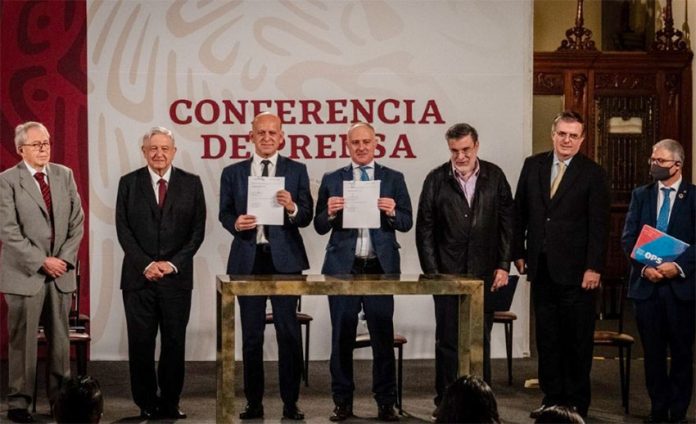
Friday's signing of the UN agreement.

The federal government signed an agreement with the United Nations Office for Project Services (UNOPS) on Friday to collaborate on the international purchase of medicines, medical supplies and vaccines.

President López Obrador said the agreement will allow Mexico to obtain high quality medications and equipment all over the world at low prices and thus put an end to shortages.

He said the collaboration with UNOPS will also stamp out corruption in the purchase of medicines, noting that money has been stolen in the past and adulterated products have been distributed.

The president thanked lawmakers for passing a law that enables the government to make consolidated purchases abroad and reiterated that a state-owned company will be created to distribute medicines, medical supplies and vaccines across the country.

Health Minister Jorge Alcocer explained that UNOPS will provide technical assistance and advice to the National Institute of Health for Well-Being — Insabi for short — as the government department prepares to make purchases of medications and medical products abroad.

He said transparency and the absence of corruption are important to the government in such purchases.

Alcocer said Mexican pharmaceutical and medical supplies companies will still be able to bid for government contracts but added that in order to be considered they will have to “comply with the high levels of quality and honesty” the government and UNOPS demand.

UNOPS Mexico director Fernando Cotrim Barbieri said his office will initially collaborate with the government on its 2021 consolidated purchase of medicine and supplies.

Foreign Affairs Minister Marcelo Ebrard noted that UNOPS has also collaborated with Mexican authorities on the tendering process for the Maya Train and a new e-passport, among other projects.

Source: El Financiero (sp), Reforma (sp) 

AMLO says he will start using a face mask when there’s no corruption

0
lopez obrador
A rare sight.

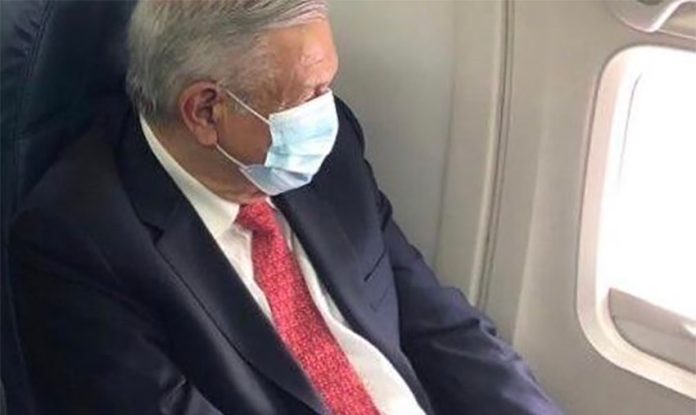
It might be a long, long time before President López Obrador wears a face mask to protect himself and others from Covid-19 — it all depends on his war against corruption.

After opposition politicians said they would seek a legal order to have the president wear a mask, he declared Friday that he won’t wear one until the country is free of corruption.

“I am going to put on a mask, you know when? When there is no corruption anymore, then I will put on my mask. So, we have an agreement, let’s hurry to put an end to corruption so I can put on my mask …” he said.

National Action Party legislators in the Chamber of Deputies announced Thursday that they will seek to legally compel the president to wear face masks at public events in order that he set an example to help prevent the spread of the pandemic.

“Science proves it, even if some say it doesn’t. If he used a mask during his visit to Washington, why does he refuse to use it here?” party spokesman Carlos Castaños said. 

Citizens Movement party Deputy Mara Robles of Jalisco has also launched a “plea” that the president wear a mask in public through a petition on change.org.

“Millions of Mexicans trust you. Few politicians have achieved leadership in recent history. For this reason, it is vital to us that you promote the use of the mask for the public and also encourage the undecided, setting an example by using it at your public events,” Robles wrote. As of midday Friday, the petition had 17,279 signatures. 

Although actual numbers are thought to be significantly higher, Mexico has reported 416,179 cases of the coronavirus, making it the sixth most infected country in the world.

Source: Reforma (sp)

US pressures Mexico on water treaty as Chihuahua protests turn violent

0
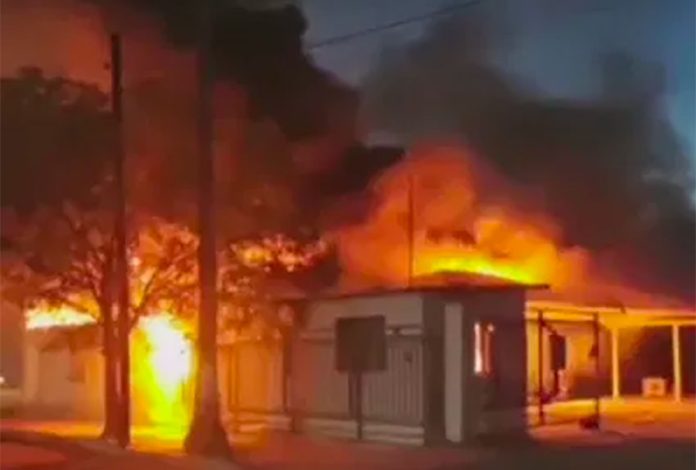
A government building burns in Delicias earlier this week.

A day after protests in Chihuahua against the payment of a “water debt” to the United States turned violent, a foreign affairs official revealed Thursday that the U.S. has contacted Mexico to ask it to comply with the 1944 bilateral water treaty.

Roberto Velasco, head of the Foreign Ministry’s North America department, told a press conference that farmers in the United States have pressured their government to lobby Mexico to deliver the water it owes to its northern neighbor.

Mexico has a massive water debt to the United States under the terms of the 1944 treaty, which the National Water Commission (Conagua) has been repaying by diverting water from dams in Chihuahua to the Rio Grande on the northern border for use by the United States.

Farmers in Chihuahua have staged several protests against the water diversion, arguing that they will be left with insufficient quantities.

Farmers north of the Rio Grande, Velasco said, are constantly saying to their government, “we want that water because we also want to irrigate our crops.”

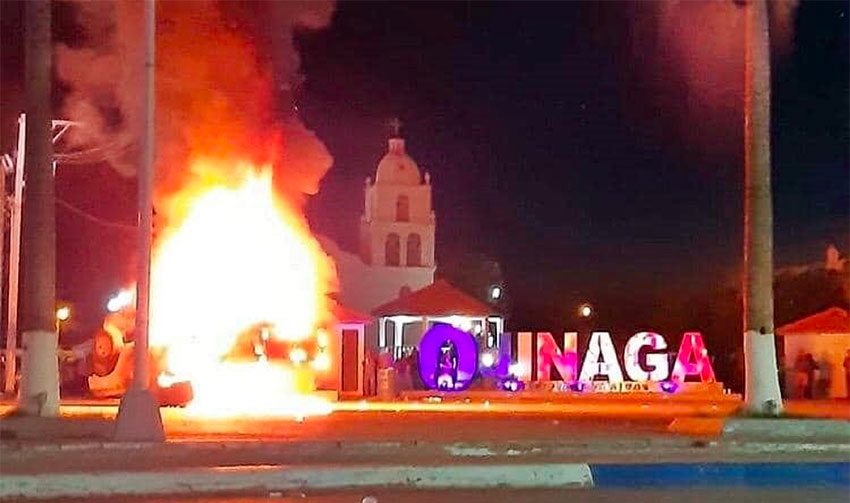
Protesters set fire to a vehicle during a protest Tuesday in Ojinaga.

Velasco said the government recently received correspondence from the U.S. section of the International Water and Boundary Commission (IBWC), an international body created by the U.S. and Mexico in 1889.

“They say Mexico has to take action now to comply with the [water treaty]. … They’ve said it in Washington, … they’ve said it publicly, they’ve sent us a diplomatic note as well,”  Velasco said.

He said that Mexico wants to settle its debt with its neighbor and claimed there is enough water to do so while guaranteeing supply for farmers in Chihuahua.

Velasco said that if Mexico fails to settle its 2020 water debt, the United States could seek a renegotiation of the existing treaty.

That could lead to Mexico losing certain advantages built into the existing agreement such as flexibility about when water “payments” are made, he said.

Conagua chief Blanca Jiménez said that as of July 23, Mexico was late in diverting some 292 million cubic meters of water to the United States. She highlighted that water from dams in Nuevo León, Tamaulipas and Coahuila has already been sent north and asserted that there will be enough water in Chihuahua even after more water is diverted from the La Boquilla Dam, located on the Conchos River about 200 kilometers south of Chihuahua city.

Farmers in the northern state take a very different view and have protested at that dam as well as other locations, and clashed with authorities.

A protest on Wednesday against further water diversion from La Boquilla and other Chihuahua dams turned violent, with at least a dozen cars, toll booths and state and federal government offices set on fire in the state’s central-south region.

Chihuahua police arrested 17 people, including five minors, who allegedly started the blazes and committed other acts of vandalism, state authorities said. The police seized vehicles, baseball bats, Molotov cocktails and other weapons from those detained.

“In relation to the events that occurred … in Camargo, Saucillo and Delicias, there will be no tolerance for those people who participated in these acts of vandalism,” said Chihuahua Attorney General César Augusto Peniche Espejel.

Lawmakers with the National Action Party (PAN) claimed that the troublemakers were not farmers but rather people with links to the ruling Morena party who infiltrated the protest.

“There are people who are seeking to discredit their struggle,” a group of 16 Chihuahua and federal lawmakers said in a statement. “The farmers don’t know the people who caused the disturbances, … we demand that the Attorney General’s Office investigate … and punish these violent groups.”

La Boquilla is one of the dams from which water has been diverted to the US.

The lawmakers also accused the federal government, in particular Conagua, of not understanding, nor wanting to understand, the water problems in Chihuahua, agricultural cycles and the needs of farmers.

In response, President López Obrador claimed at his morning press conference on Thursday that PAN politicians are in fact behind the protests, charging that they want to source water for their own business interests. He said his government is reviewing the management of water in the northern state, which is governed by a PAN governor, because he had information that water theft was occurring.

The president said that Mexico would comply with its obligation to send water to the United States but provided a guarantee that there would be sufficient water for both farmers and the general public in Chihuahua.

“We have to deliver water to the United States for a period; the agreement also allows us to have water, run-offs of water from the United States. …The opinion of technicians is that a renegotiation of this treaty wouldn’t be a good idea,” López Obrador said.

“We’ve had problems in Chihuahua because there is opposition to delivering water from dams in Chihuahua. I remind you that water belongs to the nation and is managed by the federal government in accordance with the constitution and laws. There has been resistance but we believe there is no reason for it. … Opposition politicians, in this case PAN politicians, are deceiving the people [saying] they’ll be left without water and that isn’t true.”

Source: Reforma (sp), El Universal (sp) 

After singer seen in a Oaxaca huipil, community’s artisans go online

0
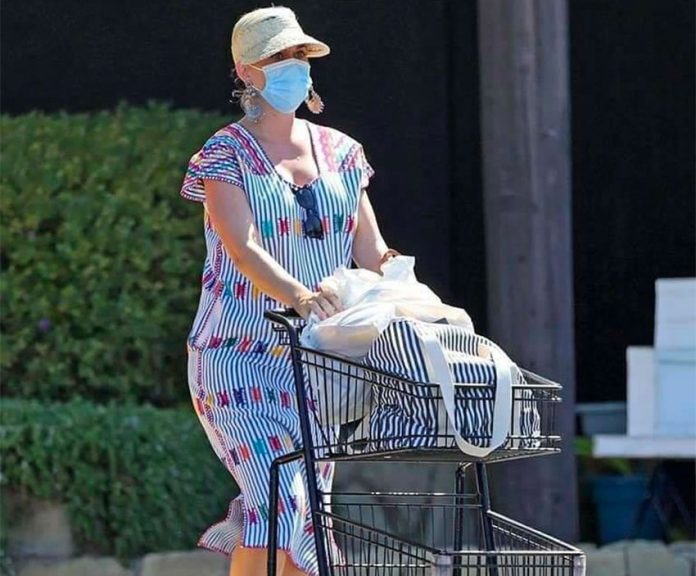
Singer Katy Perry wearing her huipil.

Original, handmade Oaxacan clothing is coming to Amazon after an Australian designer was accused of cultural appropriation.

The accusations came after pop star Katy Perry was photographed wearing a Oaxacan dress marketed by designer Pippa Holt, and prompted the state government to help local artisans market their goods directly to the public.

Perry, who is awaiting the birth of her first child in August, was seen on a trip to a supermarket in California earlier this month in a purple huipil, a traditional garment woven from cotton grown in the hills surrounding the town of San Juan Colorado in the state’s coastal region. 

Holt said she purchased the rights to the dress, and others, from Oaxacan artisan Felipa Hernández, then rebranded the huipil designs as Pippa Holt Kaftans, which she sells for 17,000 to 23,000 pesos (US $766 to $1,037) per dress.

Knives Out star Ana de Armas was also photographed this month wearing a Pippa Holt Kaftan, a garment that sells for 13,098 pesos.

The controversy over whether the former Vogue UK stylist appropriated the Oaxacan designs prompted Holt to post a statement to Instagram and turn off the comments. 

“We appreciate — we don’t appropriate,” a portion of the lengthy statement read. “We are part of a community and have worked with the same group of weavers for four years, helping build prosperity and sustainable business in their villages. We pay fairly and on time. We pay the weavers’ asking price, which is above market price for this kind of handwork. Our relationship is one of respect, trust and mutual benefit.”

In response, the head of the state’s DIF family services agency, Ivette Morán de Murat, announced a program where textile artisans will be able to sell their creations directly on Amazon, eliminating the need for intermediaries. 

“Today I proudly wear a huipil created and designed by artisans from San Juan Colorado, on the Oaxacan coast. The government of Oaxaca has made a link for them to sell their handmade products through Amazon, so that everyone can have a little piece of Oaxaca,” she announced on Twitter after meeting with the seamstresses.

The garments will also be available through Aripo, the Oaxacan Institute of Crafts online store, “so that there are no intermediaries, so that no one calls these huipiles kaftans, and no one says these designs belong to them either,” she said.

On Amazon’s Handmade platform, artisans will be able to determine their own price for their work. The website will collect a 10% commission and will waive registration fees. 

Appropriation of indigenous Mexican designs is not uncommon. In 2015 French designer Isabel Marant was accused of copying a Tlahuitoltepec blouse. In 2019, designer Carolina Herrera’s collection was accused of copying the traditional Zapotec flowers of the Isthmus of Tehuantepec.

Source: El Universal (sp), Milenio (sp), Vogue (sp)

Odontologist, engineer design suit for protection against coronavirus

0
Odontologist Adela Rendón demonstrates the new suit.
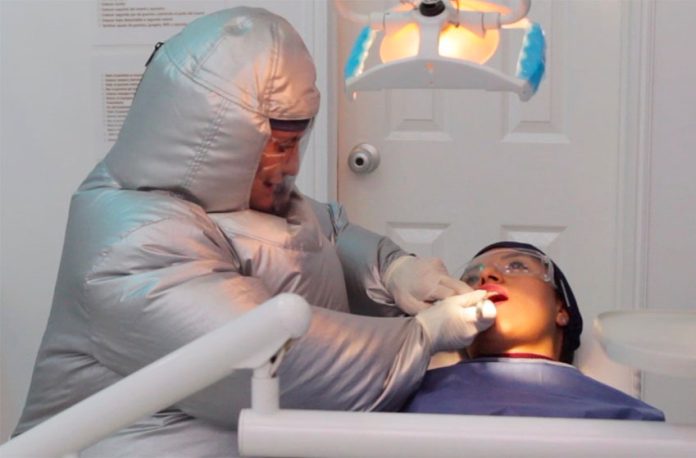
Odontologist Adela Rendón demonstrates the protective suit.

Odontologist Adela Rendón Campillo and biomedical engineer Fernando Avilés have created a Covid-19 protection suit for dentists, orthodontists and others who treat people’s teeth.

In an interview with the newspaper Milenio, Rendón remarked that dental care need not be postponed due to the virus. 

“At the beginning of the pandemic there was a guideline to suspend dental treatments as much as possible and only see emergency cases. After a while, things that were not emergencies became an emergency; the reality is that dental care is essential,” she said.

The specialist explained that pre-pandemic sanitary measures used in her profession now fall short, so she consulted with Avilés in the development of a protective suit and an acrylic hood. 

“This suit is wonderful because it keeps us absolutely isolated,” she says, noting that the filtered air circulating inside the suit helps keep medical professionals cool, and the hood negates the need for a mask or goggles. If the suit accidentally tears during a procedure, the air inside will flow out but no new air will enter. 

The suit, which is still a prototype, is designed to be reusable and facilitate ease of movement. Although it remains a work in progress, Rendón hopes that eventually the suit and hood can be used in other medical specialties to help protect medical personnel and patients, as well as saving money by eliminating the need to purchase masks and goggles.  

Source: Milenio (sp)

Hidalgo mayor declares cockfighting ‘a cultural asset’

0
A statue of a fighting cock graces the town square in Tianguistengo.

Cockfighting has been declared a “cultural asset” by the mayor of Tianguistengo, Hidalgo, despite the fact that Mexico’s Supreme Court ruled in 2018 that fights between animals are illegal.

Mayor Febronio Rodríguez’s July 26 declaration, which coincided with the unveiling of a plaque and statue honoring fighting cocks in the town square, was met with approval from the municipality’s Association of Combat Bird Breeders, but virulently opposed by animal rights activists in the municipality.

Authorities defended the blood sport, saying it  “gives identity to the municipality of Tianguistengo” and “helps to strengthen friendship with neighboring towns.”

The declaration came in response to “the urgency of animal groups that try to discredit these activities and misreport on the use, domestication, handling and treatment of animals that are raised in the region and that generate direct and indirect jobs.”

An estimated 3,000 people breed fighting cocks in Hidalgo, and the industry provides employment for 100,000 people, state legislator Rafael Garnica said last October. 

Erika Ortigoza Vázquez, director of the animal rights organization Fundación Invictus, denounced the declaration.

“Fundación Invictus expresses its repudiation and rejection of this decision of the mayor and council of Tianguistengo to approve and classify this bloody practice as an ‘intangible cultural asset’ which exalts torture and the sadistic death of these birds, in addition to promoting illegal activities such as illegal gambling, carrying arms, and irresponsible consumption of alcohol that on many occasions ends in gunshots between the gamblers,” she stated in a letter. 

“Unfortunately, instead of Mayor Febronio Rodríguez promoting to the public the importance of staying home, avoiding large gatherings and taking extreme sanitary measures, he is more concerned with justifying cockfights,” she said.

Source: La Jornada (sp), 24 Horas (sp), Milenio (sp), Sintesis (sp)

Sexual conversion therapies now illegal in Mexico City

0
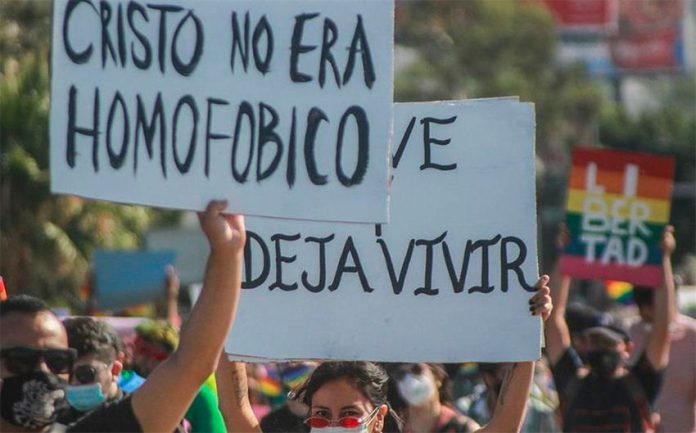
'Christ wasn't homophobic,' reads a placard during a gay rights march.

So-called conversion therapies that target LGBTQ+ people in an attempt to change their sexual identity are illegal in Mexico City starting Friday.

Medical personnel who attempt to employ such therapy will face up to five years in prison.

The controversial practice often involves prayer and counseling, but at times also uses forms of torture to convince young gay people to adopt a heterosexual lifestyle. In the United States and parts of Europe, reconditioning techniques have used ice-pick lobotomies, chemical castration and nausea-inducing drugs to “convert” people from homosexuality.

The practice has been condemned by the American Medical Association, the American Psychological Association, and the United Nations (UN) and is banned in Brazil, Ecuador, Malta and Germany.

“The degrading nature of many conversion therapy practices, including physical abuse, electroshock therapy, pseudo-medical procedures, and the use of anti-LGBT epithets and slurs, contribute to an overall dehumanizing environment toward persons with diverse sexual orientation or gender identity,” said UN Independent Expert on Sexual Orientation and Gender Identity Victor Madrigal-Borloz.

Last Friday, Mexico City lawmakers approved a bill banning the practice, with enhanced sentencing if the victim is a minor. The new law criminalizes “practices consisting of psychological, psychiatric sessions, methods or treatments that are intended to nullify, hinder, modify or impair the expression of gender identity, as well as the sexual orientation of people.” 

Efforts to “cure” homosexuality, which was once considered a mental illness, can be brutal and may have serious consequences. A 2019 study in the United States in which 35,000 LGBTQ+ young people were interviewed indicated that 42% of those who had experienced conversion therapy had attempted suicide. 

“There is nothing to cure. Homosexuality is not a disease, we are not sick,” said Temístocles Villanueva, a Morena party legislator who authored the conversion therapy bill two years ago. 

The new law is seen as a major victory for the LGBTQ+ community, both in Mexico and worldwide, in the battle to outlaw a practice that many view as akin to torture.

Longtime LGBTQ+ journalist and activist Enrique Torre Molina of Mexico City thanked the “brave activists and committed Mexico City legislators” for passing the law that protects the LGBTQ+ community in the nation’s capital city. 

“Over the past few years I’ve come to know many — too many — stories of LGBTQ+ people who survived ‘conversion therapy’ and torture, or who have stepped away from their families who believed they could and should ‘change,’” Torre told the news platform Them. “It’s exciting to witness this historic win. Our community deserves love and respect.”

Mexico City Mayor Claudia Sheinbaum also applauded the decision. “I totally agree. It seems to me that these measures belong to the era of the Inquisition,” she said. “It does not correspond to the health systems of the 21st century, it does not correspond to the liberty of this city, because this is a city of rights.” 

Source: Milenio (sp), Reuters (en), Scientific American (en), Them (en), Forbes (sp), El País (sp)

Virus stoplight still a source of irritation between health minister and governors

0
As of Thursday, Mexico's coronavirus death toll was just 84 shy of that of the United Kingdom.
As of Thursday, Mexico's coronavirus death toll was just 84 shy of that of the United Kingdom. milenio

Some governors clashed with Deputy Health Minister Hugo López-Gatell on Thursday over proposed changes to the federal government’s coronavirus “stoplight” system, used to assess the risk of infection in each of the the 32 states and establish which mitigation measures should be tightened or eased.

At a virtual meeting between federal officials and governors, López-Gatell, Mexico’s coronavirus czar, told the state leaders that they could face administrative and criminal charges if they fail to implement recommended measures to protect people’s health during the pandemic.

Some governors have chosen to ignore the federal government’s “stoplight” system advice, instead reopening their states’ economies according to their own criteria.

In that context, López-Gatell proposed changing the guidelines under which the “stoplight” system operates so that governors and other state officials can be held legally accountable if they fail to comply with the federal government’s health advice.

For example, if a state is allocated a “red light” on the government’s “stoplight” and the governor doesn’t implement the corresponding “maximum risk” restrictions, he or she could be legally sanctioned.

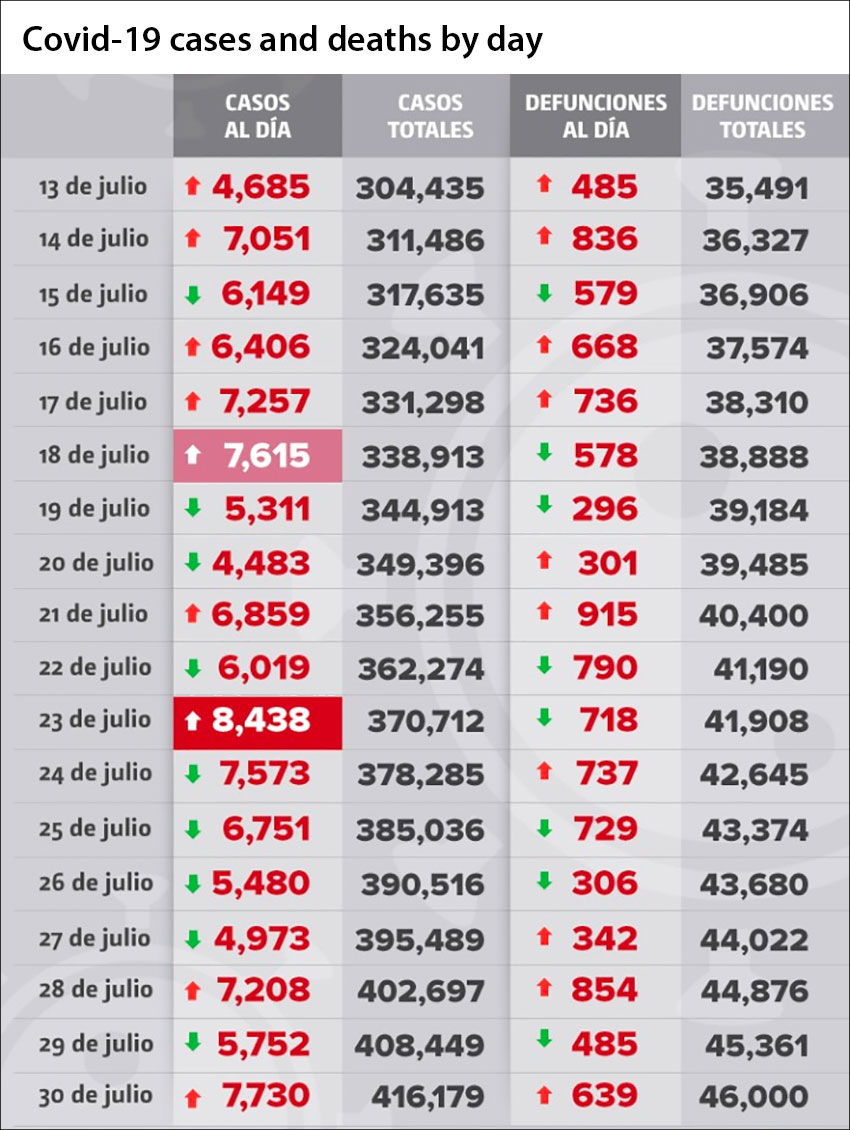
The daily tally of coronavirus cases and deaths.
The daily tally of coronavirus cases and deaths. Deaths are numbers reported and not necessarily those that occurred each day. milenio

Speaking at Thursday night’s coronavirus press briefing, López-Gatell it was essential for clear legal consequences to be established “in case of non-compliance” with federal government recommendations.

“If the federal government says you’re on red and a state says ‘I’m on orange and I’m going to allow these other activities,’ the state must answer for its sovereign decisions,” he said.

The deputy minister said the proposed changes to the “stoplight” guidelines would ensure that there is “shared responsibility” between the federal government and the states for the response to the pandemic. He denied that the proposal amounted to a “threat” against governors.

However, some governors at Thursday’s virtual meeting took umbrage at the suggestion that they could be sanctioned if they don’t meticulously follow the federal government’s pandemic management advice.

According to the newspaper Reforma, which spoke with a source with knowledge of Thursday’s private meeting, Carlos Mendoza Davis of Baja California Sur called the proposal an “affront” to the states while Omar Fayad of Hidalgo also rejected it.

The unnamed source, likely a governor or senior state official, said that behind López-Gatell’s “threat” was a desire on the part of the federal government to “escape blame” for its management, or mismanagement, of the coronavirus crisis.

López-Gatell: suggesting that governors be held legally accountable over managing Covid restrictions did not go over well.

Some of the most ardent opposition at Thursday’s meeting came from Carlos Joaquín González of Quintana Roo and Mauricio Vila of Yucatán.

The two governors, both of whom ignored advice to tighten restrictions when federal authorities switched their states from orange to red almost two weeks ago, expressed concern about having to be strict in following advice from Mexico City because their constituents depend heavily on the tourism sector, and as a consequence mustn’t be subjected to the whims of the federal government.

According to Reforma, Joaquín reiterated to López-Gatell and the other federal officials in attendance that Quintana Roo has its own stoplight system to guide the reopening of the economy and therefore won’t heed the federal government’s advice. Vila charged that the federal stoplight system is no longer viable.

Animosity between the governors and López-Gatell has been simmering for some time.

Jalisco’s Enrique Alfaro accused López-Gatell earlier this month of playing politics, seeking confrontation and allocating a “red light” to his state because “he felt like it.”

At last night’s coronavirus press conference, the deputy health minister rejected that Thursday’s meeting with the governors was acrimonious, asserting that he had respect for all the state leaders. López-Gatell also said that the federal government will publicly present a new stoplight map every two weeks, rather than weekly as it did until July 10.

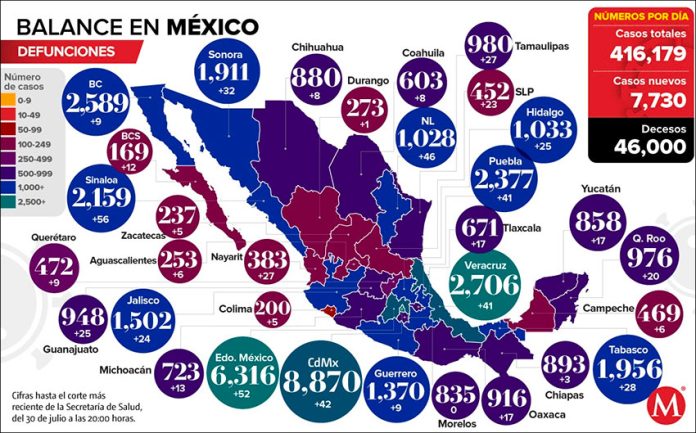
Case numbers by state since the virus was first detected.
Case numbers by state since the virus was first detected. milenio

An updated map should be presented at Friday night’s coronavirus press briefing.

López-Gatell also revealed Thursday night that more than 1,100 legal complaints have been filed against the government in relation to its response to the pandemic.

“A substantial part of our work every day is to respond to all these legal appeals that arrive,” he said, explaining that the complaints make a range of accusations including that the government has failed to act against the coronavirus threat or didn’t act in a timely manner.

López-Gatell said that some of the complaints come from political groups but declined to name them, saying that he wasn’t interested in causing controversy.

Leaders of the Democratic Revolution Party, the Citizens’ Movement party and the National Action Party have all called for the deputy minister’s resignation, claiming that he has failed at managing the pandemic.

But López-Gatell said last Friday that he wouldn’t step down, charging “this is not about playing politics, it is about saving lives and protecting people.”

As tensions mount between the federal government and those unhappy with its management of the pandemic, so do coronavirus case numbers and Covid-19 deaths.

The federal Health Ministry reported Thursday that Mexico’s accumulated case tally had increased to 416,179 with 7,730 new cases registered. The daily tally was the second highest single-day total reported since the coronavirus was first detected in Mexico at the end of February.

The Health Ministry also reported 639 additional Covid-19 fatalities, lifting Mexico’s death toll to 46,000.

Mexico has recorded just 84 fewer Covid-19 fatalities than the United Kingdom, according to data compiled by Johns Hopkins University, and therefore will likely pass that country’s death toll on Friday to rank third in the world for total deaths behind the United States and Brazil.

Source: Reforma (sp), El Economista (sp), El Universal (sp), La Jornada (sp), Imagen Radio (sp), El Financiero (sp) 

AMLO to announce creation of state-run distributor of medical supplies

0
coca-cola truck
If soft drinks can be delivered to towns across Mexico, why not medicines, the president wonders.

President López Obrador said Thursday that a state company will be created to distribute medications, medical supplies and vaccines across Mexico.

“Tomorrow we’ll speak more about a distributor of the Mexican state, a distributor of medicines, equipment and vaccines … to all the towns of Mexico just like [other] goods are distributed,” he told reporters at his regular news conference.

López Obrador said that federal Civil Protection Chief David León, “one of the government’s best public servants,” will be the director of the state-run distribution company.

“It’s unacceptable that bottled soft drinks and chips are distributed in the entire national territory but medicines don’t reach the towns,” he said.

The new distributor, the president added, will have enough resources to ensure that medicines and medical supplies get to the most far-flung and isolated parts of the country.

“It will have its budget, it will be a well-set-up company so that there’s no lack of medicine even in the most remote town in the sierra,” López Obrador said.

“Free medicine and medical care have to reach the most distant areas. We have about 50 billion pesos [US $2.3 billion] available for public health this year and next; guaranteeing people’s health is a priority.”

The president said the company will have its own trucks and that his wish is to have them emblazoned with the words “medicine, vaccines and medical equipment.”

“We must all respect these trucks,” he added. “[They’ll be] like the Red Cross ambulances or hospital ambulances that mustn’t be stopped, that must be respected because they’ll have medicine to cure the people.”

López Obrador also said he was pleased that federal lawmakers had passed a law that allows the government to make direct purchases of medicines and medical supplies abroad.

“I’m delighted that the purchase of medicine and vaccines abroad was approved in the Congress. This means breaking the monopoly … of companies that had control in Mexico, that sold poor quality medicines at elevated prices and had frequent problems with shortages,” he said.

“Tomorrow we’re going to sign an agreement with the UN to purchase medicines, vaccines [and] equipment” of the highest quality at the best prices, López Obrador said.

As a result, it appears that state-owned trucks filled with foreign pharmaceuticals may soon be plying the dusty roads of the Sierra Tarahumara in Chihuahua and pulling up in hard-to-reach, impoverished towns in states such as Chiapas, Oaxaca and Guerrero.

The federal government first announced last year that it intended to take over responsibility for the distribution of medications.

The head of a logistics firm said at the time that he believed the government didn’t have the logistical know-how to ensure that medications reach their intended destinations in a timely fashion.

“Specialized personnel with knowledge of technological advances is required in order to establish highly efficient distribution chains,” José Ambe said.

He also said the government would end up paying more to distribute medications itself, asserting that “the private sector dedicated to the distribution of medicines absorbs all operational costs, including the modernization of infrastructure.”

Source: Reforma (sp)