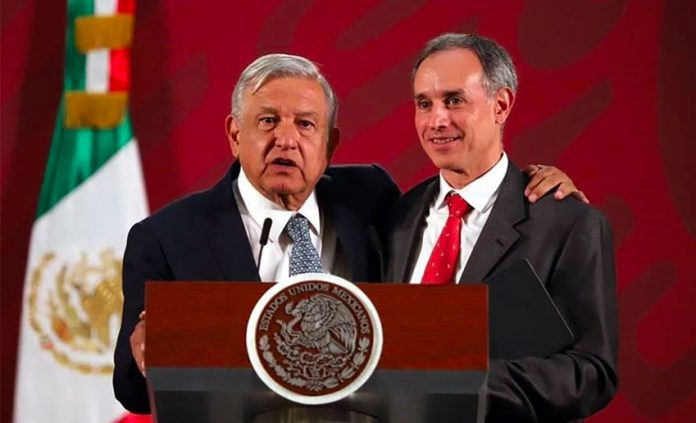
The responsibilities of Deputy Health Minister Hugo López-Gatell, the government’s chief coronavirus strategist, could soon be significantly broader.
Under a Health Ministry proposal, the Federal Commission for Protection Against Health Risks (Cofepris) – Mexico’s most important health sector regulatory body – and 12 other health agencies including the National Addictions Commission and the National Blood Transfusion Center will come under the control of the department headed up by López-Gatell.
The coronavirus point man, a Johns Hopkins University-trained epidemiologist, is the head of the Health Ministry’s department of prevention and health promotion.
However, it does not yet appear to be an entirely done deal that López-Gatell will take the reins of Cofepris, which is responsible for approving the use and consumption of medications, food, beverages, dietary supplements and pesticides among other duties.
The newspaper Reforma reported that there is opposition within the federal government to the Health Ministry’s proposal, which has been sent to the National Commission for Regulatory Improvement for approval.
The newspaper said it saw an internal government document that was critical of the proposal, pointing out that regulatory bodies similar to Cofepris in countries such as Argentina, Brazil and Colombia are decentralized, independent organizations.
The document, whose exact origin was not divulged, said that if Cofepris came under Health Ministry control, the risk of mismanagement and conflicts of interest in its daily operations would increase.
The regulator’s transparency, confidentiality, independence and impartiality could all be adversely affected, the government document said.
It warned that international bodies such as the World Health Organization could downgrade their rating of Cofepris if it were to be subjugated to Health Ministry control.
The document also said that international “collaboration and authorization schemes” could be adversely affected because Mexico’s importation and exportation of medicines, food and other products that could pose health risks must comply with strict quality and hygiene controls. The implication is that those controls could be compromised if Cofepris is not completely autonomous.
There is also opposition to the Health Ministry’s proposal from several opposition party lawmakers.
Martha Tagle, a federal deputy with the Citizens Movement Party, said that Cofepris’ independence is guaranteed by law and therefore its status cannot be changed via an “internal Health Ministry agreement.”
Reforma reported that Institutional Revolutionary Party deputies Ana Lilia Herrera Anzaldo and Frinné Azuara Yarzábal intended to oppose the Health Ministry proposal on the floor of the Congress.
National Action Party (PAN) Senator Martha Márquez said that the move to put the regulator under the control of López-Gatell was yet another attack on the autonomy of independent government bodies.
Josefina Salazar, a PAN deputy, made her thoughts clear on the Health Ministry proposal in a Twitter post.
“In a move of doubtful legality, they want to turn Hugo López-Gatell into a ‘super deputy minister,’ causing some entities … such as Cofepris to lose autonomy. [It would give] more power to the official responsible for the disastrous management of the pandemic in Mexico,” she wrote.
Fernando Belaunzarán, a deputy with the Democratic Revolution Party, described the plan as a “great gift” to the deputy minister but added that the move would have “grave consequences.”
In an ironic tone, he wrote on Twitter that the coronavirus czar should be given a cake with 60,000 candles because Mexico has almost recorded that number of Covid-19 deaths while López-Gatell has been in charge of the pandemic response.
Miguel Ángel Toscano, a former Cofepris chief, said it would be a “disaster” and “a backward step” to subordinate the regulator to the deputy minister’s department.
“It’s criminal ignorance, … I regret the absurd decision to say the least. While the [rest of the] world strengthens their health authorities, in Mexico they are undermined [and] overpowered. They’re bound to political decisions, not technical ones.”
In Chiapas, sugary drinks can be easier to find than bottled water. marcos arana
Nobody in the world drinks more Coca-Cola and other sugary drinks than the residents of Chiapas, Mexico’s southernmost and poorest state.
According to a 2019 study by the Chiapas and Southern Border Multidisciplinary Research Center (Cimsur), residents of the southern state drink an average of 821.25 liters of soda per person per year.
Broken down, the immensity of the quantity seems even more astonishing: every man, woman and child in Chiapas drinks an average of 3,285 — yes, three thousand two hundred and eighty-five – 250-milliliter cups of soda a year, according to the study.
The Cimsur study found that the sugary drink consumption rate in Chiapas is more than five times higher than the national rate of 150 liters per person per year.
Residents of the United States drink an average of 100 liters of soft drink a year, the study found, while the global average is 25 liters, just 3% of the consumption level in Chiapas.
Marcos Arana, a researcher at the National Institute of Medical Sciences and Nutrition, described Chiapas as the “epicenter” of Mexico’s “soft drink consumption epidemic.”
Consumption of refrescos, as soft drinks are known, is particularly high in the Los Altos region, where the majority of residents are indigenous people who mostly live in rural towns and villages.
Coca-Cola, which has a bottling plant in San Cristóbal de las Casas, is the undisputed “king of kings” in the region’s soda market.
According to the Cimsur study, among the reasons why Coca-Cola and other refrescos are so popular in Chiapas are marketing campaigns in indigenous languages – mainly Mayan – and limited access to clean drinking water.
In a 2018 report, The New York Times said that some neighborhoods in San Cristóbal de las Casas, Los Altos’ regional hub, have running water just a few times a week, forcing many households to buy additional water from tanker trucks.
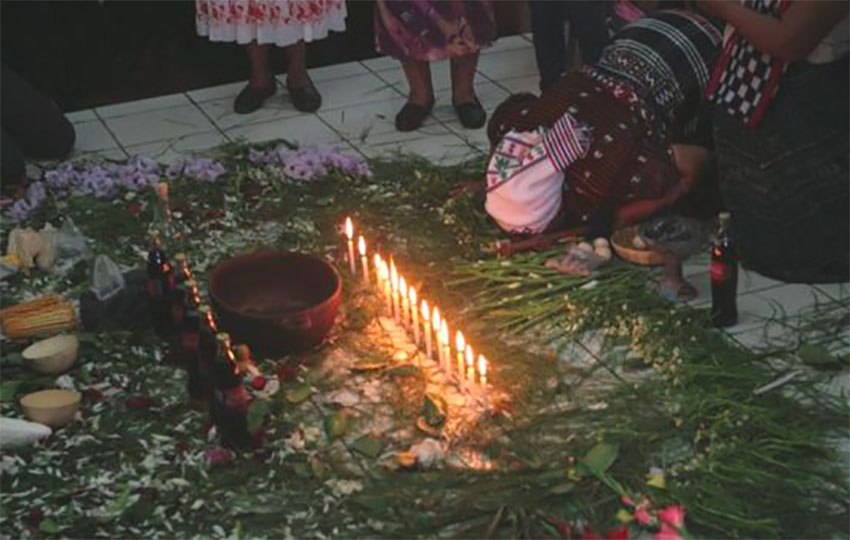
Coke’s status is such that it is used as an offering in traditional rituals. marcos arana
“So, many residents drink Coca-Cola, which … can be easier to find than bottled water and is almost as cheap,” the report said.
Similarly, Arana, the medical researcher, told BBC Mundo that “Coca-Cola is the most available product in Los Altos.”
“One has to walk a greater distance to buy tortillas or anything else,” he said. “The number of points of sale is excessive, there is no control, and prices are reduced by up to 30%.”
The discount effectively eliminates the federal tax of 1 peso per liter on sugary drinks, which was imposed in January 2014 as part of efforts to reduce consumption and associated health problems such as diabetes and obesity.
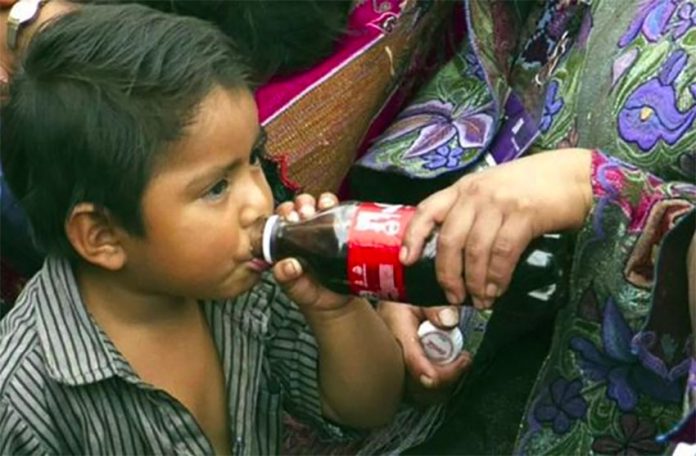
Arana said the widespread availability of cheap soda as well as advertising that specifically targets vulnerable Chiapas residents have created an addiction in many people who now see sugary beverages as an everyday necessity rather than a luxury or treat. A 2016 study found that 3% of babies in Chiapas are given Coca-Cola by their mothers when they should only be drinking breast milk, he said.
Unsurprisingly, diabetes is a major problem in Chiapas, claiming more than 3,000 lives in the state per year, according to the Times report.
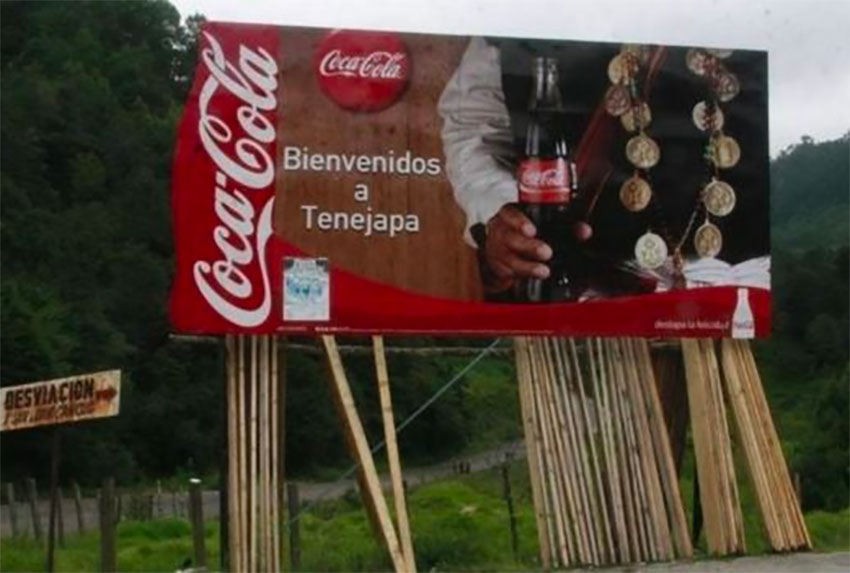
Jaime Page Pliego, the author of the Cimsur study, told BBC Mundo that he heard from residents of Tenejapa, a municipality near San Cristóbal, that diabetes and heart disease were not a problem there until the construction of a paved road to the town that allowed the easy distribution of soft drinks and junk food.
It’s now customary for Tenejapa residents to drink two or three liters of Coca-Cola while on their lunch break from working in the fields, he said.
Page added that when he asks chiapanecos, as residents of the southern state are called, why they drink so many soft drinks, he usually hears the same answers: “Because I like it; it fills me up; I miss it when I don’t drink it; I can’t stop drinking it.”
“Even diabetics … acknowledge that they keep drinking it. … They can’t imagine life without soft drinks. It’s truly a tragedy,” he said.
Soda, and especially Coca-Cola, has also been given a role in the religious lives of indigenous Mayan people in Chiapas.
Page explained that Coke has replaced pox, a corn and sugar cane liquor, as an offering to the Gods in some traditional indigenous ceremonies and rituals.
Welcome to Tenejapa, Coca-Cola country. marcos arana
“Especially in … healing rituals, [alcohol] was substituted with a soft drink [Coke], which has a sweet smell similar to pox,” Page said. “It has become the main offering for the nutrition of the gods.”
The elevation of the humble Coke to religious artifact has increased its prestige to a point that a person who is offered a different soft drink at a social or political gathering may consider it a slight.
“He who offers Coca-Cola has a good status in the community. If he offers another refresco in areas where this brand dominates, he is seen” in a poor light, Page said.
Arana told BBC Mundo that in order to reduce consumption of sugary drinks in Chiapas, more needs to be done to educate communities about the risks associated with their consumption. He also said that traditional foods and beverages, such as the corn drink pozol, need to be promoted more and that access to water must be guaranteed.
In addition, the researcher said that steps should be taken to reduce the availability of Coke and other soft drinks.
“If the authorities do something like canceling the concession for the production of Coca-Cola in the area or at least [force the company] to reduce the volume of production, it will encourage a more positive future” and help to lessen the addiction to sugar, Page said.
Santiago López Jaramillo, Latin America director of the International Council of Beverage Associations, said the council wants to work with Mexican authorities to address problems associated with excessive soft drink consumption.
Alejandro Prieto took 100 photos of the elusive jaguar for his project Jaguar Story. This is one of his favorites. Alejandro Prieto
For several months, photographer Alejandro Prieto sought to capture images of a jaguar in the wild and had set up camera traps across western and southern Mexico in hopes of getting a picture of one of the elusive big cats.
When he finally got that first image, it showed only the tail of a jaguar, disappearing into the background. But it was a good start.
“For me, it was a huge success,” Prieto reflected in a phone interview. “After that photograph, I started to have more images. I started to be more effective, more successful.”
Prieto ultimately took around 100 images of jaguars in a photographic journey called Jaguar Story. Documenting the endangered big cats in remote areas of such states as Nayarit and Campeche, he also sought to evoke the impact of the jaguar on indigenous and Hispanic culture in Mexico.
“I think I achieved what I wanted,” he said, adding that while it took “more [time] than I was expecting, it was definitely worth it.”
Even though he finished the project several years ago, he remains interested in the jaguar, which he calls “an iconic species.”
A separate photo, “Another Barred Migrant,” shows a projection of a jaguar onto an image of the border wall between Mexico and the US. Created for his Border Wall Project, the photo earned Prieto a wildlife photographer of the year award for 2019 from the Natural History Museum of London — his second straight win in what he calls “the Oscars of wildlife photography.”
More recently, another photo from the project “Roadrunner Approaching the Border Wall” earned a second-place award in the World Press Photo 2020 contest.
A lifelong animal enthusiast, the 43-year-old Guadalajara native has captured images of such diverse fauna as the axolotl, flamingo and sea lion during his career. For Jaguar Story, he turned his lens to a notoriously camera-shy subject.
“I talked to local people who lived in a jungle all their lives,” Prieto recalled. “They had never seen a jaguar their entire life. We would see tracks, marks, and know they were there, but the cats are just too shy. They’re very smart. Before you see them, they see you. That’s why it’s difficult to get to see one.”
The project required a significant degree of preparation and patience. Prieto trekked up mountains and through jungles to set up his camera traps, aided by local residents and researchers.
Guadalajara-born photographer Alejandro Prieto.
“Many places were really very remote,” Prieto said. “We would walk for hours.”
The hours-long walks, the mountain climbs and the jungle excursions eventually yielded that first photograph about five months in. Then more images started flowing as Prieto began to learn more about his subject — such as in Calakmul, home to an archaeological site and the largest number of jaguars in all of Mexico.
“We would start to see signs of jaguars,” Prieto said, such as their tracks, and their urine on trees. “I heard them twice. It happens in their mating season, a really strong noise when the female communicates with the male. It’s a sound you can [hear] from the long distance of a mountain. Hearing this sound is something I will never forget.”
He’s also amazed by how adaptable the jaguar is, able to survive in a variety of terrain, from the desert to the jungle to the mountains. His favorite camera-trapping locations include the Sierra de Vallejo in Nayarit as well as Calakmul.
“This animal needs a lot of terrain to survive,” Prieto explained. “It does not stay in one place. It’s constantly moving.”
Humans have negatively impacted the jaguar’s journey, Prieto said, listing such factors as habitat loss and ranchers who defend their livestock from predators. The number of jaguars has dipped from a “very large” number 30 to 40 years ago to only 3,500 today, he said.
“[People are] taking the environment of a territorial animal that needs a big territory, that is losing the jungles. [People are] taking their habitat, which is still the main problem, not just for the jaguar but most of the wild animals.” And, he said, there have been “decades, as well, of illegal hunting.”
He also noted that if a jaguar kills a rancher’s livestock, the rancher might poison the carcass, which “could kill not just one, but many other predators that feed at the same carcass. [The rancher does] not really care about this.”
Asked whether the jaguar poses a danger for humans, Prieto said, “I think there is no record here in Mexico that a jaguar attacked one single person … I think Brazil has had a couple of [recorded instances], some specific situations.”
He added, “Many, many people think jaguars are dangerous. I have talked to people [who have] killed jaguars, communities [who have] killed them because they thought jaguars were going to attack them. It’s absolutely false. They try to run away from people. It’s something that we [Prieto and the western Mexico-based nonprofit Alianza de Jaguar] try to tell people.”
Historically, jaguars and humans seem to have had a closer understanding of each other.
La Tigrada, a jaguar festival held annually in Chilapa, Guerrero. Alejandro Prieto
“Jaguars are very important not only for pre-Hispanic culture and for Mayans, but very important for some other cultures as well,” Prieto said.
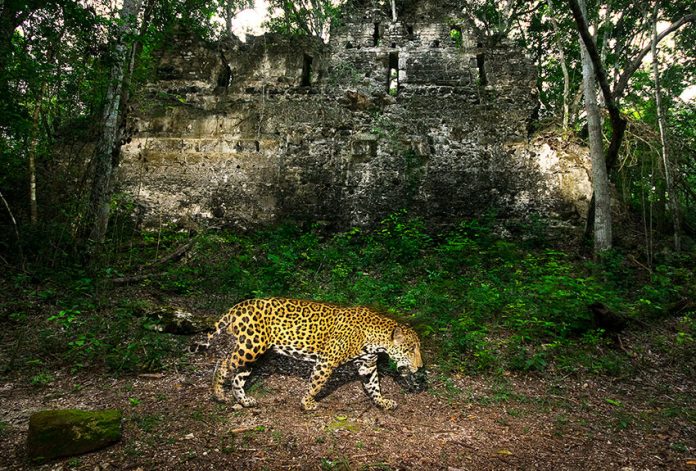
One of his favorite photos is of a jaguar crossing in front of an archaeological site.
“It’s an image I like very much,” Prieto said, adding that it seeks to convey the idea that “the jaguar is an ancient animal, passing in front of a site of ancient culture.”
Some ancient ties have parallels today, such as in jaguar-connected festivals across Mexico. Prieto visited and photographed one — La Tigrada in the town of Chilapa de Álvarez, Guerrero. La Tigrada takes place every August 15, the same day as the Feast of the Assumption. As a Guerrero state website explains, the relatively young festival is a fusion of religion and culture, honoring the Virgin Mary and the Mesoamerican Mother Earth and Tepēyōllōtl — the latter an Aztec mountain god who was turned into a jaguar.
The municipality of Chilapa was described as “one of the most lawless areas of Mexico” by the Los Angeles Times this year. The festival seems like a respite: Prieto describes La Tigrada as a memorable event with such activities as a parade, singing and dancing, with participants wearing unique jaguar costumes.
“They do many different activities,” he said. “Everything is related to jaguars. I think they’re invoking the jaguar gods so they can have good crops, a good rainy season. It’s really amazing because every person does their [own] costume and every costume is different.”
Prieto traveled north for his Border Wall Project and a different look at the jaguar — this time at the dwindling numbers in the region and the environmental impact of U.S. President Donald Trump’s wall along the U.S.-Mexico border. According to Prieto, completing the structure will doom the many migratory species native to the area.
“There’s still no wall in the mountains,” Prieto said, referring to the Huachuca Mountains in Arizona and Sonora. “But the intention is to cover them with a wall. Once [they’re] closing off the area with a wall, it will be the end of the jaguar in the U.S. There are only two to three individuals, all males.”
As he explained, jaguars “need to move to survive, they need to move to get water, they need to move to get mates, they need to move to get food, to get the right environment to survive.”
Reflecting on the decline of the local jaguar population, Prieto sought to photograph a jaguar there but could not find one.
“After a certain time, I realized it was going to be impossible,” he said.
As a result, he found an image of a wild jaguar he had previously taken — he said it might be from either Calakmul or San Luis Potosí — and projected it onto a photo of the Mexican side of the wall, near the Huachuca Mountains in Sonora, along the Arizona border. He titled the photo “Another Barred Migrant.”
‘Another Barred Migrant’ won Prieto an international award. Alejandro Prieto
“I wanted to do it in the same place, in the same area, where jaguars crossed the mountains,” Prieto said. “They would cross the top of the mountains, down the mountains, between states.” He described the photograph as “a way to say, these cats are still here, but they will not be able to be [here] any more if [people] continue to do this.”
The Natural History Museum of London took notice, and last year Prieto was among the winners of the Wildlife Photographer of the Year award, his second straight time receiving the honor.
“It’s something that really gets me proud,” Prieto said. “At the same time, [it’s] like a platform. Your picture can be shown to millions and millions of people around the world. It’s very, very important to me … What I did with the photograph, my main goal, is to focus on conservation.”
Prieto is now working on a new photographic endeavor with a similar goal: The Gardener, a look at the tapir, which he calls the gardener of the jungle.
Comparing the tapir to “a little elephant,” he said that the species is “very, very important for jungles” because, like a gardener, tapirs “take care of the jungle.” Yet, he said, they are in danger of extinction.
It will be similar to the jaguar project, Prieto said. “Of course, it’s a different situation. Different things are happening to [the jaguar]. But the habitat loss is the same.”
Jennifer Doncsecz and her husband arrive in Cancún. She looks forward to returning for Labor Day.
Mexico’s health and safety protocols appear to be inspiring confidence in travelers, making some feel even safer than they would at home.
That’s the experience travel agent Jennifer Doncsecz had when she visited Cancún’s Hyatt Ziva.
Although she was initially hesitant to make the trip, Doncsecz told Travel Weekly that by day 2 in Mexico “I actually had moments that I didn’t think about Covid — for the first time in 4 1/2 months. I was like, this is really bizarre, I’m not worried about it.” Doncsecz looks forward to her next trip south of the border on the Labor Day weekend.
For Americans, Mexico has become the top post-quarantine destination among the relatively few countries that are accepting American tourists.
Tourism officials, resorts and local governments in Mexico have banded together to implement health protocols, and they are marketing those efforts in order to entice tourists to return.
And for some, the strategy is working. “All of our hotels are now at the maximum allowed occupancy,” said Armin Kaestner of the RIU Hotels chain. “It’s great and it’s not, because [allowable capacity] is only 30%.”
Kaestner reports RIU’s Mexican properties have twice the number of bookings as its properties in Jamaica, the Dominican Republic, Aruba and the Bahamas.
The Cancún-Riviera Maya region has registered the highest number of bookings, which is not surprising given it has the highest number of hotels in Mexico, but Los Cabos has led the highest tourism rebound on a percentage basis.
“Little by little, things have been getting back to normal. It’s very interesting,” said Rodrigo Esponda of the Los Cabos Tourism Board.
Research shows that arrivals in Los Cabos in July were at 27% of their July 2019 levels, a dismal figure unless you compare it with Cancún, which is at 15%, or Puerto Vallarta which has 18% of the visitors it did last year. It is also a big comeback from April through June’s nearly non-existent numbers.
While domestic travel within the United States tops the post-lockdown list, travel to Mexico comes in second. Ray Snisky of Apple Leisure Group Vacations says August’s Cancún bookings are down just 8% year over last year.
“There’s a real push for people saying, ‘Let me get on this trip before summer ends,'” Snisky says. “I think this close-in booking trend will continue into the fall, although I don’t think it will be as dramatic as in the summer.”
David Lavigne of Delta Vacations says Mexico’s appeal “is a very fluid trend at this point.” Airlines are transporting half the usual number of passengers and hotels are capped at 25% to 30%, but at least they, and most of their beaches, are open.
The Mexican Center for Environmental Law (Cemda) and Greenpeace have obtained a new injunction against federal government measures intended to limit the participation of renewable energy companies in the domestic market.
A definitive suspension order granted by an administrative court judge invalidates an agreement published by the National Energy Control Center (Cenace) in late April that suspended national grid trials for renewable energy projects under the pretext that the reliability of supply had to be guaranteed during the coronavirus crisis.
Cemda and Greenpeace previously won an injunction against the Cenace and Sener measures in late June but the Energy Ministry has indicated that it will challenge rulings against it.
As a result of last Friday’s ruling, the two environmental groups said in a joint statement that renewable energy projects that have already been approved will be able to continue as long as they comply with existing laws and respect the human rights of the residents of the locations where they are being built.
Cemda research coordinator Anaid Velasco said that both the Cenace agreement and the Sener policy constituted a backward step in Mexico’s progress toward the promotion and greater use of renewable energy.
María Colín, a Greenpeace environmental law expert, said the aim of the legal battle against the anti-renewable measures was to guarantee the human right to affordable and accessible clean energy. She also said that community-based renewable projects can help to combat the energy poverty that afflicts millions of households.
Private energy companies, including those in the renewables sector, generate almost half of Mexico’s electricity at much lower costs than the state-owned Federal Electricity Commission (CFE) but have failed to win over President López Obrador.
He said in May that private companies, including those that generate clean, renewable energy from sources such as wind and solar, have provided “nothing” to the national electricity system.
López Obrador, a staunch nationalist, has pledged to “rescue” the CFE as well as Pemex and appears unperturbed that consolidation of control of the energy market in the state-owned companies will damage private investment.
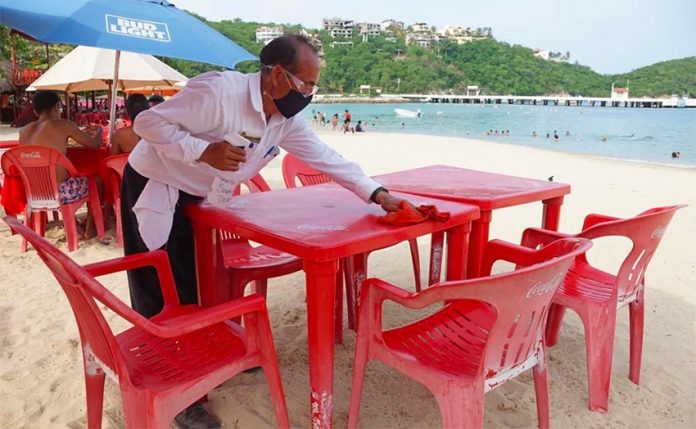
A waiter prepares a table at one of Huatulco's beaches.
Police in Huatulco arrested 30 tourists for not wearing face masks, putting visitors from Mexico City and abroad to work cleaning public spaces or levying fines against them for violating coronavirus safety laws.
The arrests came just as an increase in Covid-19 cases triggered an order that bars shut down in the popular beach destination in Oaxaca. Bar owners who don’t comply can be fined or jailed for 36 hours.
The port of Veracruz is managed by a state-owned company.
President López Obrador said on Tuesday that his administration would seek to revoke a 100-year concession granted to a “private” company that manages the Veracruz port.
But apparently unbeknownst to the president, the Administración Portuaria Integral de Veracruz is in fact a state-owned company created by the federal government in 1993.
Speaking at his regular news conference on Tuesday morning, López Obrador said the 1988-94 government of former president Carlos Salinas de Gortari gave a 50-year concession to the “private” company that manages and operates the Veracruz port.
He rebuked former president Enrique Peña Nieto’s 2012-18 government for extending the length of the concession from 50 years to 100 – until 2094 – just days after López Obrador won the July 2018 presidential election.
“I just found out that they awarded a concession for the port of Veracruz for 50 years and days after we won they extended the term for 50 more years. Just imagine it, a concession for a century! How did they sign that? We’re going to seek to revoke the contract for the management of the port, the entire 100 years.”
Later on Tuesday, López Obrador posted to his Twitter account the contract signed in 2018 that extends the port concession for an additional 50 years.
“This morning I spoke about how Salinas privatized the Veracruz port for 50 years, … Peña extended the concession until 2094, in other words for a century,” López Obrador wrote, charging that not even former president-cum-dictator Porfirio Díaz awarded such lengthy contracts.
“We will act legally,” the president’s tweet concluded.
The concession extension contract posted by López Obrador indicated that the Administración Portuaria Integral de Veracruz, or Veracruz API, is a state-owned company but the president apparently didn’t twig.
Martha Tagle, a federal deputy with the Citizens Movement Party, subsequently said it was regrettable that federal officials hadn’t explained to the president that the Veracruz API is a state-owned firm.
All of Mexico’s ports with the exception of that in Acapulco, Guerrero, are in fact owned and operated by federal, state or municipal governments, she said.
Tagle said that 30 government-owned APIs that operate 60 ports across the country generate “very significant income” for government and attract lucrative investment that creates jobs.
She suggested that López Obrador had been misinformed about the ownership of Mexico’s ports in order “to justify the entry of the navy.”
The president announced last month that the military would assume control of Mexico’s customs offices and ports as part of efforts to eliminate corruption at ports of entry. The move triggered the resignation of Communications and Transportation Minister Javier Jiménez Espriú.
Several vehicles were set on fire during the melee.
Two men accused of kidnapping a child were nearly lynched in Tlahuelilpan, Hidalgo, Tuesday night. The incident began around 8 p.m. when rumors spread through social media that police had taken into custody two men in their 20s who had attempted to abduct a 13-year-old boy.
Residents descended on the police station and attempted to kick in the door, attacking police officers who sprayed them with tear gas. Two people were shot and wounded.
Four police cruisers, two cars and two motorcycles were set on fire during the melee, and the National Guard was called in to establish order.
The accused kidnappers, who were assaulted by townspeople, were transported to a nearby hospital. One of the men suffered serious injuries.
Last month three alleged cattle rustlers in Jagüey, Hidalgo, were rescued from a lynch mob by police. Residents also set a car on fire in that case although no injuries were reported.
On both occasions, Hidalgo police used a state protocol that stipulates that when public assemblies turn violent, police may use force only when all other options have been exhausted.
Residents in Tlahuelilpan have been on edge since the August 2 disappearance of 18-year-old Mariana Zavala Escamilla, and several protests have been organized in recent weeks.
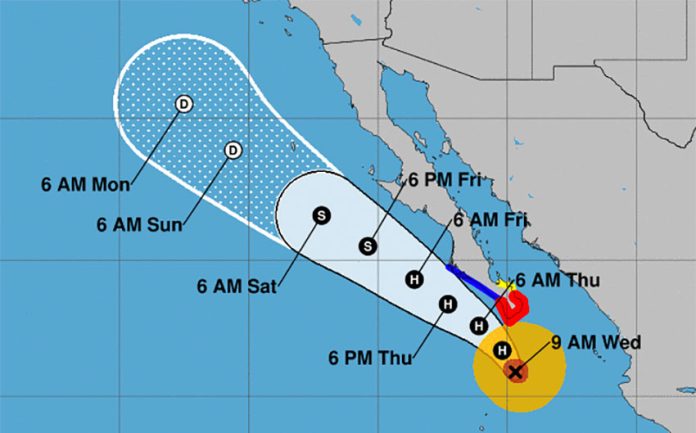
The forecast track of Hurricane Genevieve as of Wednesday morning. A hurricane warning applies to the area marked in blue; red indicates the tropical storm warning area. us national hurricane center
Heavy rains began to fall in the pre-dawn hours of Wednesday as Hurricane Genevieve closed in on Baja California Sur.
According to the U.S. National Hurricane Center on Wednesday morning, Genevieve was a Category 3 hurricane located 225 kilometers south of the tip of the Baja peninsula with sustained winds of 185 kilometers per hour. The cyclone was moving north northwest at 15 kilometers per hour.
The Mexican government has issued a hurricane warning from Los Barriles to Todos Santos, indicating that hurricane conditions are expected within the next 24 hours.
A tropical storm warning is in effect from Todos Santos to Cabo San Lazaro, and a tropical storm watch has been issued from Los Barriles to La Paz.
The eye of the hurricane is projected to skirt the peninsula later tonight and Thursday. Hurricane-force winds extend outward up to 55 kilometers from the center, and tropical-storm-force winds extend outward up to 220 kilometers.
Genevieve is expected to produce rainfall of 76 to 152 millimeters with isolated totals of 254 millimeters, which may cause flash floods and mudslides in southern Baja.
Genevieve formed Sunday night as a tropical storm and rapidly accelerated to become a Category 4 hurricane before weakening slightly. Although initially expected to pass well west of the Baja peninsula, Genevieve took an unexpected turn north, bringing it closer to land than was first projected.
This track is similar to Hurricane Odile, which made landfall on September 14, 2014, near Cabo San Lucas with 205 kilometer-per-hour winds and dropped up to 220 millimeters of rain. The cyclone caused widespread damage to the resort destination.
With Odile as a not-so-distant memory, supermarkets in Los Cabos were mobbed Tuesday as panicked residents stocked up on supplies.
Beaches and ports were closed during the afternoon due to the storm surge. Tragically, a 15-year-old tourist was swept out to sea Tuesday in the normally calm waters of Cabo San Lucas bay. Both she and the lifeguard who attempted to rescue her drowned.
Residents in shanty-towns built in low-lying areas were being evacuated to 12 shelters in the area earlier Wednesday morning. Masks and antibacterial gel are being made available, and special areas for coronavirus patients have been designated.
Civil Protection officials in Los Cabos are asking citizens to remain in their homes. Alaska and Southwest airlines have canceled flights to and from Los Cabos. The Los Cabos Hotel Association reports that 8,500 tourists are currently in Los Cabos.
CORRECTION: Flights to and from Los Cabos have been canceled by Alaska and Southwest — not Northwest — airlines. Information provided by authorities for the earlier version of this story was incorrect.
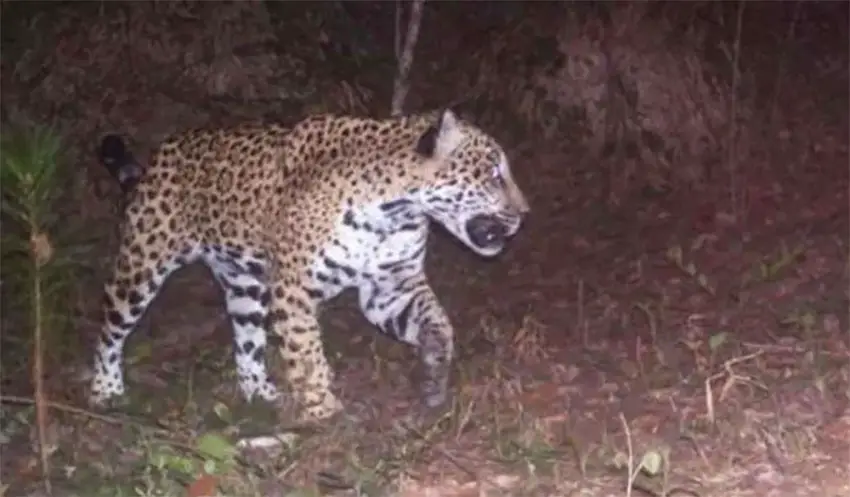
Cameras, drones and traps are being used to capture jaguars in Guerrero.
The search for a jaguar and her cub is underway in Chilpancingo, Guerrero, after the pair of felines was seen last weekend in neighborhoods near the capital city’s southern borders.
“We received a complaint about the sighting of a possible black feline prowling around a neighborhood in the south of Chilpancingo which is presumed to be a jaguar with its young, according to the stories and descriptions by neighbors,” Guerrero’s Ministry of Environment and Natural Resources (Semaren) posted to Twitter on Sunday.
Firefighters, staff from Guerrero’s Environmental Protection Agency and the Attorney General’s Office and workers from the Zoochilpan zoo have joined in the search.
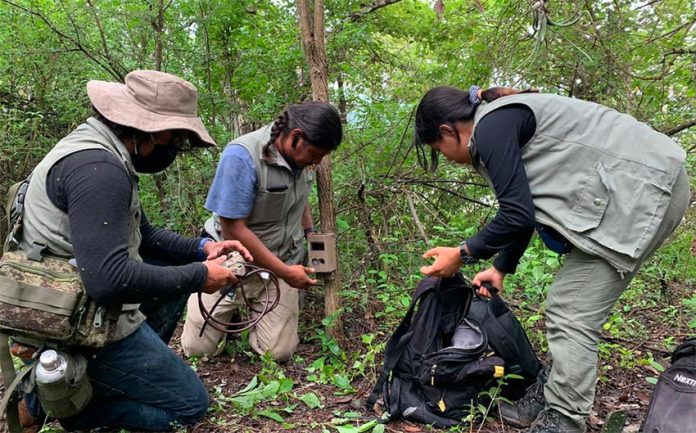
Feline expert Fernando Ruiz said that special cameras and drones are being employed to locate the jaguars. The search team’s goal is to capture and relocate them elsewhere to keep them safe from hunters or poachers. The mother and cub have already killed and eaten several goats and dogs.
Jaguars, which typically are yellow with black spots, are exclusively meat-eaters and can weigh up to 100 kilos. There are more than 4,000 living in Mexico, and they can be found in Sinaloa, Nuevo León, Tamaulipas, San Luis Potosí, Querétaro, Hidalgo, Puebla, Nayarit, Jalisco, Colima, Michoacán, Guerrero, Oaxaca, Chiapas, Tabasco, Yucatán, Campeche and Quintana Roo.
The jaguars have killed several goats and dogs.
Jaguars are frequently targeted by poachers for their body parts, which are sold on the black market in China. Last year the body of a jaguar was found in the Lacandona Jungle in Chiapas with only its penis removed.
“There has been trafficking in Mexico for many years. We’ve seen decades of trafficking in products such as the pelts, teeth and claws for use in handicrafts. What has happened recently with the entrance of the Chinese market is the [removal of this] delicate part, because they want the jaguar’s penis as an aphrodisiac,” Heliot Zarza of the National Jaguar Conservation Alliance said at a symposium on Mexico’s at-risk animals in January.
Ranchers also kill jaguars to prevent them from attacking livestock.
At least seven jaguars were killed in Guerrero last year, and the state’s population is estimated at just 120 cats, all of which are highly endangered.
The mother and cub were caught on camera on Tuesday, government officials said.